Mingsha Singing Dunes and Crescent Lake
Mingsha Singing Dunes and Crescent Lake
At the gates of Dunhuang, Crescent Lake and the Mingsha singing dunes form a singular stop along the Silk Road, between oasis and desert.
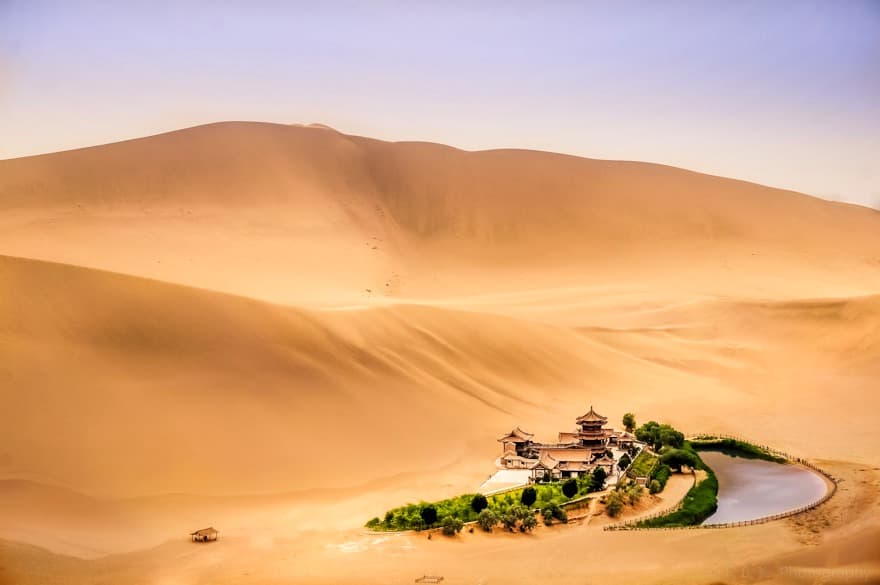
On the southern edge of Dunhuang, in Gansu province, Crescent Lake (Yueyaquan) and the Mingsha singing dunes form a unique geographical pairing: a crescent-shaped body of water lies nestled within golden dunes that rise several hundred meters. The site sits 3 km from the Gobi Desert and 6 km south of the city center.
Why visit the site
Three elements justify the journey. First, geological rarity: a permanent lake nestled within a sand sea, a remnant of an ancient water table now under strain. Second, the acoustic phenomenon of Mingsha's dunes, whose sand grains produce a muted vibration when affected by wind or collective slippage. Finally, the cultural dimension: the site belongs to the caravan landscape of the Silk Road, in direct continuation with the Mogao Caves.
The experience thus combines natural heritage and outdoor activities, within a relatively compact area that can be visited in a half-day to a full day depending on your pace.
History and legend
Local tradition attributes the lake's discovery to General Li Guang during the Han dynasty. Legend tells that his soldiers, exhausted and parched after crossing the desert, saw their commander trace a crescent moon in the sand—a spring allegedly burst forth at that spot, giving rise to the present-day lake.
Beyond the tale, the lake long served a practical function. Nearly fifty years ago, it still contributed to Dunhuang's water supply. Since then, its level has dropped significantly due to the combined effects of regional pumping, drought, and tourism pressure. Today, measures such as artificial replenishment and access restrictions attempt to stabilize the situation.
What to see and do on-site
Crescent Lake
The body of water measures approximately 100 meters long by 25 meters wide and 5 meters deep. Its elongated, curved shape, contrasting with the sand, makes it the site's emblematic image. The lake is home to fish and aquatic plants, to which local tradition ascribes medicinal properties.
On the shore, a pavilion in traditional Chinese style houses several religious buildings: the Empress's Palace, the Royal Dragon Palace, Bodhisattva Palace, and the Medicine God's Grotto. The complex, recently restored, frames a few gardens and rows of poplars providing some shade.
Mingsha Dunes
The dunes rise around 250 meters above the site and extend across roughly forty square kilometers within a broader desert region of about 80 km². The name Mingsha means "singing sand": when wind or collective grain slippage occurs, the dunes emit a characteristic rumbling. Various hypotheses circulate to explain this; some researchers suggest the existence of buried ancient structures (palaces or cavities) that might amplify the phenomenon, though no scientific confirmation has been established.
Activities available
- Hiking ascent to the ridge (allow 30 to 45 minutes of sustained effort in sand)
- Camel rides, in guided caravans
- Sand biking and mountain biking on prepared tracks
- Sand surfing (sandboarding) on the slopes
- Flights by ultralight aircraft or motorized paragliding for an overview
Note that high visitor numbers pose a recognized conservation challenge: stay on marked trails and designated areas.
When to visit
The most comfortable period runs from May through October, with peak crowds in July and August. In summer, sand surface temperatures can exceed 50°C at midday: favor late afternoon and sunset, which offer the most photogenic light on the ridges. Spring and fall offer milder conditions and more dramatic angled light.
Winter (November to March) is harsh, with sub-zero temperatures and cold winds, but offers striking landscapes and fewer visitors. The site remains accessible year-round, with seasonal hours (generally dawn to dusk).
Practical information
- Visit duration: allow 2 to 4 hours, longer if you climb the dunes or stay for sunset.
- Entrance fee: paid admission, with rates varying by high and low season. Activities (camel, sandboard, ultralight) are additional.
- Equipment: sand overshoes rented on-site, water, sun protection, scarf against wind and dust.
- Accessibility: the lake area is flat; the dunes require good physical fitness.
How to get there
From downtown Dunhuang, the site is approximately 6 km south. Bus #3 runs regular service and is the most economical option. Local taxis and ride-hailing services are plentiful and charge reasonable fares for this short trip. By bicycle, the route is flat but offers little shade.
Dunhuang is connected to the rest of Chine by train (high-speed rail station) and air (Dunhuang-Mogao Airport), with connections from Lanzhou, Xi'an, and Beijing.
Nearby
The site combines naturally with other stops in the region:
- Mogao Caves, about twenty kilometers away, a Buddhist complex inscribed on the UNESCO World Heritage List
- Downtown Dunhuang and its night market
- Further along the Silk Road, the Thousand Buddha Caves of Bezeklik in Xinjiang
- To extend the ornate caves theme, the Great Wild Goose Pagoda in Xi'an, another Buddhist landmark
Frequently asked questions
Frequently asked questions
Extend your itinerary
Dunhuang and its dunes form a major stop along Chine's Silk Road. To integrate the site into a broader itinerary combining Gansu, Xinjiang, and imperial cities, explore our Chine travel packages.
Interested in this visit?
We can include it in your personalised itinerary.