The Great Wall at Jiayuguan
The Great Wall at Jiayuguan
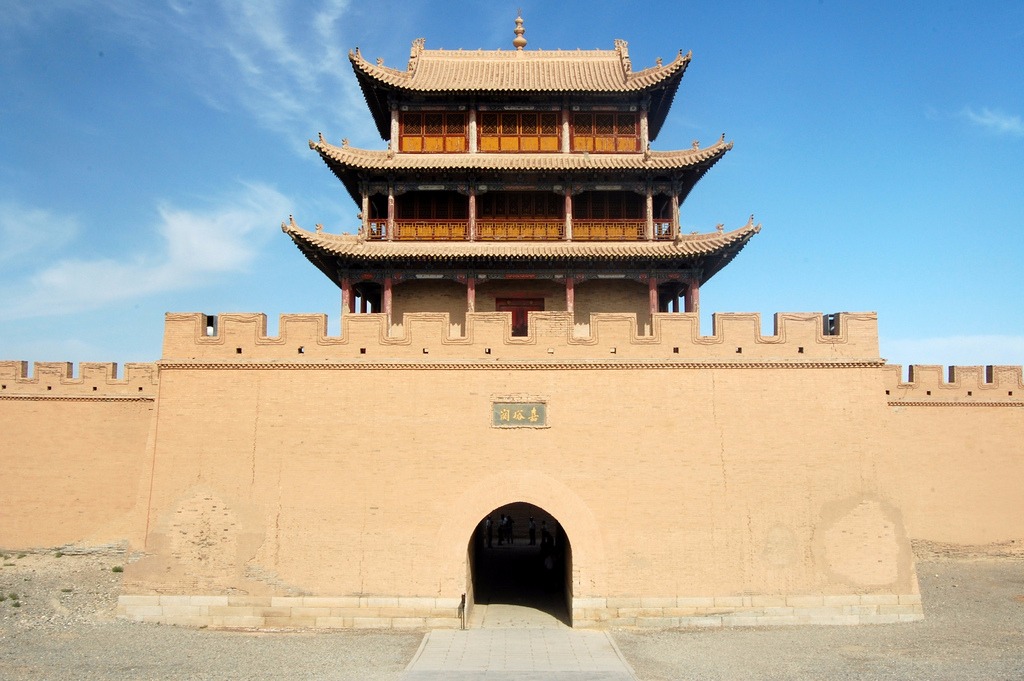
Built in 1372 facing the Gobi Desert, Jiayuguan Fort marks the western end of the Ming Great Wall, along the Silk Road.
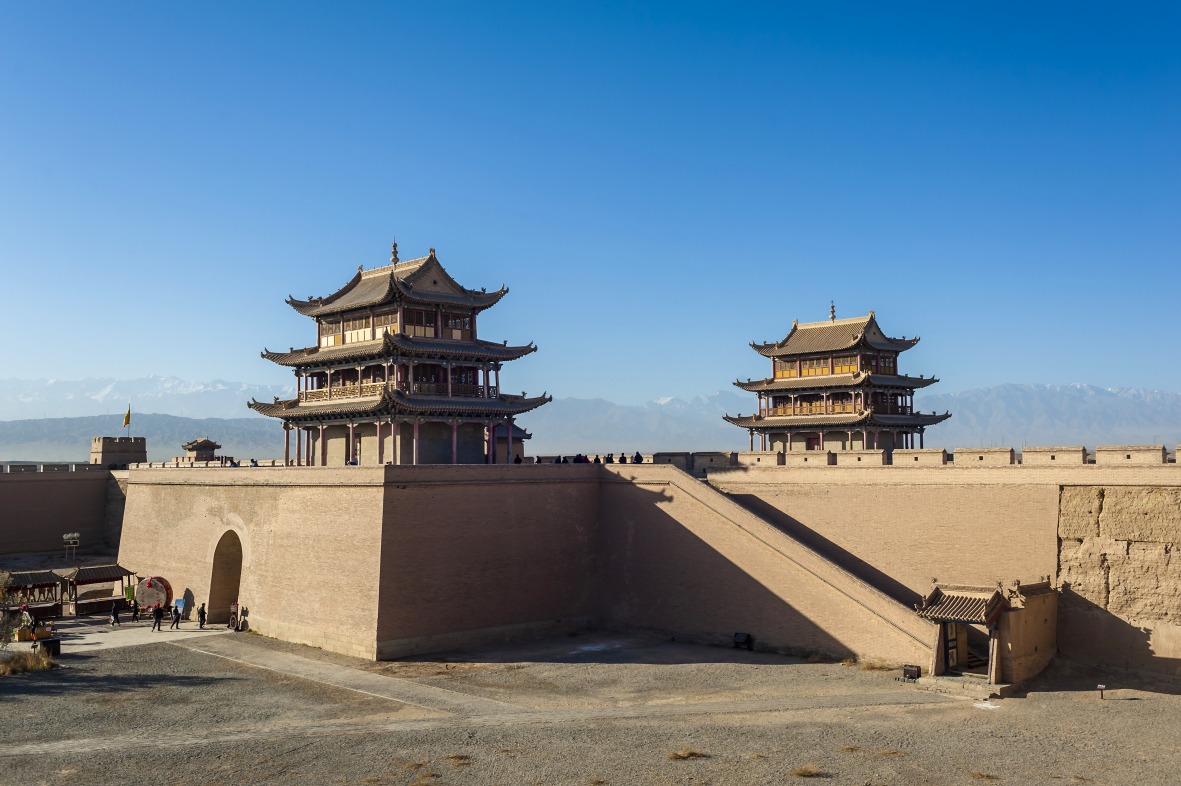
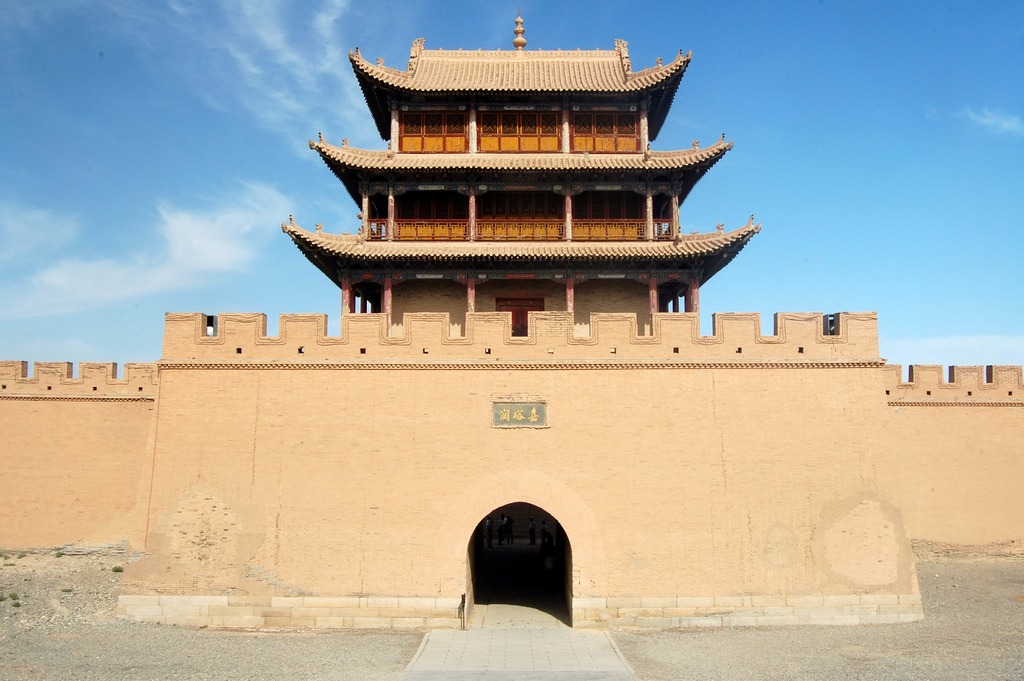
At the western extremity of the Ming Great Wall, Jiayuguan Fort (嘉峪关) guards the entrance to the Hexi Corridor, in Gansu Province. Constructed in 1372 facing the Gobi Desert, this military stronghold marked for the Chinese the boundary between the known world and the far western frontier. Today a UNESCO World Heritage Site, it remains one of the best-preserved fortified complexes along the Silk Road.
Why visit the Great Wall at Jiayuguan
Jiayuguan offers a very different perspective on the Great Wall compared to sections near Beijing (Badaling, Mutianyu). Here, there are no verdant ridges: the rampart stretches between the snow-capped peaks of the Qilian Mountains to the south and the Mazong Mountains to the north, across a desert landscape of stone and dust.
Three elements justify the detour:
- a completely preserved fort with comprehensive Ming military architecture (double walls, towers, north and south gates);
- several wall sections and watchtowers attached to the site, including the spectacular Suspended Wall that climbs steeply up the mountainside;
- a typical desert steppe environment of western Gansu, near the Wei-Jin tombs and the Silk Road.
The site can be visited in a half-day to a full day, depending on whether you include the peripheral wall sections.
History of Jiayuguan Fort
The fortress was built in 1372 under the Ming Dynasty, on the orders of General Feng Sheng, shortly after the fall of the Mongol Yuan. Its purpose was clear: to lock down the Hexi Corridor, a narrow strategic passage linking inner Chine to the oases of Xinjiang and Central Asia. Every Silk Road caravan passed through its gates.
The complex was progressively reinforced over a century and a half. The fortified city was completed in 1540, with its corner towers, moats and outer walls. At that date, Jiayuguan officially marked the western terminus of the Ming Great Wall, which extends to Shanhaiguan on the Bohai Sea, more than 6,000 km to the east.
Local legend holds that at the end of construction, a single brick remained unused. It is still visible today on one of the towers, placed like a trophy by the architect who is said to have calculated the material requirements with perfect precision.
What to see on the site
The main fort
The heart of the site is a rectangular enclosure over 700 metres in perimeter, punctuated by three large wooden towers with curved roofs. The Guanghua Tower to the east and the Rouyuan Tower to the west frame an inner courtyard and a parade ground where garrison troops trained. The western gate, called the "Gate of Conciliation of Far Lands," opened onto the desert and the unknown.
The Suspended Wall (Xuanbi Changcheng)
About ten kilometres north of the fort, this wall section climbs the steep slopes of the Mazong Mountains. The trail takes 1 to 1.5 hours round-trip and offers an open view of the fort, the desert plain, and on clear days, the snows of the Qilian.
The First Peak Wall (Diyidun)
To the south, this rammed-earth watchtower stands at the cliff edge of the Taolai River. It is the very first western link of the Ming Great Wall.
The Wei and Jin Tombs
About twenty kilometres to the east, these brick tombs (3rd-4th centuries) are decorated with frescoes depicting scenes of daily life: farming, herding, banquets, hunting. They offer valuable insight into the life of a frontier garrison long before the Ming.
Practical Information
- Visit duration: allow 2 to 3 hours for the fort, a half-day to a full day if you add the Suspended Wall and the tombs.
- Admission: combination ticket at moderate price, providing access to the fort, the Suspended Wall and the First Peak.
- On site: little shade; bring water, hat and closed-toe shoes (sand and stones).
- Accessibility: the fort is generally flat, but the Suspended Wall has steep steps.
When to go
Jiayuguan has a continental desert climate, with a frost-free period of 160 days per year. The average annual temperature is around 6.7°C, with lows dropping to -21°C in January and highs reaching 34°C in July. Rainfall is rare and concentrated in summer.
Two periods are best avoided:
- March to May: frequent sandstorms;
- November to December: strong winds and dry cold.
The best window runs from late May to October, with peak comfort in September, when temperatures drop and the low-angle light highlights the contrast between the ochre walls and the Qilian peaks.
How to get there
By air: Jiayuguan Airport is about 12 km from the city centre, with flights from Beijing, Xi'an and Lanzhou.
By train: Jiayuguan is well connected to the Chine rail network, with daily services to Beijing, Chengdu, Shanghai, Xi'an, Lanzhou, Dunhuang, Liuyuan, Turpan and Urumqi. This is the most popular option for travellers on the Silk Road.
On site: the fort is about 6 km from the city centre. Local taxis and ride-hailing services are the most convenient way to visit the fort, Suspended Wall and First Peak in the same day.
Nearby
Jiayuguan fits naturally into a Silk Road itinerary, between Lanzhou and Dunhuang. Several sites extend your visit:
- the July 1st Glacier, about a hundred kilometres to the south-west, perched at 4,300 m altitude in the Qilian Mountains;
- the painted tombs of the Wei and Jin, accessible as a half-day trip from the city centre;
- further west, towards Xinjiang, Aiding Lake, Chine's lowest point, in the Turpan depression;
- for Buddhist heritage, the Beishan Temple is worth a detour for travellers interested in the religious art of the north-west.
Frequently Asked Questions
Frequently asked questions
Jiayuguan marks the western terminus of the Great Wall built under the Ming Dynasty. Other older sections, notably from the Han Dynasty, extend further west towards Dunhuang. But symbolically, it is indeed at Jiayuguan that the "Great Wall" as it is visited today comes to an end.
Allow 2 to 3 hours for the fort alone, and a full day if you add the Suspended Wall, the First Peak and the Wei-Jin tombs.
Yes, this is the classic pairing on the Silk Road. The two cities are connected by direct train and complement each other: Jiayuguan for Ming military architecture, Dunhuang for the Buddhist caves of Mogao and the Mingsha dunes.
The main fort can be explored easily with children. The Suspended Wall, however, has steep stairs and significant elevation gain, making it less suitable for young children or people with reduced mobility.
Include Jiayuguan in your trip
Jiayuguan Fort is a natural addition to an itinerary dedicated to the Silk Road, between Xi'an, Gansu and Xinjiang. To build a custom trip including this western terminus of the Great Wall, explore our trips to Chine.
Interested in this visit?
We can include it in your personalised itinerary.