The Princely City of Jingjiang
The Princely City of Jingjiang
Best-preserved Ming princely palace in Chine, the Jingjiang Princely City in Guilin surrounds Solitary Elegance Peak and its carved caves.
The Jingjiang Princely City forms a historical complex spanning 20,000 m² located approximately 7 km northeast of downtown Guilin. Built around Solitary Elegance Peak (Duxiu Feng), it represents the best-preserved palace of Ming dynasty princes in Chine.
Why visit the Jingjiang Princely City
The site combines three rarely found attractions within a single area: an intact Ming princely palace, a karst peak over 216 meters high at the heart of the city, and a series of caves adorned with ancient carvings. Designated a national cultural relic in 1996, the complex offers a rich understanding of Chinese imperial architecture and its relationship with Guilin's karst landscape.
Unlike the Forbidden City in Beijing, which came later and is more monumental, Jingjiang predates the construction of the imperial palace and bears witness to the architectural model of a Ming princely fief. It also provides panoramic views over Guilin and the Li River.
History of the Princely City
The city was founded by Zhu Shouqian, grandson of Zhu Yuanzhang, founder of the Ming dynasty. Its construction began in 1372 and concluded in 1392, taking over twenty years to complete. Zhu Shouqian, having received the title of Prince of Jingjiang under his grandfather's reign, had his official residence erected here.
Throughout its 257 years of existence, the city housed 14 princes from 12 successive generations. Forgotten after the fall of the Ming, it was designated a national cultural relic in 1996, which enabled its restoration and opening to the public.
What to See
The Palace and Its Ming Layout
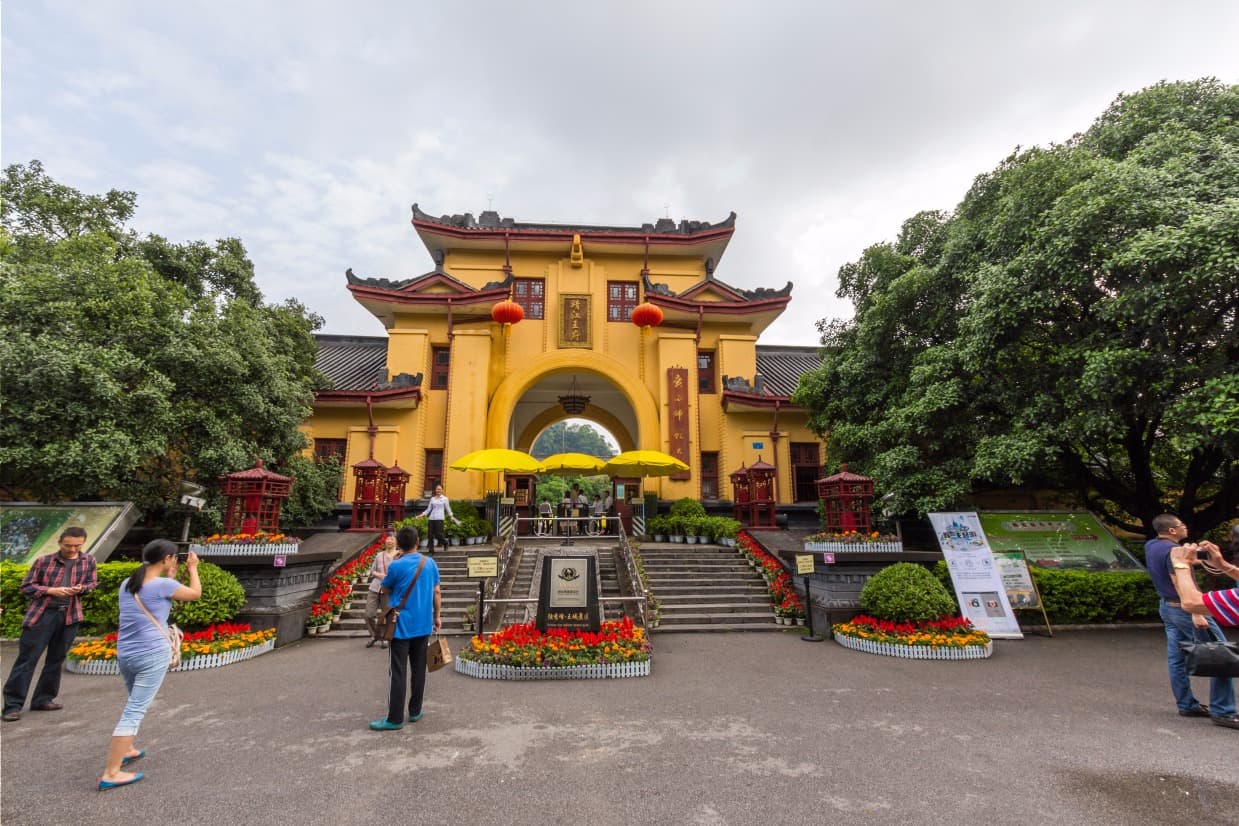
The complex comprises 4 halls, 4 pavilions, and approximately 40 buildings. The architecture follows a hierarchical feudal layout typical of the Ming dynasty, with a symmetrical axis aligned with Solitary Elegance Peak. The arrangement respects ritual codes: ancestral temple on the left, altar of earth and grain on the right, courtyard in front, private residence at the rear. Red walls and glazed yellow tiles signal the princely status of the site.
The main structures include the Chengyun Gate, the Chengyun Hall, the bedroom, the Ancestral Temple, the Altar of Earth and Harvests, as well as terraces and towers.
The Ramparts and Four Gates
A wall of squared green stones encircles the city for 557.5 m from north to south and 336 m from east to west. Four gates provide access:
- Tiren or Donghua gate to the east
- Duanli or Zhengyang gate to the west
- Zunyi or Xihua gate to the north
- Guangzhi or Hougong gate to the south
The main entrance, the Chengyun Gate, was constructed during the Qing dynasty (1636–1911). Its arch bears the engraved names of four peoples, commemorating the legend of Zhuangyuan.
Solitary Elegance Peak (Duxiu Feng)
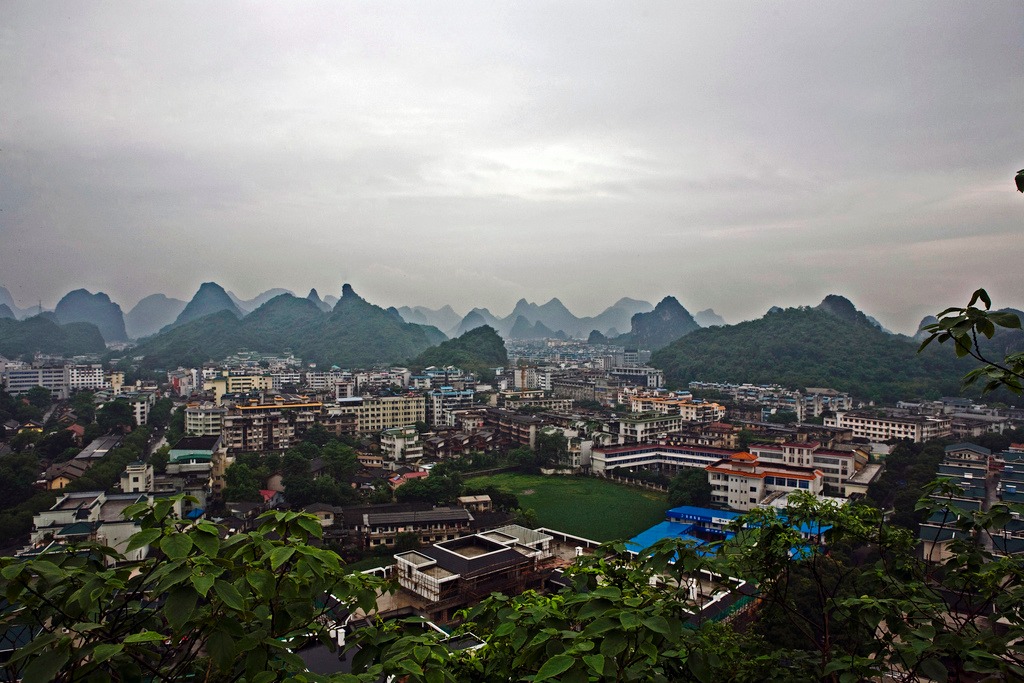
At the center of the city, the peak rises to over 216 m. Built as a landmark between 1372 and 1393, it has served as a beacon for Guilin residents for over 630 years. Its summit offers a sweeping panorama across the city and surrounding karst formations; expect a sustained climb of stairs.
The peak houses several secondary structures: the Xuanwu Pavilion, the Crescent Pond, the Temple of Three Guests, the Dashu Rock, the Taiping Rock, the Sun Yat-sen Memorial Tower, and the Sanyuan Jidi Hall.
Peace Cave
Located at the foot of the peak, Peace Cave houses carvings illustrating the 60 signs of the Chinese zodiac. It is one of the most singular stages of the tour, straddling the boundary between place of worship and sculptural gallery.
Practical Information
- Visiting time: allow 2 to 3 hours to explore the palace, climb the peak, and visit the cave.
- Admission fee: a combination ticket grants access to the princely city, the manor, and the peak. Entry fee is moderate; confirm rates on-site.
- Hours: open daily from morning until late afternoon. Hours may be extended during peak season.
- Tip: wear sturdy footwear for the Duxiu Feng climb and bring a water bottle during summer months.
When to Visit
The Guilin region is best visited from April through October, with preference for shoulder seasons. Spring (April–May) offers lush vegetation and mild temperatures; autumn (September–October) is bright with less rainfall. Summer (June–August) is hot and humid, but climbing the peak is best done early morning to avoid heat. Winter is mild but often overcast.
Avoid Chinese national holiday weeks (Lunar New Year, May 1st week, October 1st week) when the site experiences peak crowds.
How to Get There
The Princely City is located in Guilin's historic center, making access straightforward from most downtown hotels:
- On foot: from the Li River waterfront or Jiefang Bridge, allow 10 to 20 minutes depending on your starting point.
- By bus: several urban lines serve stops near East Jiefang Street and Jiefang Bridge. Ask your hotel for the "Jingjiang Wangcheng" stop.
- By taxi or ride-sharing: short journey from most tourist areas.
Nearby Attractions
The Princely City integrates easily into a full day exploring Guilin. Combine it with a stroll along the Li River, nearby hills (Elephant Trunk Hill, Wave-Subduing Hill), and Seven Stars Park. To extend your journey, several major sites dot the Guilin region and the rest of the country:
- Longgong Cave – underground karst complex
- Thousand Buddhas Caves of Bezeklik – Buddhist rock art
- Great Wild Goose Pagoda – Tang architecture in Xi'an
- Hexigten Geopark – geological landscapes of Inner Mongolia
Frequently Asked Questions
Frequently asked questions
Allow 2 to 3 hours for a complete visit including the palace, climbing Solitary Elegance Peak, and Peace Cave. A half-day is comfortable if you wish to take time reading the historical panels.
Yes, the combined entry ticket provides access to the Princely City, the Jingjiang Manor, and Solitary Elegance Peak (Duxiu Feng), including Peace Cave at its foot.
It is the best-preserved palace of Ming dynasty princes in Chine. Built between 1372 and 1392, it housed 14 princes across 12 generations and was designated a national cultural relic in 1996.
The ascent is via a steep staircase with approximately 216 meters of elevation gain. It remains accessible to a person in normal condition, but may be challenging for those with limited mobility or during intense heat.
April through May and September through October, when temperatures are mild and skies often clear. Avoid Chinese national holiday weeks, which generate heavy crowds across the entire site.
Plan Your Journey
The Jingjiang Princely City fits naturally into a circuit around Guilin and the karst landscapes of the Li River. To build an itinerary combining imperial heritage, hiking, and villages, explore our Chine travel ideas.
Interested in this visit?
We can include it in your personalised itinerary.