Foshan
Foshan
Birthplace of Ip Man's Wing Chun and a millennia-old ceramics capital, Foshan reveals itself in a day trip from Guangzhou. Lingnan temples, dragon kilns and martial arts await.
Name: Foshan
Chinese Name: 佛山
Province: Guangdong
Status: Prefecture-level City
Population: 7,194,311
Area: 3,849 km²
Foshan is a city in Guangdong province, approximately 20 km west of Guangzhou in the Pearl River Delta. Foshan is a vibrant area brimming with temples, gardens and museums, attracting enthusiasts of history and Chinese culture.
The ancient city is also renowned for its craft heritage, particularly its pottery and ceramics.
History
Foshan's history stretches back nearly 5,000 years. Once called Lihua, it became a religious center of the Pearl River Delta and was known as Chancheng.
Changcheng is the name used today to designate the downtown district.
During the Qing dynasty, Foshan was an important city for China's foreign trade.
Foshan is one of the birthplaces of Kung Fu. Many believe this martial arts practice originated here.
In 1925, Foshan became a city, though this status was revoked in 1927. Foshan regained city status in 1951, and achieved prefecture-level city status in 1974. During the 1980s and 1990s, the current Foshan territory underwent numerous administrative reorganizations. The city reached its present boundaries and administrative divisions in 2003.
Today
Foshan is a modern city that has nonetheless preserved significant remnants of its past. The city also distinguishes itself through its artisanal qualities in pottery and ceramic production. The city is equally renowned for wood sculpture and metalwork.
When visiting Guangzhou, reserve a day to explore Foshan and discover these numerous points of interest. Stop by the Shiwan district, one of China's ceramics centers. In one of the porcelain factories, visit workshops that reveal all the secrets of porcelain manufacturing. Take advantage of this short getaway to see the ancient Nanfeng kiln, which features two dragon-shaped kilns 30 meters long. The district's shops offer the perfect opportunity to acquire authentic, beautiful porcelain. For the curious, it's possible to learn porcelain-making through private classes.
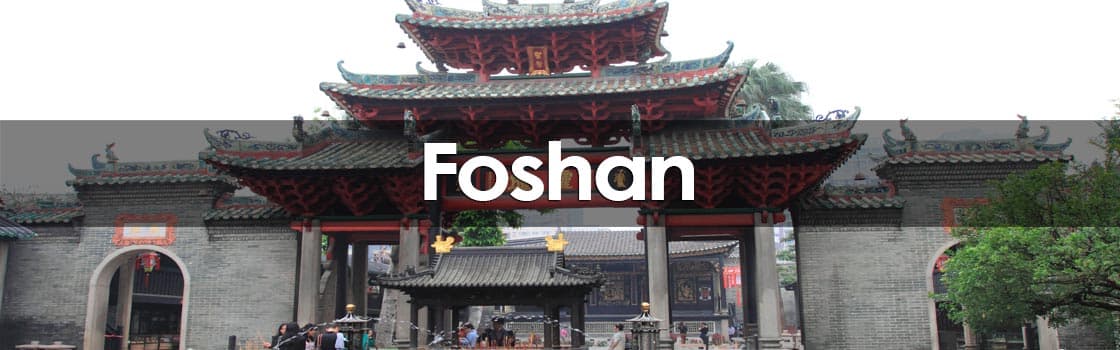
Beyond artisanal interest, Foshan houses beautiful buildings including the Ancestors' Temple. The ancestral temple located in the Foshan Museum is considered the most stunning religious edifice in the Pearl River Delta. Its impressive architecture perfectly reflects Southern China's design. The complex houses remarkable figurines and collection pieces.
Nearby stands the Renshou Buddhist Temple, well worth a visit. To end your day, nothing beats a peaceful stroll through the Liang Garden, lined with willows. The beautifully restored Liang Family Residence will prove a pleasant discovery.
Climate
Foshan enjoys a relatively pleasant climate year-round. Characterized as subtropical humid, its summers are very hot and humid while winters are mild. The average annual temperature is 22°C.
Rainfall is relatively rare but can occur at any time of year.
It's possible to visit Foshan throughout the year, though spring and autumn are more pleasant. Still, remember to pack rain gear just in case.
Airport
Foshan Airport offers flights to and from Beijing and Wuxi.
Train
The Foshan railway station sits on numerous lines and serves as a stop from Hong Kong, Beijing, Shanghai, Kunming, Chongqing and Nanning.
Bus
Daily and regular buses run from Guangzhou to Foshan. Foshan can also be reached from Shenzhen and Zhuhai via long-distance buses.
Daily connections exist with Hong Kong, though they're quite irregular—check schedules carefully.
Boat
Reaching Foshan by boat is a perfect opportunity to discover the Pearl River's banks. Foshan can be accessed by boat from Hong Kong, Guangzhou and Wuzhou.
A metro recently opened in Foshan. Currently only one line is operational, though a second line was expected to open by 2016.
It's easy to get around Foshan using motorbike taxis.
What to Do in Foshan?
- Learn pottery-making in one of Shiwan's porcelain factories.
- Visit the Zhu Miao Ancestral Temple, a historic symbol of the city.
- Enjoy a peaceful walk through the Liang Garden.
Want to discover this destination?
Our local advisors design your tailor-made trip.