Mount Tianzhu (Tianzhushan)
Mount Tianzhu (Tianzhushan)
A UNESCO World Heritage site nestled in Anhui, Mount Tianzhu showcases 45 granite peaks, Tang Dynasty temples, and a labyrinthine valley still off the beaten path.
Located in Qianshan County in Anhui Province, Tianzhushan, also known as Mount Tianzhu, is a collection of scenic sites rich in natural landscapes and historical significance. Thanks to its remarkably preserved environment and deep historical heritage, many travelers are drawn to visiting Mount Tianzhu. It's a common saying in Chine that tourists will have no desire to visit other mountains after experiencing Mount Tianzhu.
History
In 106 B.C., Mount Tianzhu was named "the Southern Mountain" by Emperor Wu of the Han Dynasty. However, during the Spring and Autumn period, when the mountain became the domain of the ancient state of "Wan"—historically the regional name for Anhui—locals began calling it the "Wan Mountain."
Following State Council approval in 1982, Mount Tianzhu became the subject of several international and regional designations. It was named one of the country's first groups of key national scenic areas.
Designated as a national forest park in 1992, the site has hosted AAAA-class tourism activities since 2000, which were upgraded to AAAAA-class status in 2011. On the international stage, Mount Tianzhu has been recognized as a UNESCO Global Geopark since 2011 and was inscribed as a World Heritage Site in January 2015.
Exploring Tianzhushan
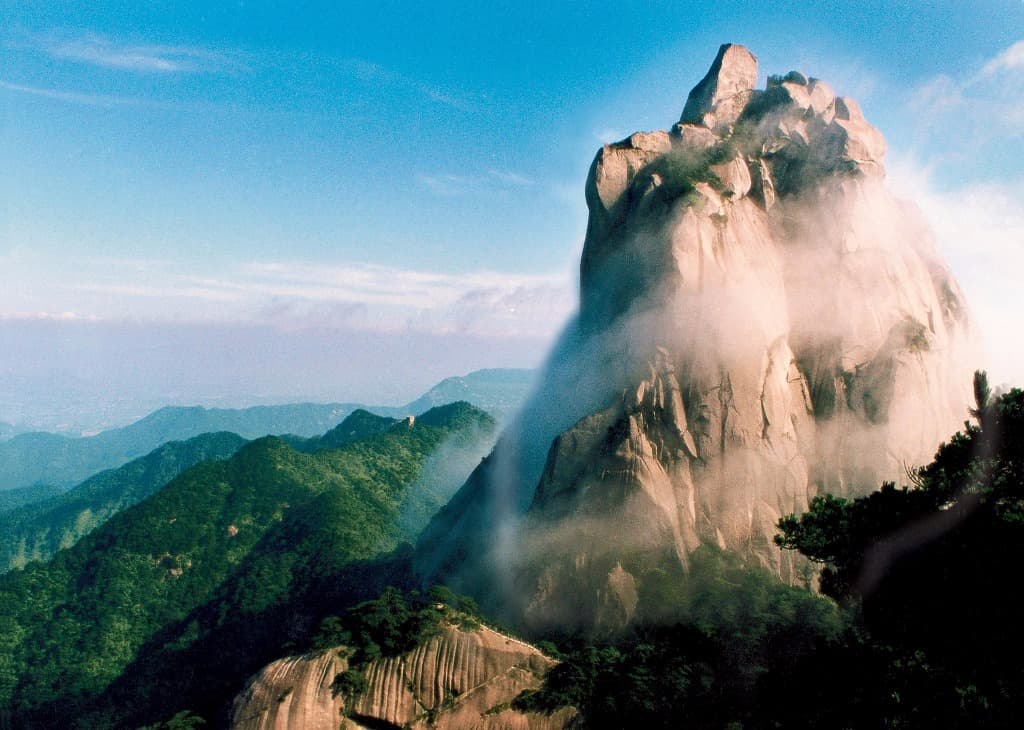
Spanning 82.46 km² of mountainous terrain, Mount Tianzhu is a collection of nature's most striking and awe-inspiring creations. Often ranked among China's premier national and world heritage sites, it features more than 45 peaks, 86 granite formations, 25 caves, 18 waterfalls, and 17 springs.
The most iconic of these landscapes is the "Tianzhu Peak," the highest summit on the site at an elevation of 1,488 meters. Like a colossal column, this peak stands out for its extraordinary shape and the mists that partially shroud it. This dramatic vista has been immortalized countless times by great Chinese poets such as Bai Juyi and Li Bai.
Considered the country's most mysterious granite cavern, the Valley of Mysteries is one of the site's most remarkable attractions. Composed of countless interconnected underground galleries, the cave creates the impression of stepping into a parallel world. This vast labyrinth can only be safely explored with a guide to avoid getting lost.
Recognized as a UNESCO Global Geopark, Mount Tianzhu is home to numerous rare plant and animal species. During your hiking excursions, your English-speaking guide can point out many plant species, and if fortune favors you, you may observe in silence certain wildlife such as civets (a type of raccoon-like mammal), lyrebirds, and giant salamanders.
Along the hiking trails, you can enjoy breaks at visitor information centers as well as at the historical monuments and museums scattered across the mountain. Mount Tianzhu is home to several structures bearing Taoist and Buddhist cultural significance.
The Foguang Temple and the Shangu Temple, built during the Tang Dynasty, are perfect examples. They have left the mountain adorned with cultural relics, ancient inscriptions, and classical Chinese calligraphy carved into its cliffs. While enjoying a pristine environment and unparalleled views, you can swiftly reach the summits by taking the cable car service available on-site. You'll then enjoy breathtaking panoramas of lush vegetation and catch glimpses of the religious and historical monuments nestled within this natural splendor.
Located just 55 km from the geopark, Tianzhushan Airport is served daily by flights to Beijing, Shanghai, and Guangzhou. Visitors from these cities can easily reach the geopark via these flights. You can take intercity buses that regularly run the route between Mazu and the tea village.
Hours and Admission
The entrance fee for Mount Tianzhu Park is 15 RMB per person.
Want to discover this destination?
Our local advisors design your tailor-made trip.