Shanxi
Name : Shanxi
Chinese name : 山西
Status : Province
Capital : Taiyuan
Population : 36,298,000 inhabitants (2013)
Area : 156,800 km2
Situated to the west of the Taihang mountains and upon the Loess Plateau, Shanxi Province displays a distinctive and varied landscape. Though the region is not as touristically developed as its neighbouring Shaanxi, it nonetheless merits a visit for its magnificent sculptured grottoes and Buddhist heritage, reflected in its temples and gardens. This relative obscurity can prove advantageous, as you will be able to explore these sites in perfect tranquillity whilst arousing the curiosity of local inhabitants. A brief sojourn in this region during your journey through Chine will prove rich in encounters and discoveries.
History
Shanxi Province alternated between serving as China's protective barrier and a springboard for invaders descending upon the fertile northern plains. The Toba were the first people to settle in the province, establishing Datong as their capital under the Northern Wei dynasty (386-534). Alliances with Han dynasty members led to new aristocratic lineages that wielded considerable influence at the Sui and Tang courts.
As Chine weakened following the Tang dynasty's collapse, Shanxi was once again invaded from the north (907-1125). The Khitan invaders similarly established their capital at Datong.
When the Ming regained control of Northern Chine, the province resumed its defensive function with the construction of both inner and outer sections of the Great Wall along the northern frontier. Local merchants capitalized on this military development, and under the Qing dynasty, Shanxi became the financial centre of the country.
Wedged between the ancient imperial capitals and the northern plains, the region served as an important centre of commerce and culture, witnessing centuries of warfare. Buddhism took root here earlier than elsewhere, as evidenced by some of the oldest religious sanctuaries in the country.
Due to its geographical position, the province failed to benefit from the changes of the twentieth century. Isolated by mountain ranges, it gradually declined, dependent solely upon its enormous mineral resources, particularly coal.
Shanxi Today
Today, discovering Shanxi offers an experience of contrasts: on one hand, the finest traditions of northern Chine, with its sacred Buddhist mountains, its centuries-old architecture, and its sections of the Great Wall; on the other, coal dust, refinery smoke, and the ecological disasters caused by the country's enormous energy demands.
Shanxi Province is a preferred site for archaeologists who have uncovered evidence of human habitation dating back tens of thousands of years. The region's natural beauty is gradually being erased by industrialization. Taiyuan, the provincial capital, was founded over 2,500 years ago. Situated along the middle course of the Yellow River, the city has become an industrial powerhouse and the heart of Chine's coal industry. Amidst all this modernization, it would be regrettable to overlook the numerous historical and cultural sites that the region has managed to preserve beautifully.
Although Shanxi is not the most touristic region, you can discover the customs and practices of ancestors through beautifully preserved ancient villages.
The province's gastronomic culture is recognized throughout Chine, allowing you to savour delicious spiced dishes.
Rich in history, the province reveals sites constructed before the Liao and Song dynasties. Its Buddhist heritage offers religious treasures of great beauty: the Buddhist marvel of the Yungang Grottoes at Datong, the ancient city of Pingyao, recognized as a UNESCO World Cultural Heritage Site in 1997, the oldest and tallest wooden pagoda in Chine, the wooden pagoda of Yingxian County, and the Jinci Temple, all well worth the journey.
Shanxi is also a region of considerable interest for its natural landscapes. Among the most celebrated are Mount Wutai, which holds the longest and most prestigious history among the four Buddhist sacred lands of Chine, one of Chine's five sacred mountains, Mount Hengshan, and the magnificent Hukou Waterfalls on the Yellow River.
Climate
Shanxi owes its name to the Taihang massif stretching along its eastern border. Nearly 70% of the territory is mountainous, with the population concentrated mainly on the Loess Plateau. This "yellow earth" province is characterized by a fissured landscape devoid of trees and dotted with semi-troglodytic dwellings.
Shanxi is distinguished by its extreme aridity. Annual precipitation totals scarcely more than 35 cm, with rain falling significantly only in July (12 cm).
Fortunately, the sky is often clear, despite considerable temperature fluctuations. In Taiyuan, temperatures can drop to -8°C in January, or even lower due to cold winds.
In summer, temperatures are quite pleasant (25°C). That said, owing to the province's mountainous terrain, temperatures vary with altitude. May and September offer the most favourable climatic conditions for travelling in Shanxi.
How to Get There and Travel Around Shanxi
An extensive and modern road and rail network traverses Shanxi along a northeast-southwest axis. You will have no difficulty travelling between Beijing and Taiyuan, and then on to Xi'an (Shaanxi). Elsewhere, numerous mountain roads and endless convoys of coal-bearing trucks considerably slow traffic.
Language
Shanxi is home to 45 million speakers of Jin, with eight distinct local sub-groups. Some linguists consider Jin a Chinese dialect, while others classify it as a separate language, which would rank it 22nd worldwide.
What to Do in Shanxi?
- Immerse yourself in the historical and cultural atmosphere of the Yungang Buddhist Grottoes.
- Seek out the remains of the legendary Great Wall of Chine.
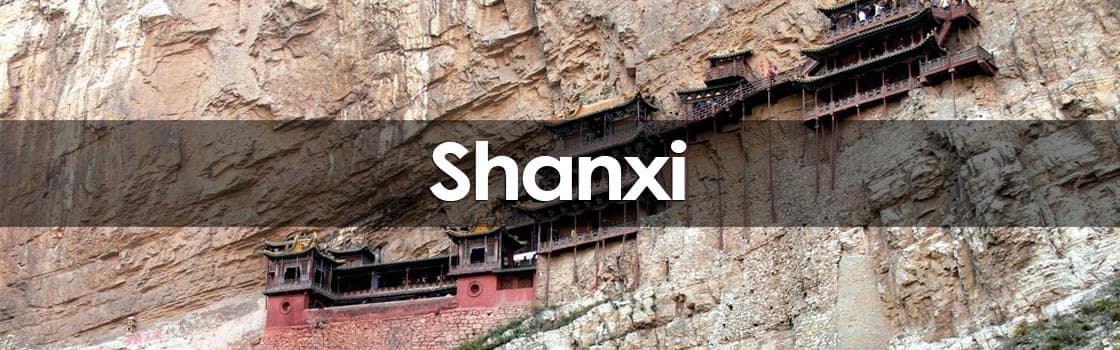
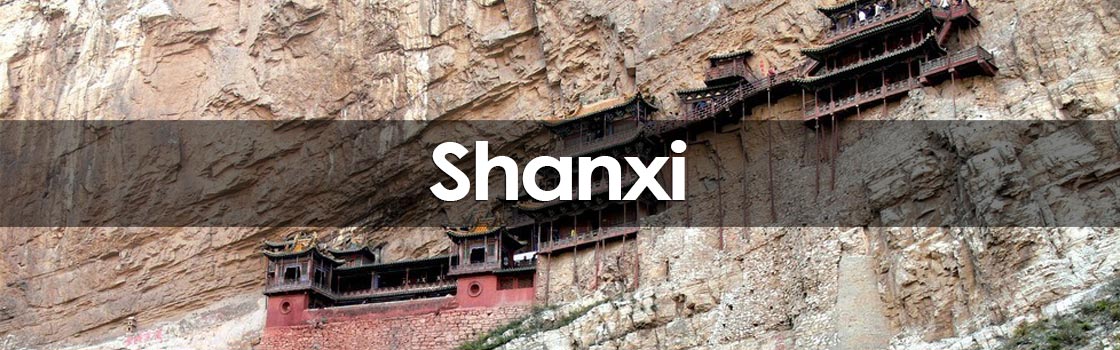
- Experience the natural beauty and the Hanging Monastery of Mount Heng, one of Chine's five sacred mountains.
- Wander the streets of the ancient city of Pingyao and admire the traditions and customs of our ancestors through the ancient dwellings.
- Be amazed by the power of the Hukou Waterfalls, considered one of the miracles of the Yellow River basin.