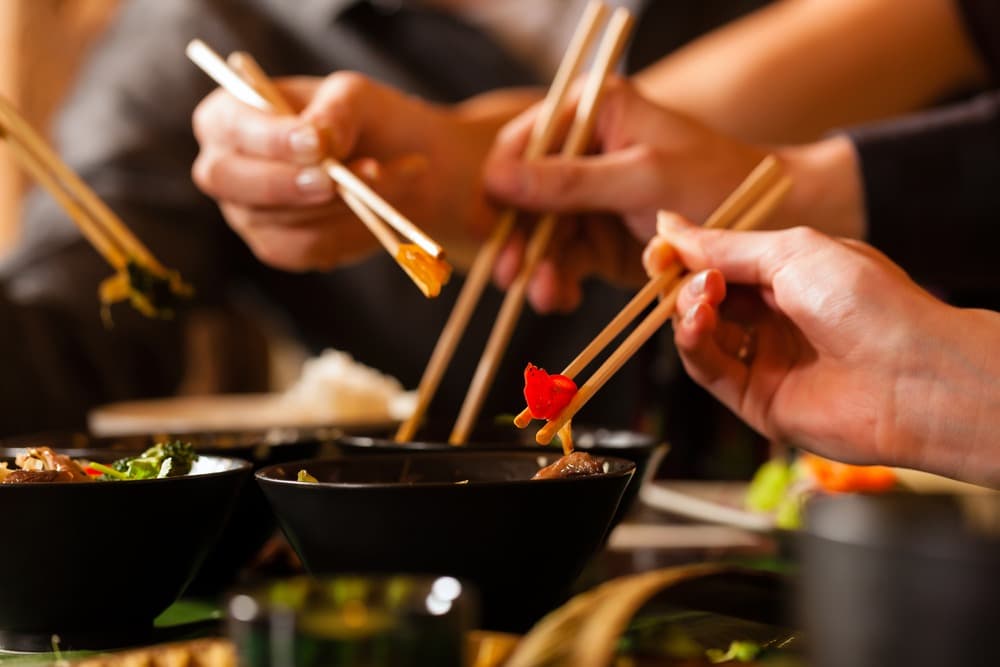
The History of Chopsticks
Like many aspects of Chinese culture, the history of chopsticks is so ancient that its origins trace back to a mythical era. Yu the Great is said to be their father...
Like many aspects of Chinese culture, the history of chopsticks is so ancient that its origins trace back to a mythical era. Yu the Great is said to be their father...
From the Neolithic period onwards, people across the globe who had previously only known how to roast food over open flames learned to boil food in pots. All of humanity, faced with a steaming bowl of broth, confronted the same problem: how to retrieve cooked morsels from boiling liquid without burning your fingers and without having to wait for the soup* to cool down?
The Universal Invention of the Spoon
The answer to this delicate problem was remarkably consistent worldwide and took the form of a tool mimicking the concave shape formed by cupped hands, the way one's hands naturally position themselves to drink.
Shells or fruit shells worked equally well, provided one could find them. The word "spoon" may well derive from "shell," and it was likely this very shape, along with the form of cupped hands, that our ancestors sought to replicate in diverse materials such as wood, horn, bone, and earthenware. They added handles, which proved especially practical for retrieving hot liquid from deep vessels.
The Neolithic site of Charavines in the Isère region revealed many examples, as have been found at Chinese sites from the same era. Meanwhile, the knife—invented far earlier, even when carefully shaped from stone—could also serve to spear morsels.
Yu the Great, Father of Chopsticks in China
Our paths truly diverged when the Chinese conceived of yet another method for grasping food in hot broth, while the rest of the world continued with spoon and knife. Recall that the fork didn't appear in Europe until the late Middle Ages.
This revolutionary invention is attributed to Yu the Great, 大禹 dàyù, the last of the five mythical emperors and founder of China's first dynasty, the Xia.
According to legend, one day when he was particularly impatient to eat the meat simmering in a ding 鼎 (a tripod cooking vessel) and wished to avoid burning his fingers, he snapped off two small branches from a nearby tree and used them as pincers! Chopsticks were born...
A Practice Widespread Across East Asia
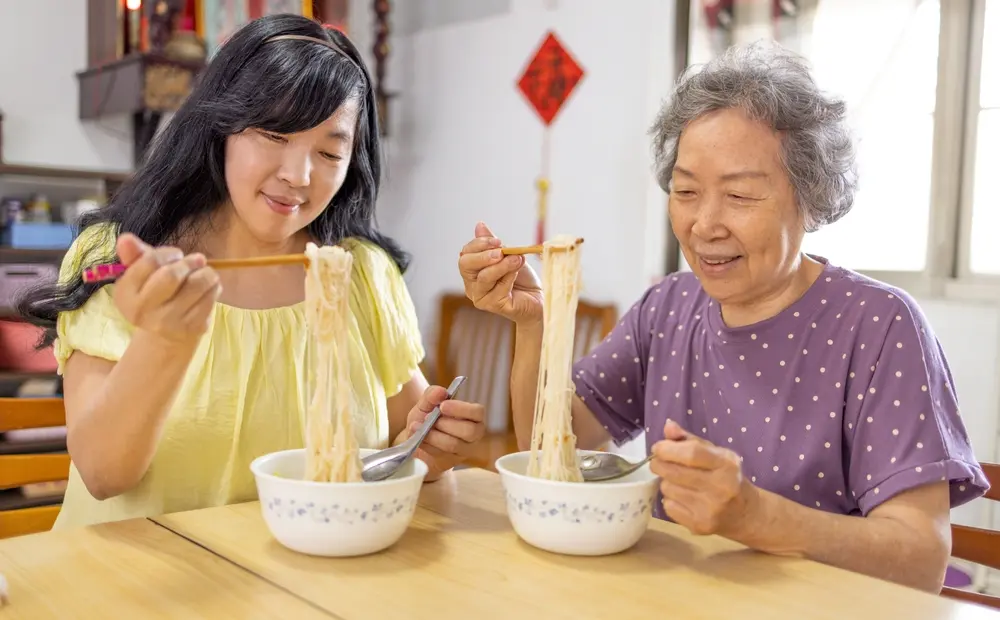
Archaeology confirms this: in the second millennium B.C., a pair of bronze chopsticks was discovered at the site of an ancient Shang capital, Yinxu near Anyang in Henan 河南安阳殷墟**.
All of China had embraced chopsticks by the end of the Han dynasty (around 220 A.D.), and the method proved so successful that its use spread throughout Asia: from Japan to Korea and Vietnam, extending to Malaysia and Singapore.
Today, it is estimated that 30% of the world's population eats with chopsticks, 30% with cutlery, and 40% with their hands—the latter proportion supposedly on the rise; thank you, burgers.
* Like French, Chinese has two words for "soup" or "broth": 羹 gēng and 汤 tāng, though their respective definitions are somewhat different.
**It was at this Shang site that the earliest traces of Chinese writing were discovered, the Jiaguwen 甲骨文. Yinxu was inscribed on the UNESCO World Heritage List in 2006.
Frequently asked questions
According to Chinese mythical tradition, the invention of chopsticks is attributed to Yu the Great (大禹 dàyù), founder of the first Xia dynasty. Legend tells that he used two small tree branches to retrieve meat from a boiling pot without burning his fingers.
The earliest chopsticks found by archaeologists date back to the second millennium B.C. They are a pair made of bronze discovered at the site of Yinxu, an ancient Shang capital, near Anyang in Henan, China.
It is estimated today that 30% of the world's population eats with chopsticks, primarily in East Asia (China, Japan, Korea, Vietnam). 30% of the population uses cutlery and 40% eats with their hands.
The use of chopsticks spread from China throughout much of Asia: they are used notably in Japan, Korea, Vietnam, Malaysia, and Singapore. China had generalized their use by the end of the Han dynasty, around 220 A.D.
Chinese chopsticks are generally longer and thicker than Japanese chopsticks. The latter are often pointed at the tip and shorter, designed for the Japanese manner of eating rice and fish. Korean chopsticks, meanwhile, are often made of metal.