The Temple of Heaven, the link between ancient Chinese and the celestial world
The Temple of Heaven lives up to its evocative name: it is dedicated to the Celestial world as conceived by the Chinese during the imperial era.
The Temple of Heaven lives up to its evocative name: it is dedicated to the Celestial world as conceived by the Chinese during the imperial era. A UNESCO World Heritage Site since 1998, the site may have lost some of its initial authenticity but remains an architectural treasure revealing Chinese cosmogony.
The Temple of Heaven (Chinese traditional: 天壇; Chinese simplified: 天坛, pinyin: Tiān Tán)
Presentation of the Temple of Heaven
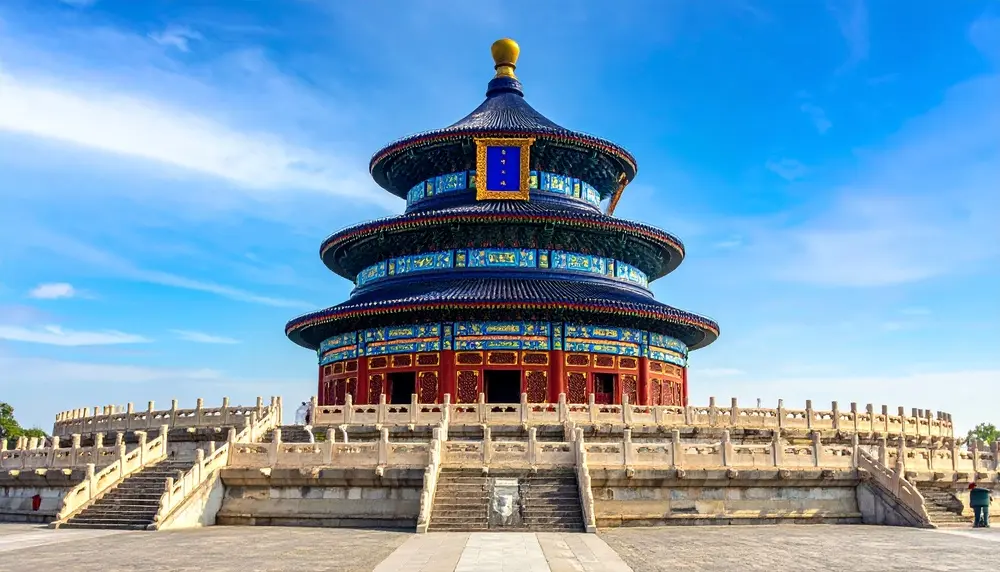
Located south of Beijing, within the "Chinese City" (in simplified characters: 外城, in pinyin: Wàichéng), the Temple of Heaven is today known to the general public as one of the main attractions of the Chinese capital.
But at its creation, and until its opening to the public in 1918, the site was dedicated to sacrificial ceremonies, essential to demonstrate respect to the Celestial authority by the Emperor, son of Heaven and guarantor of earthly authority.
The Emperor would traditionally visit the temple on the 8th day of the first lunar month each year to pray to Heaven for good harvests. Meetings of high dignitaries could also be held there.
The Temple of Heaven tends to be described as Taoist, even though the worship celebrated there predated this purely Chinese religion. Today, the monument is on the very official UNESCO World Heritage List (since 1998), in part thanks to its symbolic value linked to Chinese cosmogony.
The Temple of Heaven is particularly precious because it is evocative of Chinese beliefs under the Ming (1368-1644) and Qing (1644-1911) dynasties.
The Architecture of the Temple
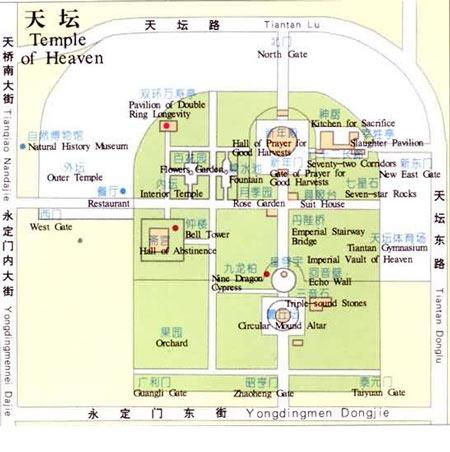
Contained within a large park of 270 hectares, it is the largest temple in Beijing. It extends 1.5 km from north to south, and 1 to 1.7 km from east to west. The perimeter of the complex contains gates at each cardinal point.
The northern ends are rounded, those to the south are straight, which means the overall shape of the site is not entirely square: here we find a simple symbol of a round sky above a square earth, the Sky being akin to the Western concept of Paradise.
Contrary to what its name suggests, it is not a single building but several, connected by a 360-meter-long causeway called "The Sacred Way."
The architecture of the complex buildings is based on earth/sky symbolism, which itself refers to the relationship between the human world (earth) and the celestial world (sky):
square enclosures with green-colored tiles symbolizing the earth
round buildings with blue-colored tiles symbolizing the sky.
The Different Components of the Temple of Heaven
The Hall of Prayer for Good Harvests (Qi Nian Dian 祈年殿):
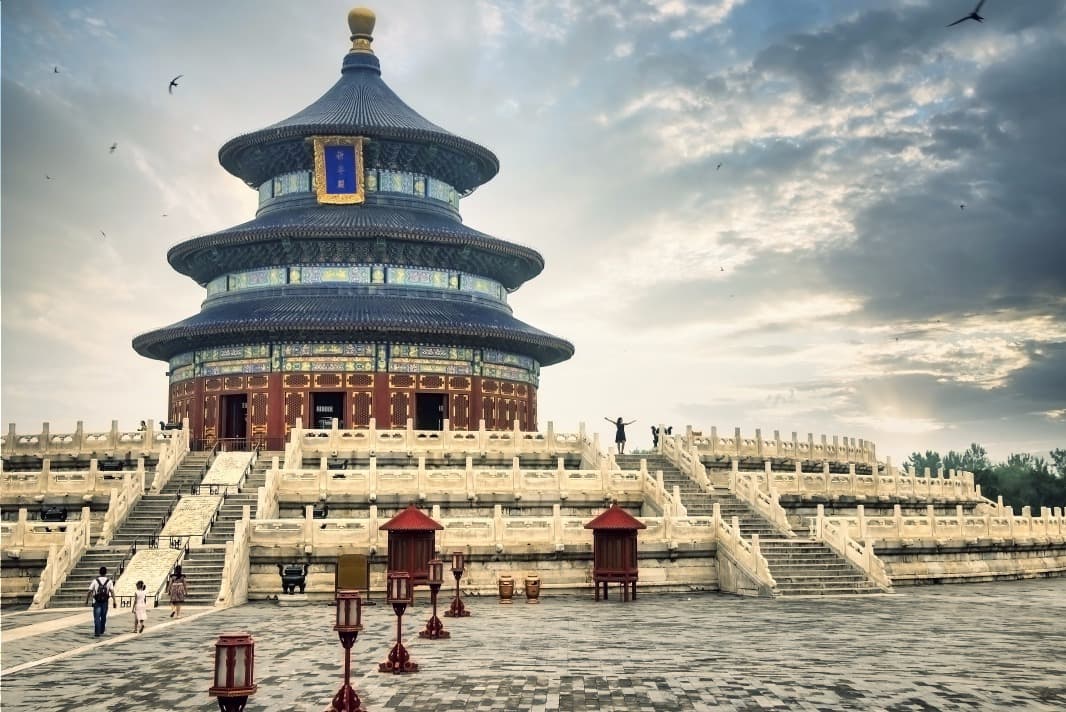
A rotunda-shaped pavilion in the north of the complex. This is the most famous place in the site, its symbol. The enclosure in its current form was erected in 1751. It is here that the Emperor came to pray for abundant harvests. Several buildings had preceded it in the same location since 1420.
Its structure is divided into three successive concentric circular terraces. The building itself is also circular and features three superimposed roofs with glazed blue tiles. Originally, each had a different color: from top to bottom, blue (Sky), yellow (Emperor), and green (people). In 1752, Emperor Qianlong unified the color of the three roofs.
Made of solid wood, the interior is generously decorated and very colorful. There are 28 wooden pillars. The first crown of 12 pillars represents the 12 months of the year, the second of 12 represents the 12 double hours of the day, while the 4 central ones symbolize the 4 seasons.
The Hall is placed on a square enclosure: the reference is once again clear, the Sky (circular) above the Earth (square)
The Residence of the Lord of Heaven (Huang Qiong Yu 皇穹宇):
A rotunda-shaped pavilion built on a marble terrace. This is the place where unused altars were kept.
The Hall of Abstinence (Zhai Gong 齋宮):
A palace located in the western part of the complex. The Emperor had to fast there for three days before performing the sacrifice.
The Altar of Heaven (Yuan Qiu Tan 圜丘壇):
A space resembling the terrace of the Hall of Prayer for Good Harvests as it also features three superimposed circular terraces. But it has no rotunda building. It is of course placed on a square enclosure to remind us of the symbolism of Sky above the earthly world. It is located on the same axis as the Hall of Prayers but to the south of the complex.
The number nine is particularly present here: at the center of the 3rd terrace lies the Heart Stone of Heaven. It is surrounded by 9 circles, the first containing 9 slabs, the second 18, and the 9th and last containing 81.
The two other terraces also have nine circles, and are separated from each other by nine steps. In total, there are 3,402 marble slabs, or 378x9...
The number 9 is odd and therefore yang. Yang, according to traditional Chinese thought, is the polarity of the Celestial, and 9 is the highest of all yang numbers, much like the Sky in relation to the human world. It is also the number of the Emperor.
A Brief History of the Temple of Heaven
Built during the reign of Emperor Yongle (also the originator of the Forbidden City), between 1406 and 1420, the site was initially called the Monument of Heaven and Earth, but in 1530, with the construction of the Temple of the Earth north of Beijing, its name became simply the Temple of Heaven.
The site was enlarged and renamed the Temple of Heaven during the reign of Emperor Jiajing in the 16th century, as he had three other temples built: the Temple of the Sun to the east, the Temple of the Earth to the north, the Temple of the Moon to the west.
In the 17th century, Emperor Qianlong had it renovated. In 1890, the Hall of Prayers was rebuilt after being struck by lightning the previous year.
In 1911, the government prohibited the sacrificial ceremonies dedicated to Heaven that were traditionally celebrated there, and the site was opened to the public in 1918. It logically lost its ritual and religious value to become essentially a tourist attraction. In preparation for the 2008 Olympics, a renovation was undertaken from 2005 to 2006.
Since January 2008, the Temple of Heaven has been twinned with the Château de Chambord in France, creating the first exchange of this kind between French and Chinese monuments.
On the UNESCO World Heritage List since 1998:
It is an architectural and landscape masterpiece that perfectly and simply illustrates one of the foundations of Chinese cosmogony.
The structural organization of the Temple and the symbolic arrangement of the buildings exerted great influence for several centuries on architecture in the Far East.
The creation of this complex and its arrangement was a powerful symbol of what made the legitimacy of the dynasties that governed Chine during its imperial history.
Frequently asked questions
The Temple of Heaven is easily accessible by metro from central Beijing, via Line 5 (Tiantandongmen station) or Line 8. It is also possible to reach it by bus or taxi. The complex is located south of Tiananmen Square, about 3 km away.
The Temple of Heaven park is generally open from 6 AM to 10 PM, while the architectural sites within are accessible between 8 AM and around 5:30 PM. The entrance fee varies depending on the season and areas visited. It is advisable to check the official information before your visit as prices may change.
Allow between 2 and 3 hours to visit the entire Temple of Heaven complex and enjoy the surrounding park. If you wish to soak in the atmosphere and observe Beijing residents who come there for walks or to practice tai-chi, plan for half a day.
The number 9 is omnipresent in the Altar of Heaven because it is odd and therefore 'yang', a polarity associated with the Celestial in traditional Chinese philosophy. Nine is also the highest among all yang numbers, symbolizing the supremacy of the Sky and imperial power. It appears in the circles of slabs (9, 18, up to 81) and the steps separating the terraces.
The Hall of Prayer for Good Harvests (Qi Nian Dian) is the emblematic circular building in the north of the complex, where the Emperor came to pray for good harvests. The Altar of Heaven (Yuan Qiu Tan), located to the south, is an open-air structure composed of three superimposed circular terraces, with no rotunda building. Both are aligned on the same north-south axis and connected by the Sacred Way.
The Temple of Heaven has been inscribed as a UNESCO World Heritage Site since 1998 for its exceptional architectural and symbolic value. It remarkably illustrates Chinese cosmogony under the Ming and Qing dynasties, with an arrangement of buildings that influenced architecture in the Far East for several centuries. It also symbolizes the legitimacy of Chinese imperial dynasties.