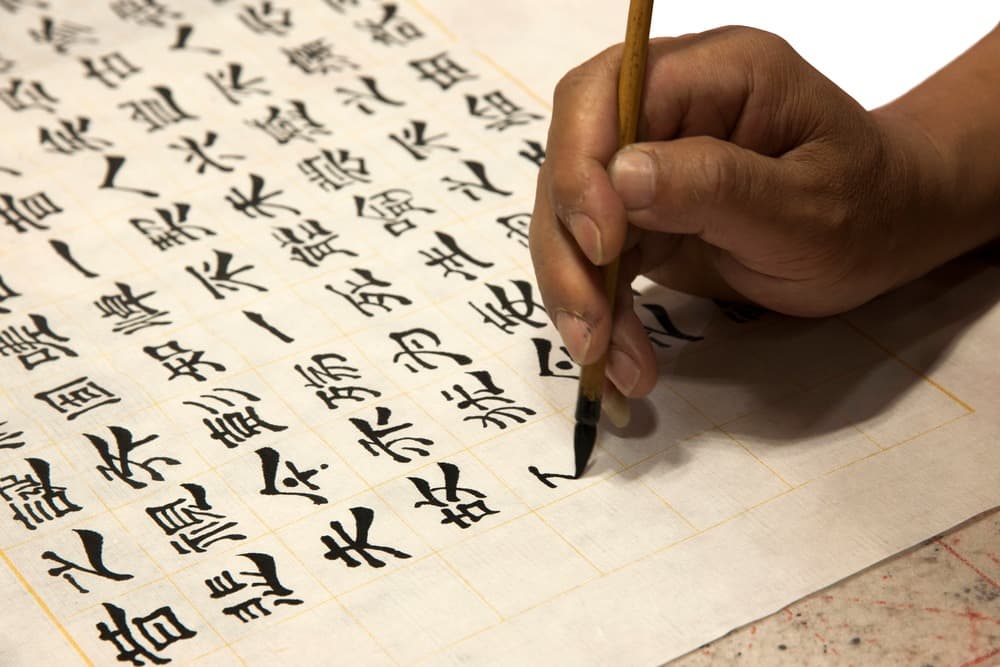
Chinese Calligraphy
Calligraphy is a discipline that fascinates Westerners through its gestures and artistic beauty. The Chinese call it shu fa (书法 shū fǎ), which means the "art of tracing" or "art of drawing strokes". Literally, shu 书 means to write and fa 法, method.
Calligraphy is a discipline that fascinates Westerners through its gestures and artistic beauty. The Chinese call it shu fa (书法 shū fǎ), which means the "art of tracing" or "art of drawing strokes". Literally, shu 书 means to write and fa 法, method.
Calligraphy, the art of writing
Regardless of civilization and writing system, the act of calligraphy carries an artistic dimension—the goal being to form the most perfect character possible. Due to the distinctive nature of its "alphabet" and the vast number of ideograms (over 40,000), Chinese calligraphy stands as an art form in its own right.
This practice, which the Chinese call "Shufa," can even be viewed as a personal development technique: both physical, for the breath control and movement it demands, and mental, for the concentration and mental clarity it requires.
It is no coincidence that martial arts masters enjoy practicing it, or that in Chan Buddhism, it is seen as a meditation exercise. Fine calligraphy reveals in a person a great capacity for concentration and physical control.
Did you know?
- Calligraphy has become an art practiced by one-fifth of humanity—it is the only non-alphabetic writing system that has persisted to this day
- The ancestor of classical Chinese character dictionaries is named Kangxi Zidian, published in 1716 under the Qing dynasty (1662-1723). It comprises 214 radicals still in use in modern dictionaries.
- Singer and actor Andy Lau is an accomplished practitioner of this art form
Overview
Calligraphy is today a prized art among tourists visiting Chine. Legend tells that Cang Jie 仓颉 (Tsang-Kié), "the divine," invented Chinese writing. According to legend, endowed with two pairs of eyes, he possessed the ability to see what others could not. He created characters by observing nature, particularly the imprints of bird claws and the natural world.
Legends and traditions surrounding calligraphy
According to tradition and certain ancient legends, the earliest traces of Chinese writing are said to be divination trigrams invented by Fuxi or Fu Hsi (伏羲 - 伏犧, Fúxī), who is the civilizing hero and the first of the three Augusts (三皇, sān huáng). Trigrams are solid lines and broken lines that fit within a square and are based on three levels. This was a divination technique in ancient Chine.
Fuxi's system was a representation of yin and yang, analyzed in depth in the Yi Jing. Nevertheless, historians and specialists refute this hypothesis, considering it pure legend.
The reason for this rejection is the presence of curves in the earliest characters dating from the Shang dynasty. Moreover, it seems evident that the first characters were pictograms—that is, the representation of a concept through an image.
A history linked to the evolution of Chinese writing
The most striking fact in the history of calligraphy is the work of Qin Shi Huangdi's minister, Cang Jie (mentioned above).
After studying the heavenly bodies and their configurations, he observed the imprints left by bird claws and traces of wild animals to invent writing. From the conclusions he drew, he conceived a system that laid the foundation for what calligraphy is today.
Drawing inspiration from elementary forms, he named them wen. He then obtained simple characters to which he associated sounds, which he called zi. The combination of elementary forms and sounds gave rise to the writing method known in Chine today. Cang Jie based his work on the relationship between nature and writing, which is visible in the calligraphic act.
Chinese writing is rooted in the spirit of the local population. Characters are not "abstract entities" but representations of natural phenomena and the expression of an "essential truth," according to Mediavilla.
Discoveries of bones and turtle shells
The earliest discoveries regarding Chinese calligraphy were made at Anyang, in Henan province. Fragments of bone and turtle shells dating from the Shang dynasty (1650-1066 BC) were found primarily. These animal parts represented the cosmos for the Chinese.
These bones were used mainly for divination. Diviners consulted ancestors to predict the future of emperors. Shells or bones were thrown into fire and the cracks that appeared were observed, thereby deducing the thoughts of ancestors. Researchers uncovered thousands of turtle shells and bones, and catalogued approximately 2,000 characters resembling our current characters.
Much later, the Western Zhou (西周xī zhōu, 1046-771 BC) attempted to unify Chinese writing around 800 BC. Officials are said to have, using bamboo strips, catalogued over a thousand characters. The goal was to enable court members and the various administrations throughout the country to use them.
No such repository has been recovered, but Chinese chroniclers of the time mention it. It appears, according to their writings, that the characters were stylized and uniform. They were called dà zhuàn or "large seal" script, while others speak of "great sigillary." However, although the style may have been refined, the characters were of unequal sizes and the strokes were not realistic.
Evolution of Chinese calligraphy
The Eastern Zhou (東周dōng zhōu 770-256 BC) did not greatly influence the country due to conflicts between princes. These princes moreover implemented their own dialects and characters, and in a sense contributed to the evolution of writing, though with confusion.
From 221 BC onward, the reign of Qin Shi Huangdi structured Chinese writing solely to unify Chine and stop linguistic and territorial regionalization.
The emperor ordered Li Si (Lǐ Sī, 李斯), Prime Minister of the Qin Empire, to edit a manual containing three thousand characters. He compelled scribes and scholars to use them. These are called xiao zhuàn, "small seal" or "small sigillary" script.
Li Si and his collaborators did not invent new characters but rather simplified the sinuous forms and standardized the thickness of strokes (there are two techniques in calligraphy: direct attack and indirect attack). Furthermore, they maintained the configuration of characters inscribed within a virtual rectangle.
This technique continues to this day: everyone is expected to write within pre-established or virtual rectangles. Schoolchildren use notebooks with pages featuring rectangles to familiarize themselves with uniform character sizes (or Hanzi汉字). The current situation in Chine allows us to say that Qin Shi Huangdi's reform succeeded in creating unified and legible writing.
In 213 BC, a reform called the "burning of books" eliminated writings deemed corrupt and launched different parallel calligraphic styles. It was during this period that lishu (隸書) calligraphy emerged, invented by Chéng Miǎo, a prison director under the Qín dynasty.
The stroke is thick and the tip is hidden, making it impossible to find the beginning and end of the character, creating a certain unity in the stroke. In contrast to "small seal" script, scholars and scribes rejoiced in practicing this new calligraphy, which they deemed simpler and less laborious.
Calligraphy today
There are different types of calligraphies: cao shu (草書), xing shu (行書), kai shu (楷書), and zhuan shu (篆書). These are different forms of writing and stroke execution.

Cao shu is a calligraphy known as "cursive" or "grass" style, where strokes are abbreviated and linked, creating a continuous flow. This writing was developed by Chang Chih of the Eastern Han dynasty (25-220 BC). It is prized by scholars but not by beginners.

Liu Tê Cheng, also of the Eastern Han dynasty, created the xing shu or "running script" style. The stroke is cursive, the movement rapid, yet each stroke is preserved. It was during the third century AD that the li shu style appeared, with thick strokes and hidden tips. This was the calligraphy most appreciated by scribes since it facilitated their work.

Then came kai shu, the regular script—legible and simple. It is said that this calligraphy allowed imperial power to dominate the country, so much so that between the third century AD and 1958, this writing style was never revised.