10 European cities replicated identically in China
China has gained a somewhat infamous reputation for its propensity to copy and counterfeit entire products or concepts. In recent years, it has decided to raise the stakes even further
China has gained a somewhat infamous reputation for its propensity to copy and counterfeit entire products or concepts. In recent years, it has decided to raise the stakes even further by replicating European cities and villages with remarkable precision. A curious way, perhaps, to preserve its image...
Luxury, elegance, refinement... Europe undoubtedly maintains a distinctly favorable image among the Chinese. As middle classes accumulate greater purchasing power, they can increasingly afford to travel with ease. And among the preferred destinations of China's newly wealthy, the old continent occupies a place of honor.
With this growing enthusiasm for Europe, Chinese developers seized the opportunity to profit by replicating some of the most beautiful European cities with striking fidelity. Paris naturally makes the list, alongside Austria's Hallstatt, Sweden's Sigtuna, Florence, and numerous other globally renowned destinations. Some find it amusing or even flattering; others are outraged and consider it yet another violation of intellectual property... Let's discover this non-exhaustive ranking without further ado:
1 Paris or Tiandu Cheng
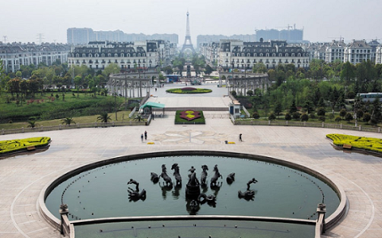
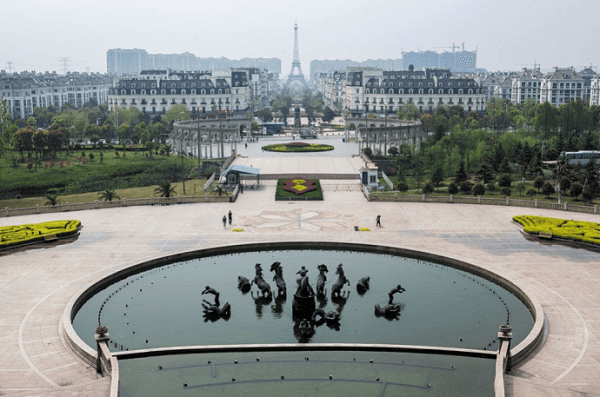
Paris... Paris wronged! Paris broken! Paris martyred! But Paris... copied! What French person hasn't marveled at thousands of Chinese tourists crowded near Paris's principal monuments with their umbrella hats? The Chinese fascination with Paris inspired certain developers to faithfully reproduce the French capital in the Tiandu Cheng neighborhood in Hangzhou. Complete with Haussmann-style buildings, a replica of the Eiffel Tower, the Arc de Triomphe, Montmartre, and French gardens, this miniature city could easily be mistaken for the real Paris. Surrounded by agricultural fields, it has not yet attracted China's affluent classes. Nevertheless, this charming Chinese Paris enchants numerous couples unable to afford a honeymoon in France.
2 Hallstatt in Austria and its Chinese clone

Listed as a UNESCO World Heritage Site since 1997, this quaint Austrian village of 800 residents was hardly pleased to be copied like a common brand! Understandably: from its characteristic timber-framed houses and window-box flowers to its charming boutiques and the scenic lake bordering the commune, virtually nothing was spared... The reproduction of this picturesque Austrian village is reportedly located in Guangdong province in the south. Hallstatt's residents remain astounded that this replication occurred without their consent, while UNESCO questions the legal standing of this reproduction...
3 Holland near Shanghai
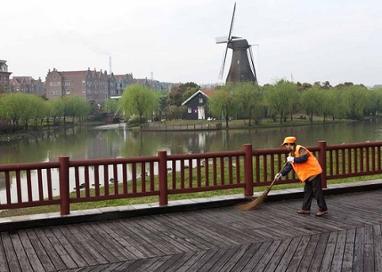
An ambitious architectural project aimed to create satellite cities near Shanghai to ease congestion in the sprawling Chinese metropolis. This initiative led an architecture firm to draw significant inspiration from Dutch villages to create Gaoqiao. Windmills, modest waterways, brick-red houses... every element has been meticulously reproduced to evoke a stroll through quaint Dutch streets. Despite the European charm pervading this city, it has struggled to achieve genuine commercial success, largely due to its distance from Shanghai.
4 Germany made in China
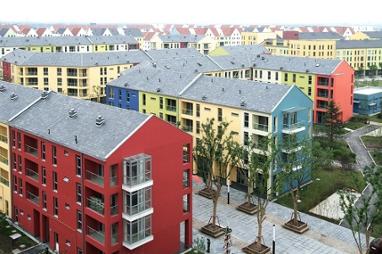
Germany too has received its share of architectural imitation through Anting. Built to accommodate roughly 50,000 residents, Anting aspires to embody the modernity and aesthetic refinement of a German city. It features contemporary, eco-conscious buildings, Bauhaus-influenced architecture, and a replica of the memorial dedicated to Goethe and Schiller, whose original stands in Weimar. This hybrid modern city, part Chinese and part German, has nonetheless struggled to find an audience, primarily due to a cultural misstep. The city was constructed without considering Feng Shui, an art of living essential to every self-respecting Chinese person.
5 The Swedish city of Sigtuna in China
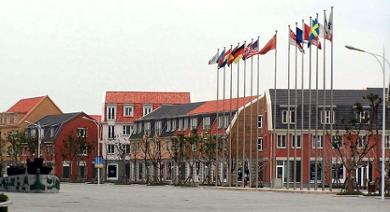
Luodian, an enchanting small city located approximately 25km from Shanghai, exudes Scandinavian charm. A miniature replica of Sigtuna, Luodian was inaugurated in 2004 and can accommodate nearly 30,000 residents. Unfortunately, this Chinese city never gained a lake comparable to Mälaren due to insufficient residents. Yet another city that failed to fully captivate the Chinese population. Perhaps importing a couple of Swedes might have helped elevate its appeal?
6 England on Shanghai's outskirts
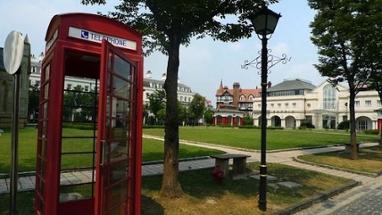
Songjiang is a city located in Shanghai's metropolitan area. Like its neighbors, it benefits from pronounced European influence, lending it the appearance of a charming small English town. Appropriately christened Thames Town, it was constructed to accommodate 10,000 residents. Telephone booths, Victorian-style buildings, cobblestones... every British cliché is assembled here to make Thames Town a genuinely so British little borough. All it's missing now is football supporters...
7 Florence as a Chinese shopping mall
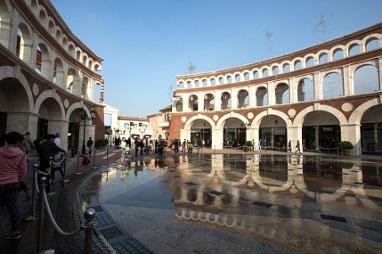
Developers don't do things halfway when it comes to attracting consumers. With this philosophy in mind, a shopping mall situated in the middle of nowhere served as the pretext for replicating one of Italy's most stunning cities: Florence. Its 200,000 square meters house numerous luxury boutiques including Prada, Louis Vuitton, and Céline. Unsurprisingly, this destination has become a genuine attraction for affluent Chinese and continues to expand annually. Consumer society, indeed...
8 Portuguese city in China that mimics Las Vegas within an Italian setting
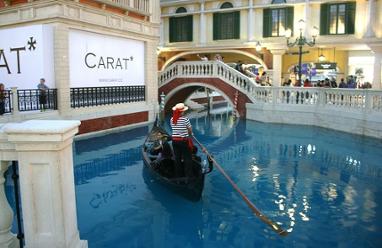
Yes, this title likely caused you some cognitive dissonance, yet it's absolutely true: Macau, a former Portuguese colony for over 400 years, has transformed into China's Las Vegas. To honor this weighty distinction, casino hotels don't hesitate to faithfully replicate their counterparts in Nevada. Here you'll find the celebrated MGM, as well as the Venetian with its reproduction of Venice indoors. These Chinese are quite audacious!
9 Breeza Citta di Pujiang, the city that aspires to be Italian
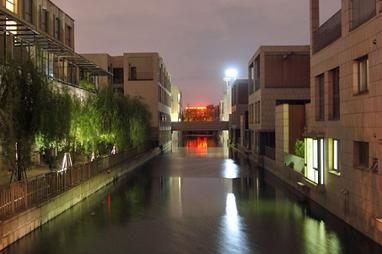
This city bears no resemblance to any renowned Italian city. Yet developers attempt to attract the population using precisely this argument. Narrow streets, a small waterway, restaurants with terraces, everything has been deployed to convince the Chinese, who nonetheless remain perplexed by the "charm" of this location.
10 The Tower Bridge at Suzhou
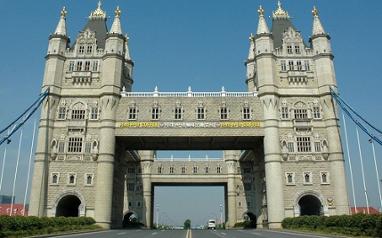
If there's one thing that catches the eye when strolling through Suzhou, it's undoubtedly its replica of London's celebrated Tower Bridge. Though Suzhou's version boasts four great towers instead of two, the reproduction remains remarkably faithful and is visible from kilometers away.
While these cities were constructed to welcome a population of affluent Chinese, they appear to struggle at present to attract residents. The assumption that Western culture could seamlessly blend with Chinese culture may well explain these repeated failures. Is the West merely a fantasy in the Chinese imagination? You have four hours to decide.
Frequently asked questions
The replication of European cities in China responds to several objectives: to ease congestion in major metropolises like Shanghai by creating satellite cities, to satisfy the growing appeal of Western aesthetics among Chinese middle classes, and to develop upscale real estate projects associated with European prestige.
Paris is arguably the most publicized replica, with the Tiandu Cheng neighborhood in Hangzhou reproducing the Eiffel Tower, the Arc de Triomphe, and Haussmann-style buildings. Austria's Hallstatt, a UNESCO World Heritage Site, was also replicated in its entirety in Guangdong province.
Most of these 10 cities struggle to attract residents. Projects like Anting (German city), Luodian (Swedish Sigtuna), and Thames Town (English city) are often called 'ghost cities.' Cultural difficulties, distance from major metropolises, and the absence of Feng Shui in some projects explain these relative failures.
Yes, most of these replicas are accessible to visitors. Thames Town near Shanghai, for instance, has become a favored location for wedding photo shoots. Tiandu Cheng in Hangzhou also attracts couples seeking a Parisian setting without traveling to France. It's advisable to inquire about transportation access from Shanghai or Guangzhou depending on your destination.
The question of legality remains ambiguous. Hallstatt's residents were surprised to learn their village had been copied without their consent. UNESCO, which designated Hallstatt a World Heritage Site in 1997, questioned the legality of this reproduction. However, no clear international legal framework exists to prohibit the architectural replication of a village.