The Great Wall of China from Beijing
A stay in Beijing is rarely planned without dedicating a day to the Great Wall of China.
A stay in Beijing is rarely planned without dedicating a day to the Great Wall of China. Whether you're seeking breathtaking panoramas, a purely touristy atmosphere, or a wild hike off the beaten path, the Great Wall has something for everyone.
But which section of the wall should you choose? Between sections under renovation, those restricted by the State, or those swarming with Chinese tourists, it's sometimes difficult to see clearly and make a choice.
You'll be faced with choosing from numerous excursions across different sections of the Great Wall, but you need to know which one to pick. In this article, you'll find the advantages and disadvantages of each section near the capital. You can also contact us to organize with us a discovery of the Chinese wall far from beaten paths
The Great Wall at Badaling
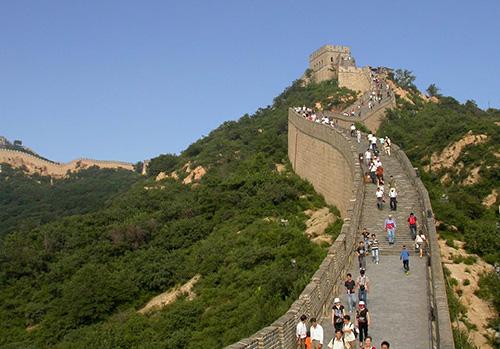
Located just 70 kilometers from Beijing, the Great Wall at Badaling is by far the most popular destination for foreign and Chinese tourists. Its proximity to the capital and state of restoration make Badaling a first choice for visitors short on time, older tourists, or people with disabilities. Badaling indeed offers a cable car option for 80 RMB round trip and frequent stops for refreshing beverages sold by vendors at nearly every tower. The main drawback of Badaling is the crowds. During peak summer season, you won't be the only foreigner storming the ramparts, far from it. A sticky and noisy human traffic jam will await you on the steps, making it hard to enjoy the beauty of the place.
Visits on weekdays and outside peak season (November to March) can nonetheless prove more pleasant despite vendors who will always try to resell you t-shirts, drinks, or postcards.
If crowds don't scare you, you can reach the Badaling section by Bus no. 919 from Deshengmen for just 12 RMB, request a taxi from your hotel, or choose an organized tour.
Advantages: Quick to reach given its proximity to Beijing. Easy to climb and some wheelchair access is available.
Disadvantages: Your photos (and the experience) will likely be spoiled by herds of tourists. It will be impossible to reflect and soak in the power of the place.
Perfect for: Travelers with disabilities and people who love Disneyland.
The Great Wall at Juyongguan
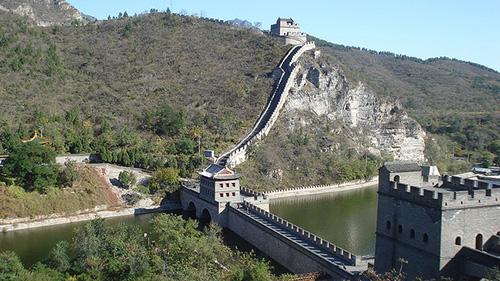
Less crowded than Badaling but closer to Beijing (around 50km), the Juyongguan section can be a good alternative. Listed as a UNESCO World Heritage site in 1987, the Juyongguan portion boasts a rich cultural past.
The site is spectacular with mountains on either side. It exudes an atmosphere of power with its towers and famous marble platform called the "Cloud platform". The platform houses an arched gate and statues of the four celestial gods.
This site will be perfect for time-pressed visitors who want to avoid crowds. A hiking trail is marked for a walk of approximately two hours. It will allow you to enjoy magnificent views and the fortresses.
For those with more time, it's possible to sleep at the foot of the wall and wake at dawn to admire the sunrise over the mountains and towers.
Advantages: The closest section to Beijing, little or no crowds.
Disadvantage: Doesn't have the classic look of the Great Wall.
Perfect for: History enthusiasts.
The Great Wall at Mutianyu
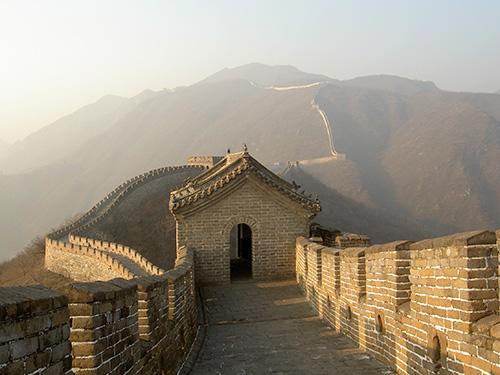
Built to deflect attacks on Badaling, Mutianyu now enjoys great popularity among those who prefer tranquility and nature.
Located east of Juyongguan and about 70 km from Beijing, Mutianyu is one of the best-preserved sections of the Great Wall. Composed of 22 towers and approximately 2250 meters in length, the wall traverses the hills with thousands of steps. Less touristy than Badaling and more typical than Juyongguan, Mutianyu is particularly beautiful in autumn, when the surrounding wooded hills offer a watercolor of orange hues.
Several times restored, this part of the wall has lost some of its ancient charm but remains nonetheless distinctive.
Advantage: Accessible without being overrun by other tourists.
Disadvantages: Restorations have given it a somewhat sterile atmosphere.
Perfect for: Those who want to avoid other tourists.
The Great Wall at Jinshanling
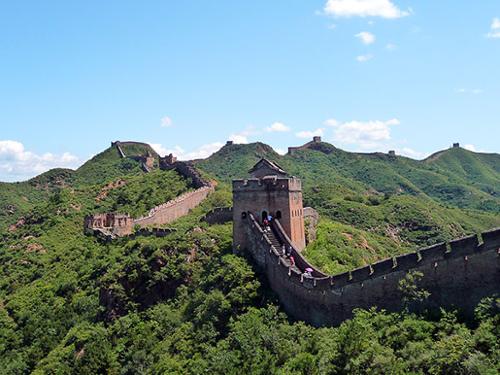
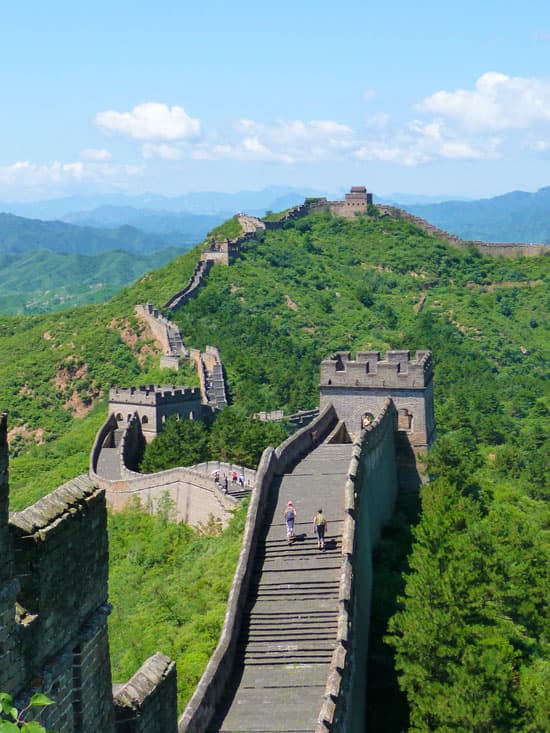
Jinshanling, the one we visited in 2011. Whereas the previously mentioned Great Wall sections are located near Beijing, Jinshanling is situated 120km north of the capital. The most adventurous who wish to discover the Chinese wall in peace will find everything they're looking for on this section. Partially restored, Jinshanling features very robust stretches that are sometimes even a bit precarious. Straddling mountain ridges, Jinshanling offers breathtaking views of the Hebei province mountains.
It's possible to reach the wall via a hiking trail or by using the cable car for 50 RMB round trip. Although there are a few vendors tucked into certain towers, your discovery will unfold in calm and solitude. These vendors will even be welcome for a refreshing break after a dizzying climb under the burning sun.
Advantages: Superb landscapes, authentic partially restored ruins, and discovery in peace and quiet.
Disadvantages: Located 120 km from Beijing, expect around 2 to 3 hours of travel from the city center.
Perfect for: Photographers and hikers.
The Great Wall of China at Jiankou
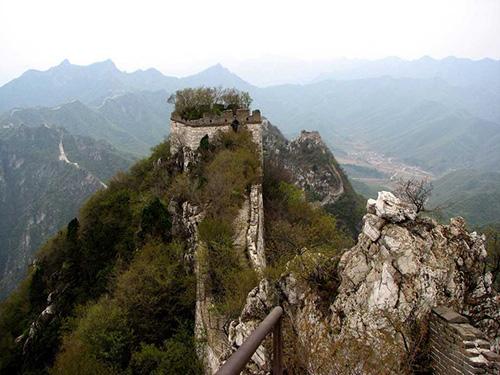
The last Great Wall section near Beijing we can recommend is Jiankou. Situated just 73 km from Beijing, Jiankou requires, like Jinshanling, a full day to explore.
With its trees and shrubs sprouting from the wall, Jiankou is the wildest section of the Great Wall. Jiankou is highly recommended for hikers in good physical condition and adventurers. The steep, difficult, and sometimes dangerous climbs are rewarded by spectacular views of the unrestored wall snaking through the surrounding hills.
Due to its state of semi-abandonment and deterioration, Jiankou should not be attempted solo or in bad weather. A good pair of hiking shoes, plenty of water, and a cautious approach will allow you to experience one of the most exciting wall discoveries.
Advantages: A real sense of discovery and freedom.
Disadvantages: A difficult hike that can prove dangerous for the less experienced.
Perfect for: Adventurers and experienced hikers.
Frequently asked questions
The Juyongguan section is closest to Beijing (around 50 km), followed by Badaling (70 km). Badaling is the easiest to access thanks to bus no. 919 from Deshengmen for 12 RMB, and it has a cable car as well as facilities for people with reduced mobility.
To avoid crowds, prioritize Jinshanling (120 km from Beijing), Jiankou (73 km), or Juyongguan. Badaling and Mutianyu are the most frequented, especially during peak summer season and Chinese holidays. Weekday visits and off-season trips (November to March) are generally quieter.
Yes, several sections are suitable for hiking. Jinshanling offers spectacular scenery of the Hebei mountains with partially restored stretches. Jiankou is the wildest section, reserved for experienced and fit hikers due to steep and dangerous climbs. Mutianyu also offers a marked trail covering approximately 2250 meters with 22 towers.
Prices vary by section. As a reference (to be verified), Badaling's cable car cost 80 RMB round trip and Jinshanling's 50 RMB. Bus no. 919 to Badaling from Deshengmen cost 12 RMB. It's advisable to check current prices before your visit, as this information dates from 2014.
Autumn (September-November) is ideal for visiting the Great Wall: temperatures are mild and vegetation offers magnificent colors, especially at Mutianyu. Avoid peak summer season (July-August) and Chinese holidays (Golden Week in May and October) when the most popular sections are extremely crowded.
No, Jiankou is reserved for experienced hikers in good physical condition. This unrestored section features steep climbs and potentially dangerous areas. It is strongly discouraged to visit solo or in poor weather. Good hiking shoes and a large quantity of water are essential.