Dujiangyan Irrigation Project
Built during the Qin dynasty, the Dujiangyan Irrigation Project has controlled the Min River for over 2,000 years. This UNESCO site in Sichuan combines ancient engineering prowess, history, and stunning river landscape, just an hour from Chengdu.
Constructed around 256 BCE by Li Bing, governor of the region under the Qin dynasty, the Dujiangyan Irrigation Project stands as one of the rare ancient hydraulic works still fully operational today. Located in Dujiangyan, Sichuan province, it has controlled the Min River's floods and irrigated the Chengdu Plain for over 2,000 years. Inscribed as a UNESCO World Heritage site in 2000, it masterfully blends civil engineering, history, and spectacular natural landscape.
Quick Reference Guide
- Admission: Paid entrance (site access ticket)
- Recommended duration: 3 to 4 hours to explore the entire site
- Access: Bus or high-speed train from Chengdu (approximately 1 hour); Dujiangyan station on the Chengdu–Dujiangyan high-speed rail line
- Dress code: No restrictions; comfortable walking shoes recommended for paths along the riverbanks and suspension bridges
- Accessibility: Partial — some areas are accessible, while others involve stairs and uneven terrain
What You'll See
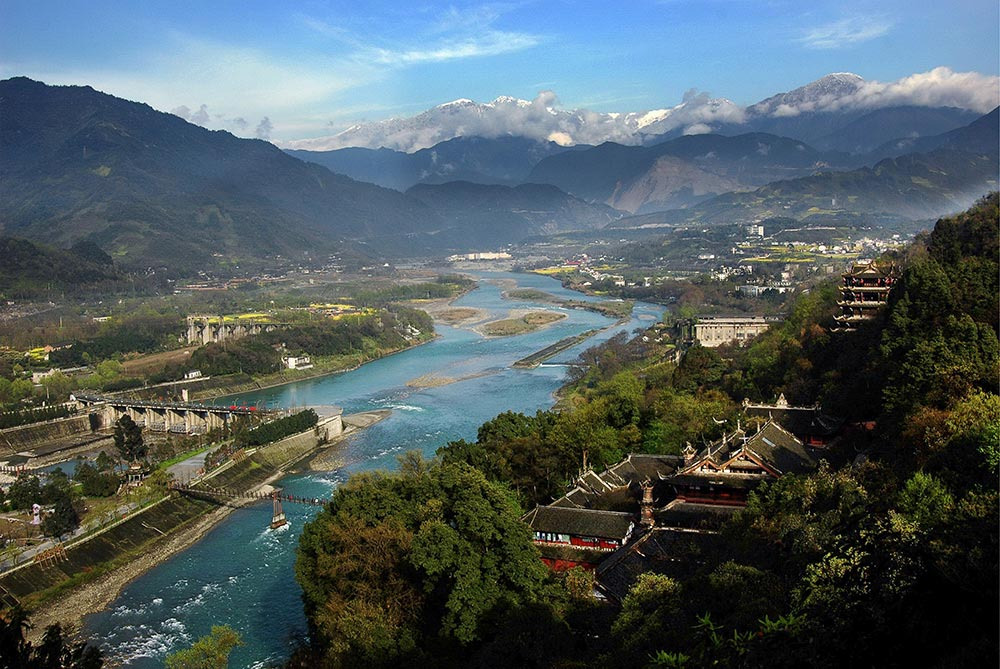
The site centers on three main structures that operate as an integrated system. The Yuzui Weir, or "Fish Mouth" dam, divides the Min River into inner and outer channels. The Feishayan spillway regulates flow and evacuates sediment. The Baopingkou sluice controls water entering the irrigated plain. Suspended walkways and riverside trails offer direct views of these structures in action.
History and Context
Li Bing, governor of the region under the Qin kingdom, designed the system to end devastating floods on the Min River and transform the Chengdu Plain into an agricultural heartland. His son Er Lang oversaw complementary works. Without concrete or conventional dams, the structure harnesses natural topography and fluvial dynamics. It has withstood major earthquakes, including the 2008 event, and continues to irrigate over 670,000 hectares.
Highlights of Your Visit
The Yuzui Weir
The fish-mouth-shaped dike, constructed from woven bamboo filled with stones, forms the heart of the system. Standing on the walkway that runs along it offers a tangible sense of how the current divides according to the seasons.
The Baopingkou Sluice
Carved directly from rock, this narrow passage regulates water entry into the inner channel. The view from Lidui Hill, which overlooks the sluice, provides the best overview of how the entire mechanism functions.
Lidui Park
Adjoining the hydraulic site, this tree-lined park houses Er Wang Miao temple, dedicated to Li Bing and his son. Wooden buildings, interior courtyards, and carved stone tablets add cultural and spiritual dimensions to your visit.
Suspension Bridges
Several bridges span the Min River at different points across the site. They allow circulation between the riverbanks and offer close-up views of the river's powerful flow, particularly dramatic during the rainy season.
Photography Tips
Morning light is most favorable, illuminating the riverbanks without backlighting. The Yuzui Weir photographs well from the central walkway. For a comprehensive view of the Baopingkou sluice, climb Lidui Hill. In summer, higher water levels make the structures more spectacular, but mist may reduce visibility.
Location and Access
The site lies in Dujiangyan city, approximately 60 km northwest of Chengdu. The Chengdu–Dujiangyan high-speed rail line serves the town directly. Local buses connect the station to the site. The Chengdu Research Base of Giant Panda Breeding and Mount Qingcheng, also UNESCO-listed, are located in the same area and easily combined into one or two days.
Nearby Attractions
- Mount Qingcheng — UNESCO-listed Taoist site, just a few kilometers away, easily visited the same day.
- Chengdu Research Base of Giant Panda Breeding — leading center for observing giant pandas, approximately one hour by transport.
- Jinli Street, Chengdu — historic thoroughfare in central Chengdu, ideal for an evening after your site visit.
Frequently asked questions
Spring (March–May) and autumn (September–November) offer pleasant weather and lush vegetation. Summer (June–August) coincides with the rainy season: the Min River's flow peaks, making the structures more impressive, but heat and humidity are high.
Yes, both UNESCO sites are close to each other. Starting early from Chengdu, you can visit the irrigation project in the morning and dedicate the afternoon to Mount Qingcheng, or spread the experience across two days for a more leisurely exploration.
Allow 3 to 4 hours to explore the three main structures, walkways, and Lidui Park with Er Wang Miao temple. A half-day is sufficient for a complete visit without rushing.
Photography is allowed throughout the outdoor site. Inside Er Wang Miao temple, check local signage; some areas may restrict photography.
The Chengdu–Dujiangyan high-speed rail line is the fastest and most convenient option. Long-distance buses also depart from several bus stations in Chengdu. From Dujiangyan station, local buses or taxis take you to the site entrance.
Yes, the site is family-friendly. Walkways and riverbanks are secure. Some sloped paths or stairs may require attention with young children, but most of the route remains accessible.
Interested in this visit?
We can include it in your personalised itinerary.