Meili Snow Mountain
A sacred massif of Tibetan Buddhism in northern Yunnan, Meili Xue peaks at 6,740 m with Kawagebo as its crown. Glaciers, Tibetan villages, and spectacular sunrise views make it one of southwest China's most remarkable destinations.
Meili Xue mountain, or the Meili massif, rises at the border of Yunnan and Tibet in Deqin County. Its principal peak, Kawagebo, reaches 6,740 meters—the highest mountain in Yunnan. A sacred site in Tibetan Buddhism, it has never been officially summited. Believers circumambulate it during a ritual pilgrimage. For travelers, it offers sweeping views of glaciers, coniferous forests, and Tibetan villages clinging to the slopes.
Quick Practical Info
- Access: from Deqin (roughly 10 km away), reachable by vehicle via National Road G214; the Feilai Si viewpoint is the most visited vantage point.
- Clothing: warm garments essential year-round; temperatures drop sharply at night, even in summer.
- Altitude: the Feilai Si viewpoint sits at approximately 3,300 meters—allow time for acclimatization.
- Recommended duration: one day for the viewpoint; several days for the full pilgrimage circuit (kora).
- Restrictions: climbing Kawagebo has been prohibited by Chinese authorities since 1991, at the request of local Tibetan communities.
What You'll See
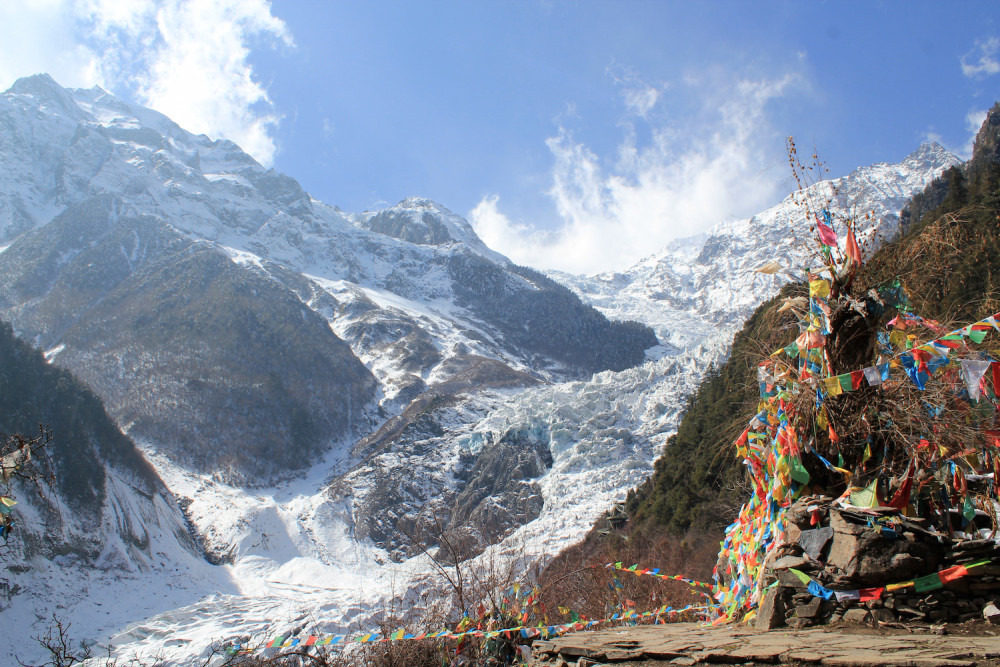
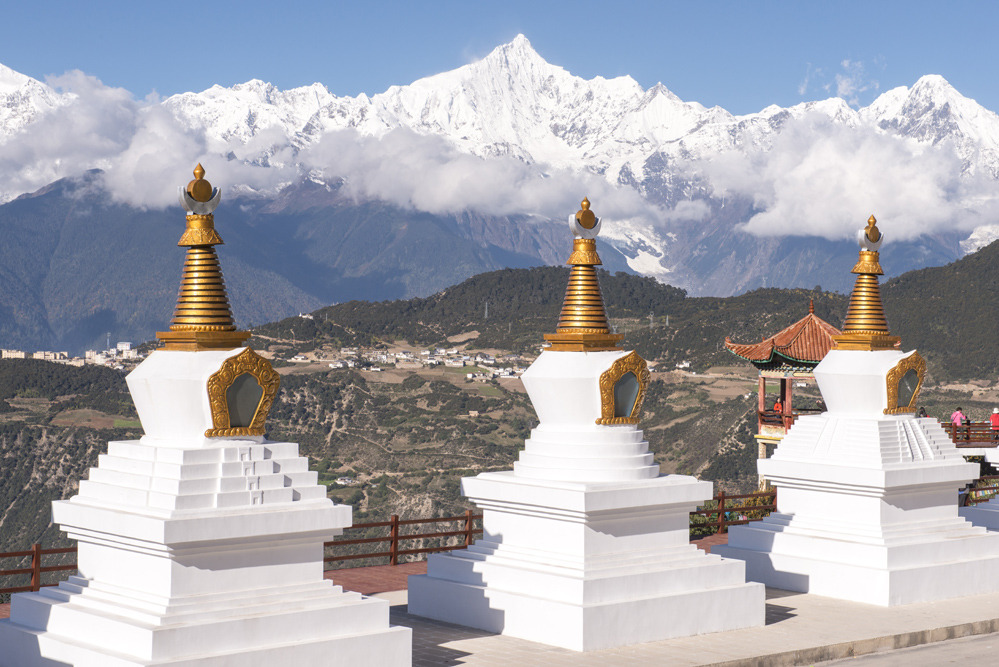
The massif comprises thirteen snow-capped peaks. The Mingyong glacier descends to approximately 2,700 meters elevation, one of the lowest glaciers at this latitude in the northern hemisphere. The Feilai Si viewpoint, facing Kawagebo, is the classic vantage: at dawn, the first rays illuminate the snow-covered faces in orange hues. The Lancang (Mekong) valley borders the massif to the east.
History and Context
Kawagebo is the tutelary deity of Tibetans in the Kham region. In 1991, a Sino-Japanese expedition of seventeen climbers perished in an avalanche—a catastrophe interpreted locally as a sign of the mountain's anger. Since then, any climbing attempt has been officially forbidden. The Buddhist pilgrimage around the massif, the kora, draws thousands of devotees annually, especially during the Year of the Horse in the Tibetan calendar.
Highlights of Your Visit
Sunrise from Feilai Si
The Feilai Si viewpoint, facing Kawagebo, is the prime observation spot. On clear days—relatively uncommon—the peaks ignite at dawn. The light rarely lasts more than twenty minutes: arrive before sunrise.
Mingyong Glacier
A marked trail from Mingyong village leads to the glacier's foot. The glacier tongue descends through a forest of rhododendrons and pines. The glacier has been retreating for decades: rock markings testify to its visible withdrawal.
The Kora (Pilgrimage Circuit)
The complete circuit around the massif takes ten to fifteen days on foot. It crosses passes above 5,000 meters, monasteries, and Tibetan villages. This circuit demands excellent fitness and accreditation for the Tibet-Yunnan border zones.
Etiquette and Visit Guidelines
- Kawagebo is a sacred mountain: avoid any disrespectful behavior near altars, stupas, and prayer flags.
- Do not touch offerings or prayer wheels without invitation.
- When performing the kora, always circumambulate stupas and prayer wheels clockwise (Buddhist convention).
- Ask permission before photographing people, especially pilgrims.
Photography Tips
The golden light of sunrise on Kawagebo is the site's iconic image. Position yourself at the Feilai Si viewpoint at least thirty minutes before dawn. Clouds frequently cover the massif: plan several nights on-site to maximize your chances. In winter (November–February), the air is drier and skies clearer. Mingyong Glacier photographs well in late morning, before mist rises from the valley.
Location and Access
Meili Xue massif lies in Deqin County, northwest Yunnan, at the border with the Tibet Autonomous Region. The nearest town is Deqin, itself accessible from Shangri-La (Zhongdian) via the G214 road, a journey of several hours through spectacular gorges. No railway serves Deqin. Buses connect Shangri-La to Deqin. Accessibility for people with reduced mobility is limited to the Feilai Si viewpoint, reachable by vehicle; trails to the glacier and kora are not wheelchair-accessible.
Nearby Attractions
- Shangri-La Old Town — vibrant Tibetan center with the grand Ganden Sumtseling monastery, several hours' drive south.
- Tiger Leaping Gorge — one of the world's deepest gorges, on the Yangtsé, accessible from Lijiang or Shangri-La.
- Lijiang Old Town — classic Naxi town designated a UNESCO World Heritage Site, a logistical hub for the region.
Interested in this visit?
We can include it in your personalised itinerary.