Yubeng Village
A Tibetan village accessible only on foot, Yubeng nestles at the base of the sacred Meili massif in northwest Yunnan. A pilgrimage waterfall, alpine lake, and views of Kawagebo's glaciers make it an extraordinary trekking destination.
Yubeng is an isolated Tibetan village nestled at the foot of Meili Snow Mountains in northwest Yunnan. Accessible only on foot or horseback, it is divided into two hamlets—Upper Yubeng and Lower Yubeng—separated by dense forest. The site serves as a starting point for Buddhist pilgrims who circumambulate Mount Kawagebo, the region's sacred peak.
Quick Practical Guide
- Access: from Xidang, several hours of hiking (steep ascent) or horseback; no motorable road leads to the village.
- Clothing: warm garments essential, altitude exceeds 3,000 m; trekking gear recommended.
- Suggested Duration: minimum 2 nights to explore both hamlets and the sacred waterfall.
- Altitude: approximately 3,200 m (Upper Yubeng)—acclimatization necessary.
- Accommodation: basic Tibetan guesthouses available on site.
What You'll See
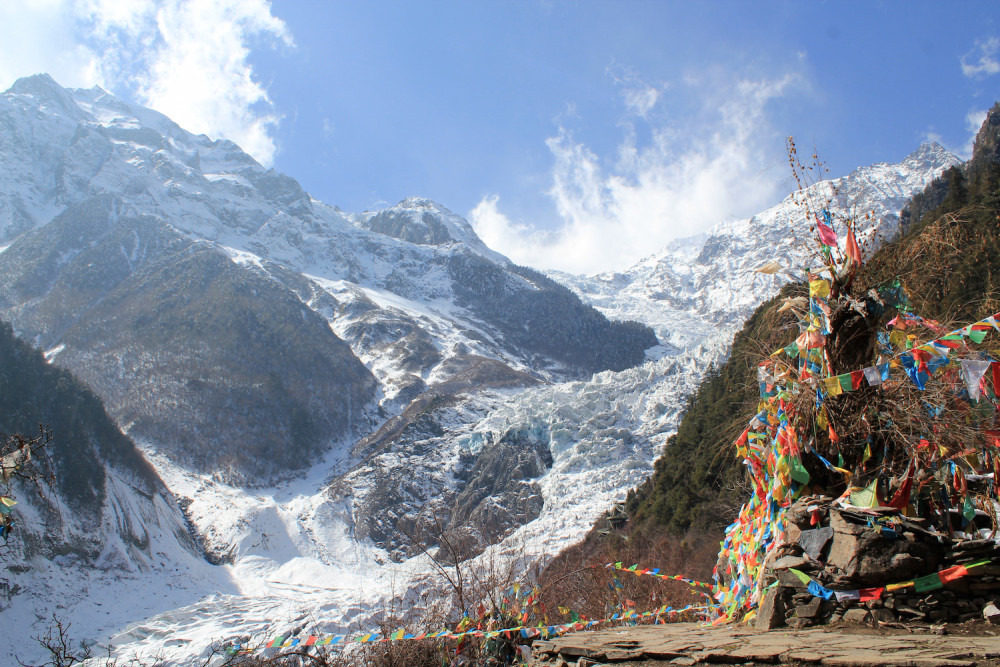
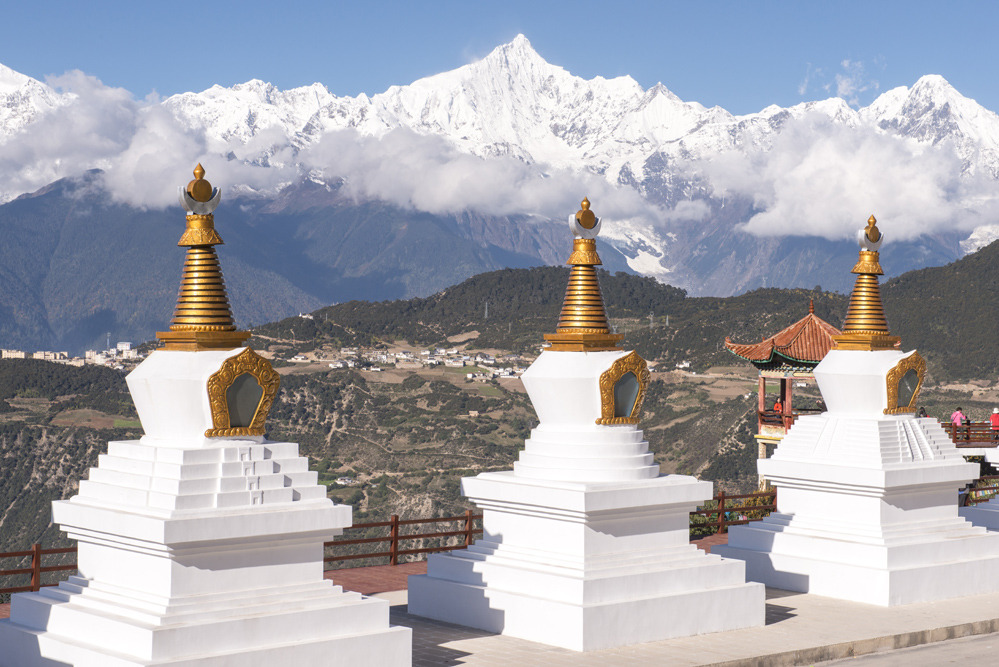
The upper village concentrates traditional Tibetan wooden and stone houses, surrounded by barley fields and free-roaming yaks. The lower village opens onto a trail leading to the sacred waterfall of Yubeng, an active pilgrimage site. On clear days, Kawagebo's glaciers (6,740 m) dominate the northern horizon.
History and Context
Yubeng is mentioned in Tibetan pilgrimage accounts spanning several centuries. Mount Kawagebo, never officially summited, is revered as the tutelary deity of the Kham region. In 1991, a Sino-Japanese expedition perished on its slopes; since then, all climbing attempts have been prohibited by local authorities and Tibetan communities. This context lends the village an aura of a spiritually charged and preserved place.
Highlights of Your Visit
The Sacred Waterfall
From Lower Yubeng, a forest trail of approximately two hours leads to a waterfall that Buddhist pilgrims consider blessed water. Prayer flags line the path. The waterfall partially freezes in winter, offering a different spectacle depending on the season.
Yubeng Lake
Above the upper village, a more demanding trail leads to an alpine lake surrounded by coniferous forests and rhododendrons. The view of Meili's glaciers is unobstructed on clear days. This trek requires good physical fitness.
The Kawagebo Circumambulation
Tibetan pilgrims undertake a multi-day circuit around the massif. Yubeng is a key stage on this kora. Encountering pilgrim groups along the route is frequent, especially in autumn and spring.
Etiquette and Visiting Rules
- Circumambulate stupas and mani stones in a clockwise direction.
- Do not photograph residents without their explicit consent.
- Avoid loud behavior near prayer sites.
- Kawagebo climbing is prohibited—respect this restriction.
- Pack out your waste: the village has no organized waste collection system.
Photography Tips
Morning light illuminates Kawagebo's glacial faces from the upper village. Colorful prayer flags set against the forest backdrop offer striking compositions on the waterfall trail. In winter, snow on the ground and glaciers create dramatic contrast with the dark wooden houses.
Location and Access
Yubeng lies in Deqin County, approximately 10 km as the crow flies from Deqin town. The usual starting point is Xidang village, accessible by bus or vehicle from Deqin. From Xidang, the trek to Yubeng takes between 3 and 5 hours depending on pace; horses can be rented on site to carry luggage or transport less mobile individuals. Wheelchair access is impossible due to terrain.
Nearby Attractions
- Meili Snow Mountains — the massif that towers over Yubeng, visible from the village on clear days.
- Deqin — the nearest town, logistical base for organizing the trek.
- Mekong Gorges — the deep gorges carved by the Lancang River traverse the region.
- Shangri-La (Zhongdian) — Tibetan town several hours to the south, home to Songzanlin Monastery.
Frequently asked questions
Spring (April-May) and autumn (September-October) offer the best conditions: clear skies, manageable temperatures, and rhododendrons in bloom in spring. Winter is cold but spectacular with snow. Summer coincides with monsoon season; trails can be slippery and glacier views often obscured.
Foreign travelers must obtain the Tibet Travel Permit for certain areas of Tibetan Yunnan. Requirements vary by period and nationality—check with a local agency before departure, as regulations can change.
The trail from Xidang is marked and well-traveled; many trekkers do it unguided. However, a local guide is useful for secondary excursions (alpine lake, less-defined trails) and for understanding Tibetan cultural context.
The ascent from Xidang is long and steep at over 3,000 m altitude. Good physical condition and prior acclimatization (one night in Deqin or Shangri-La) are recommended. Horseback remains an option for luggage.
Electricity is available in guesthouses but limited. Mobile coverage is weak or absent depending on the provider. Bring backup batteries and download offline maps before you arrive.
Interested in this visit?
We can include it in your personalised itinerary.