Hulishan Fortress
Hulishan Fortress
Coastal fortress of Xiamen built in 1894-1896, famous for its 79-tonne German Krupp cannon in the Guinness World Records and its view over Jinmen.
The Hulishan Fortress dominates the southeastern coast of Xiamen, in Fujian Province. Built in the late 19th century to defend the city against foreign incursions, it today houses a German Krupp cannon listed in the Guinness World Records and more than fifty artillery pieces from the Ming and Qing dynasties.
Why visit Hulishan Fortress
The site combines three rarely found interests: remarkably preserved late-Qing Chinese military architecture, a unique artillery collection from Southern China, and a direct vantage point over Jinmen Island, administered by Taiwan, just a few kilometres offshore.
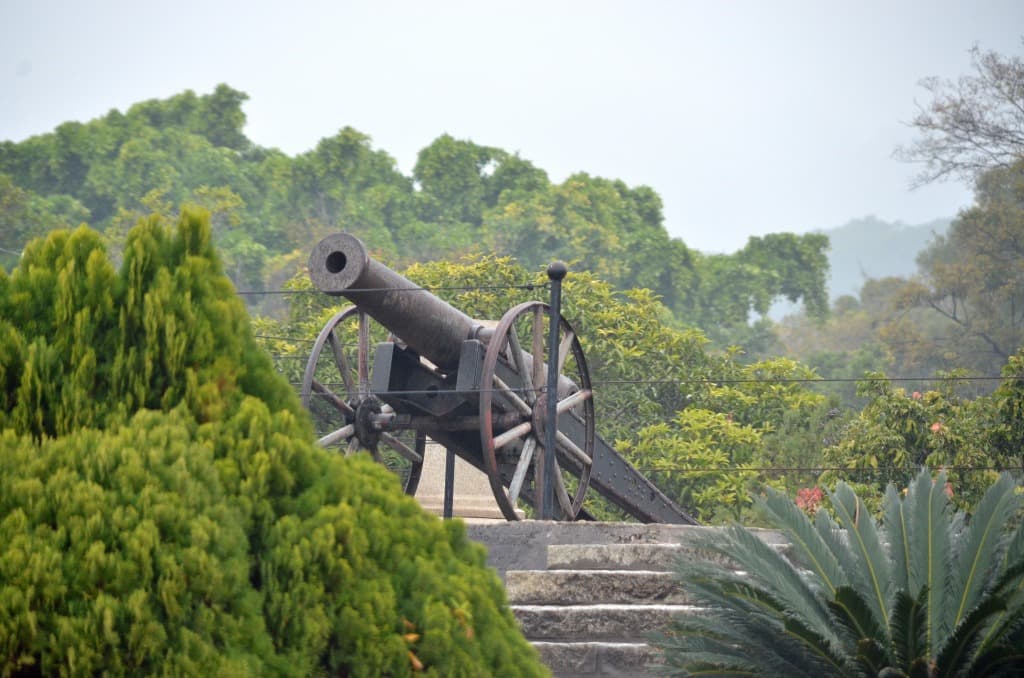
The site covers 70,000 m², including a granite castle spanning 13,000 m². The 13-metre-long, 79-tonne Krupp cannon, manufactured in 1886 and purchased from the German Krupp arsenal, remains the centrepiece. Its presence earned the fortress a Guinness World Record listing since 2000 as the largest 19th-century cannon still in place.
History of the fortress
Construction began in 1894, during the reign of Emperor Guangxu of the Qing Dynasty, and was completed in 1896. At that time, the imperial court was reinforcing its coastal defences against foreign pressure and purchased modern cannons from Europe, particularly from Krupp in Germany in 1886.
Considered one of the most advanced fortifications of its time in China, the fortress served as a deterrent against the Japanese navy in 1900 during the Boxer Rebellion, and again in 1937 at the start of the Sino-Japanese War. Its cannons remained operational until the mid-20th century.
One architectural detail deserves attention: the foundations combine camphor tree sap, brown sugar syrup, glutinous rice, clay and sand. This traditional mortar, both hard and elastic, allowed structures to absorb the shock of cannon fire without cracking.
What to see on site
The castle and ramparts
The main granite structure comprises an observation tower, an ammunition depot, a sentinel platform and barracks. A trench encircles the complex, and an underground tunnel connects the eastern and western sections of the fort, testament to the tactical care taken in designing soldier movement under fire.
The Krupp cannon
The centrepiece of the site, this 19th-century German cannon measures 13 metres long and weighs 79 tonnes. Its historical range is estimated at around 16 kilometres according to Chinese sources, which would have amply covered the strait leading to Xiamen. Two observation platforms are set up directly in front; binoculars are available for rent to spot Jinmen Island.
The artillery collection
Over 50 cannons from the Ming and Qing dynasties line the site. Most were recovered from Xiamen waters or found during urban works. An integrated museum displays ancient weapons and relics donated by Singaporean collector Zhang Rongguang. It features notably what is presented as the world's smallest cannon: 11 cm long and weighing 0.2 kg.
The view over Jinmen
From the ramparts, on clear days, you can see Jinmen Island, situated about ten kilometres away and administered by Taiwan. Boats offer approximately one-hour cruises around the island departing from the nearby jetty.
Practical information
- Visit duration: allow 1.5 to 2 hours to explore the fort, museum and observation platforms.
- Admission fee: modest entrance fee, payable on site. As prices change regularly, check before your visit.
- Opening hours: daytime opening, generally from morning to late afternoon. Confirm on site or with your accommodation.
- Best time to visit: late morning or mid-afternoon offers the best light on the cannons and sea. Avoid the humid summer months (July-August); autumn and spring are more pleasant in Xiamen.
How to get there
The fortress is located on the southern coast of Xiamen Island, near Xiamen University. Several urban bus lines serve the site: lines 2, 22, 35 and 48 have a stop in immediate proximity. By taxi or ride-sharing from the city centre, expect about twenty minutes depending on traffic.
Nearby attractions
The visit combines easily with other sites on southern Xiamen Island. Xiamen University, renowned for its landscaped campus, is just minutes away. Baicheng Beach and Nanputuo Temple are in the same area. To extend your itinerary within the city, consult the Xiamen guide.
Frequently asked questions
Frequently asked questions
A complete visit, including the ramparts, the Krupp cannon, the museum and the view over Jinmen, takes between 1.5 and 2 hours.
Yes, on clear days. Jinmen Island, administered by Taiwan, is visible from about ten kilometres away. Binoculars are available for rent on site.
Yes. The site is outdoors, the pathways are accessible, and children are generally interested in the cannons and the tunnel connecting the eastern and western sections of the fort.
Yes. It was listed in 2000 as the largest operational 19th-century cannon still preserved on its original site.
Xiamen University, Nanputuo Temple and Baicheng Beach are all accessible in the same area, allowing for a half-day or full-day itinerary on the southern part of the island.
Prepare your trip
Hulishan Fortress naturally fits into an itinerary dedicated to coastal Fujian and Chinese military history. To build a bespoke journey including Xiamen, explore our trips to China designed with English-speaking experts.

Interested in this visit?
We can include it in your personalised itinerary.