Mogao Caves
Mogao Caves
Located 25 km from Dunhuang, the Mogao Caves comprise 492 Buddhist sanctuaries carved into the cliffs from the 4th to 14th centuries, UNESCO-listed since 1987.
The Mogao Caves form a complex of 492 Buddhist sanctuaries carved into the cliffs of the eastern slope of Mingsha Shan, approximately 25 km southeast of Dunhuang, in Gansu Province. Situated on the edge of the Gobi Desert, along a strategic stretch of the Silk Road, the Dunhuang oasis was for over a millennium a crossroads between China, Central Asia and India. The site, nicknamed the "Caves of a Thousand Buddhas", has been inscribed on the UNESCO World Heritage List since 1987.
Why visit the Mogao Caves
Mogao holds one of the world's most comprehensive collections of Buddhist art: nearly 45,000 m² of murals, approximately 2,000 painted sculptures and close to 50,000 manuscripts have been preserved in its cavities. The frescoes span ten dynasties, from the 4th to 14th century, and document religious iconography as well as daily life, clothing, trade exchanges and contacts between civilisations along the Silk Road.
The significance of the site goes far beyond aesthetics. Scholars read the cultural, economic and religious history of medieval western China from its walls. For the visitor, it is an opportunity to observe in one place a thousand years of stylistic evolution, from Northern Wei to Yuan, supported by contemporary museography of high quality.
History of the site
Tradition places the foundation of Mogao in the year 366. The monk Yuezun, passing through the valley, is said to have had a vision of "a thousand Buddhas under a golden rain" and ordered the first cavity to be carved into the cliff. Over the following millennium, monks, local patrons and Silk Road merchants financed the excavation and decoration of hundreds of chapels, until the site's decline under the Yuan dynasty in the 14th century, when trade routes shifted towards the sea.
The most famous episode of the modern era dates back to the year 1900: a Taoist monk, Wang Yuanlu, discovered a sealed grotto, sealed since the 11th century, containing tens of thousands of manuscripts, silk paintings and liturgical objects over a thousand years old. In the years that followed, explorers Sir Aurel Stein (1907) and Paul Pelliot (1908) purchased a considerable portion of this collection, today dispersed among London, Paris, Saint Petersburg and Beijing. This "library grotto" nonetheless revolutionized studies on medieval Central Asia and Chinese Buddhism.
Since 1944, conservation of the site has been overseen by the Dunhuang Academy (Dunhuang Cultural Relics Research Institute), which conducts a leading scientific programme in digitization and restoration.
What you will see on site
Of the 492 registered caves, approximately thirty are open to the public on a rotating basis, and each guided visit covers about ten of them, selected by guides according to conservation status and visitor flow. Among the most regularly presented masterpieces:
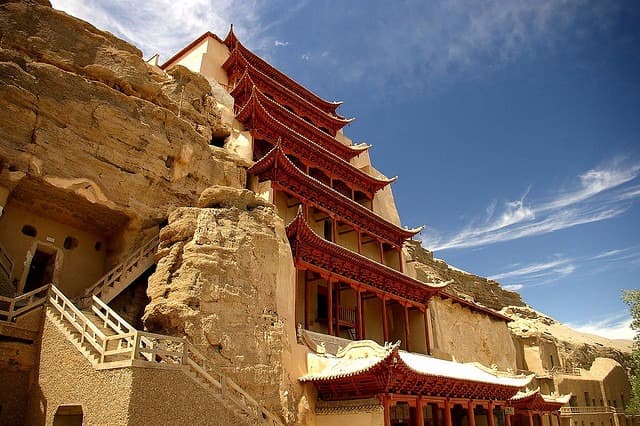
- the large seated Buddha statues, including the colossal Buddha in cave 96, sheltered by the emblematic nine-storey pagoda of the site;
- the reclining Buddha in cave 148, several metres long, surrounded by his mourning disciples;
- the narrative frescoes of Northern Wei and Tang periods, particularly jataka scenes and apsara musicians in flight;
- cave 17, known as the "library grotto", emptied of its manuscripts but essential for understanding the history of the place.
The visit always begins at the Digital Exhibition Center, a few kilometres from the site, with two short films presenting the history of Mogao and reconstructing in immersion several caves closed to the public. A shuttle then takes visitors to the foot of the cliff.
Practical information
Since 2014, access has been strictly regulated to preserve the fragile pigments: attendance is capped at around 6,000 visitors per day during peak season. Prior booking is mandatory, ideally 7 days in advance for individuals and 15 days for groups, through the official Dunhuang Academy website.
- Duration of visit: allow 3 to 5 hours in total, including Digital Center and caves.
- Admission fees: full price ticket during peak season (May-October), reduced rate during low season; discounts for students with valid ID. Check updated prices before departure.
- Opening hours: daytime opening year-round, with extended hours April to October. Check official hours before your visit.
- Photography prohibited inside the caves.
- Guided commentary is provided in Chinese; a few slots in English are available, to be reserved in advance.
When to visit
Dunhuang has a continental desert climate. The summers (June-August) are hot and dry, with daytime temperatures frequently exceeding 35°C; this is also China's peak tourist season, with quotas filling quickly. The winters (December-February) are harsh, sometimes dropping to -10°C, but the site remains open and far less crowded.
The most comfortable periods are May-June and September-October: mild temperatures, clear skies and ideal light on the ochre cliffs. Avoid the "Golden Week" in early October, when visitor numbers surge.
How to get there
The site is located approximately 25 km from Dunhuang city centre. Several options are available:
- Local buses: regular minibuses connect Dunhuang to the site at modest rates. This is the most economical option.
- Taxi or ride-sharing: journey of around thirty minutes from the city centre or railway station. Negotiate or insist on metre use.
- Air or rail: Dunhuang has an airport with connections to Xi'an, Lanzhou and Beijing, as well as a railway station (high-speed line from Lanzhou).
The mandatory stop at the Digital Exhibition Center, on the city outskirts, is the departure point for all visits: this is where you must present yourself with your booking.
Nearby
Mogao is part of a series of complementary sites around Dunhuang:
- the Mingsha Shan dunes and the Crescent Lake (Yueyaquan), on the southern edge of the city, particularly spectacular in late afternoon;
- the Yumen and Yang passes, ancient Han fortresses marking the western frontier of the empire;
- the Yulin Caves, a Buddhist complex related to Mogao, far less crowded;
- Dunhuang's night market, for Gansu cuisine.
To extend your itinerary to other highlights of Chinese Buddhism, you might consider the Great Wild Goose Pagoda in Xi'an or the Great Buddha of Leshan in Sichuan.
Frequently asked questions
Frequently asked questions
Yes, booking is mandatory. Allow 7 days in advance for individual visits and 15 days for groups. The daily quota is capped at around 6,000 visitors during peak season and fills quickly from July to October.
Approximately thirty caves are open on a rotating basis, but each guided tour covers only about ten, selected by the guide. The Digital Exhibition Center allows you to discover others in high-definition digital form.
May-June and September-October offer the most pleasant conditions. Avoid the "Golden Week" in early October, which is very crowded, as well as the height of summer when temperatures exceed 35°C.
Allow 3 to 5 hours in total: introductory films at the Digital Center, shuttle transfer, guided cave tour and free exploration of the site.
No, photography is prohibited inside the sanctuaries to protect the pigments. It is permitted outside, on the cliff and around the nine-storey pagoda.
Plan your trip
The Mogao Caves are a key stop on an itinerary along China's Silk Road, between Xi'an, the Hexi Corridor and Xinjiang. To build a tailor-made journey including Dunhuang and the region's Buddhist sites, consult our Chine travel suggestions.
Interested in this visit?
We can include it in your personalised itinerary.