Chen Clan Ancestral Hall
Chen Clan Ancestral Hall
Built in 1894 by the Chen clan, this Cantonese complex of 19 buildings in Guangzhou brings together seven traditional decorative arts of southern China.
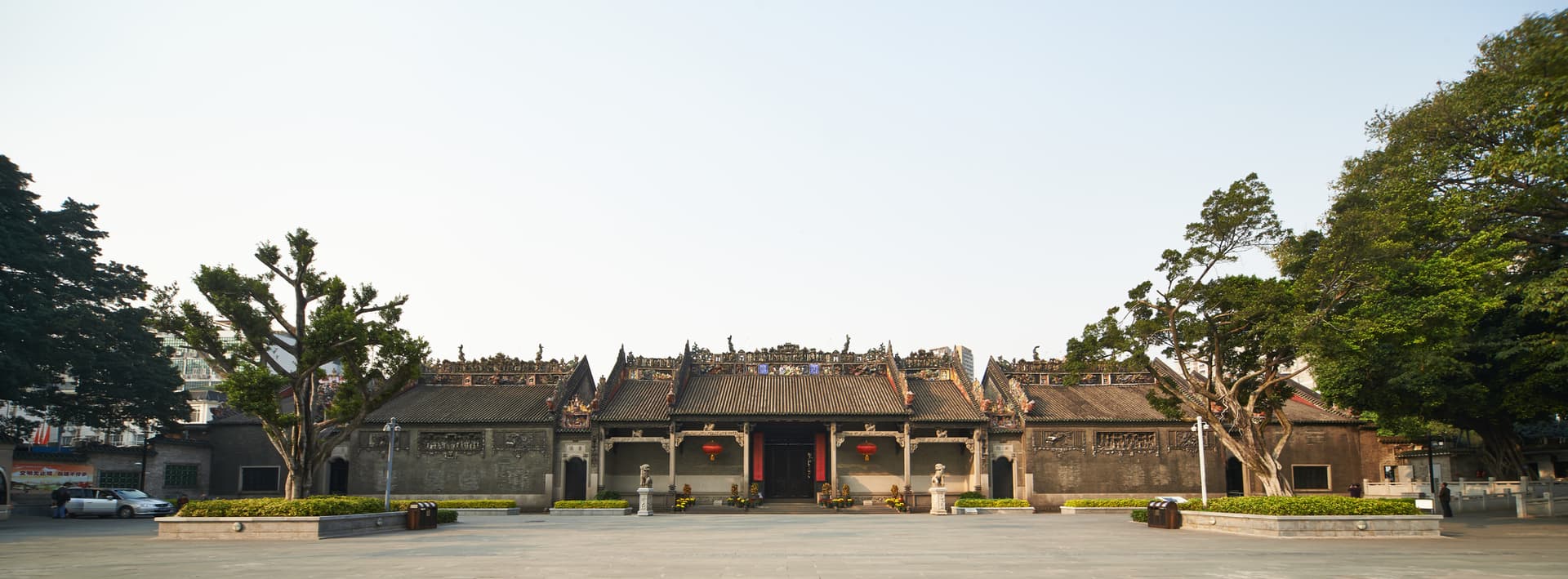
The Chen Clan Ancestral Hall (Chen Jia Ci) is one of the largest preserved examples of Cantonese clan architecture in China. Located on Zhongshan Avenue in Guangzhou, this complex spanning over 10,000 m² comprises 19 buildings in traditional Lingnan style, renowned for their wood carvings, ceramic friezes and ornate roofs.
Why visit Chen Clan Ancestral Hall
The site offers three compelling reasons. From an architectural standpoint, it brings together the seven traditional decorative arts of southern China: wood carving, stone carving, brick carving, iron casting, clay moulding, Shiwan ceramic friezes and wall paintings. Historically, it testifies to the power of major Cantonese clans during the late Qing dynasty. Today it houses the Guangdong Museum of Folk Art, which presents regional craftsmanship collections within a heritage-listed setting. Plan on 1.5 to 2 hours for your visit.
History of the hall
Built in 1894 by the Chen clan during the Qing dynasty, the complex was conceived as a shuyuan—both an ancestral temple for clan worship and an academy to prepare young men of the clan for imperial examinations. The construction, financed by residents of over 70 surrounding villages where the Chen lineage dominated, was completed in just four years—a remarkable feat for such a vast undertaking.
The site survived Mao's Cultural Revolution of 1966 without major destruction, making it one of the few clan complexes of this quality still visible in Guangdong. Its transformation into a folk art museum as early as 1959 helped preserve it. The hall is today listed as part of China's national heritage.
What to see on-site
Ceramic roof friezes
The long roof ridges of the main buildings feature polychrome ceramic friezes from Shiwan, depicting Cantonese operas, mythological scenes and historical figures. These ensembles, stretching several metres in length, rank among the finest in southern China.
Wood and stone carvings
Porticoes, beams and interior screens are adorned with relief scenes: battles from the Three Kingdoms, floral motifs, dragons and phoenixes. The stone bas-reliefs on entrance pillars and carved bricks on side walls warrant close inspection.
The main hall and courtyards
The central axis is organised around a grand ancestral hall flanked by two interior courtyards. The courtyards feature Chinese parasol trees and bonsai, with layouts typical of Lingnan residential architecture: covered galleries, carved openings, upturned roof eaves.
Craftsmanship collections
The side galleries display carved ivory pieces, Cantonese embroidery, porcelain, as well as jade and enamel objects. Labels are provided in Chinese and English.
Practical information
- Address: No. 7 Zhongshan Avenue, Liwan District, Guangzhou.
- Hours: open daily with continuous service. Last entry approximately 30 minutes before closing.
- Admission: modest entrance fee (equivalent to a few euros per person).
- Duration of visit: 1.5 to 2 hours.
- Best time: weekdays and mornings to avoid tour group crowds.
How to get there
The easiest way is by metro: Line 1, Chenjiaci station. Exit D leads directly to the main entrance of the hall; Exit C opens onto Chenjiaci Square, just a few steps away. Several bus lines also serve the area (Chen Jia Ci and Zhongshan Ba Lu stops); information is updated at the station. A taxi from central Guangzhou takes about twenty minutes depending on traffic.
Nearby attractions
The Liwan neighbourhood, surrounding the hall, retains shopping lanes and traditional Cantonese houses. A short metro ride away, you can extend your day at Shangxiajiu pedestrian street, Liwan Park or the Sun Yat-sen Memorial. To expand your itinerary across China, the Great Goose Pagoda in Xi'an and the Great Wall at Juyongguan near Beijing offer two other major landmarks of Chinese architectural heritage.
Frequently asked questions
Frequently asked questions
Allow 1.5 to 2 hours to explore the 19 buildings, observe the ceramic friezes and visit the craft galleries. Architecture enthusiasts may spend a half-day here.
No. Since 1959, the complex has housed the Guangdong Museum of Folk Art. The ancestral hall is preserved for heritage purposes but no longer hosts regular ceremonies.
Main labels are bilingual in Chinese and English. No signage in other languages is provided; an English-language audioguide is available at the entrance.
Access to the main courtyards is level, but some stone thresholds and passages between pavilions remain elevated. Part of the route is negotiable in a wheelchair with assistance.
Yes. The Liwan neighbourhood, Shangxiajiu Street and Liwan Park are all within 15 minutes by metro and easily combine for a half-day itinerary.
Planning your trip
Chen Clan Ancestral Hall fits naturally into a circuit dedicated to southern China, between Guangzhou, Hong Kong and traditional villages of Guangdong. To build a custom itinerary incorporating clan heritage, Cantonese cuisine and Lingnan landscapes, explore our China travel packages.

Interested in this visit?
We can include it in your personalised itinerary.