Ganluyan Temple
Ganluyan Temple
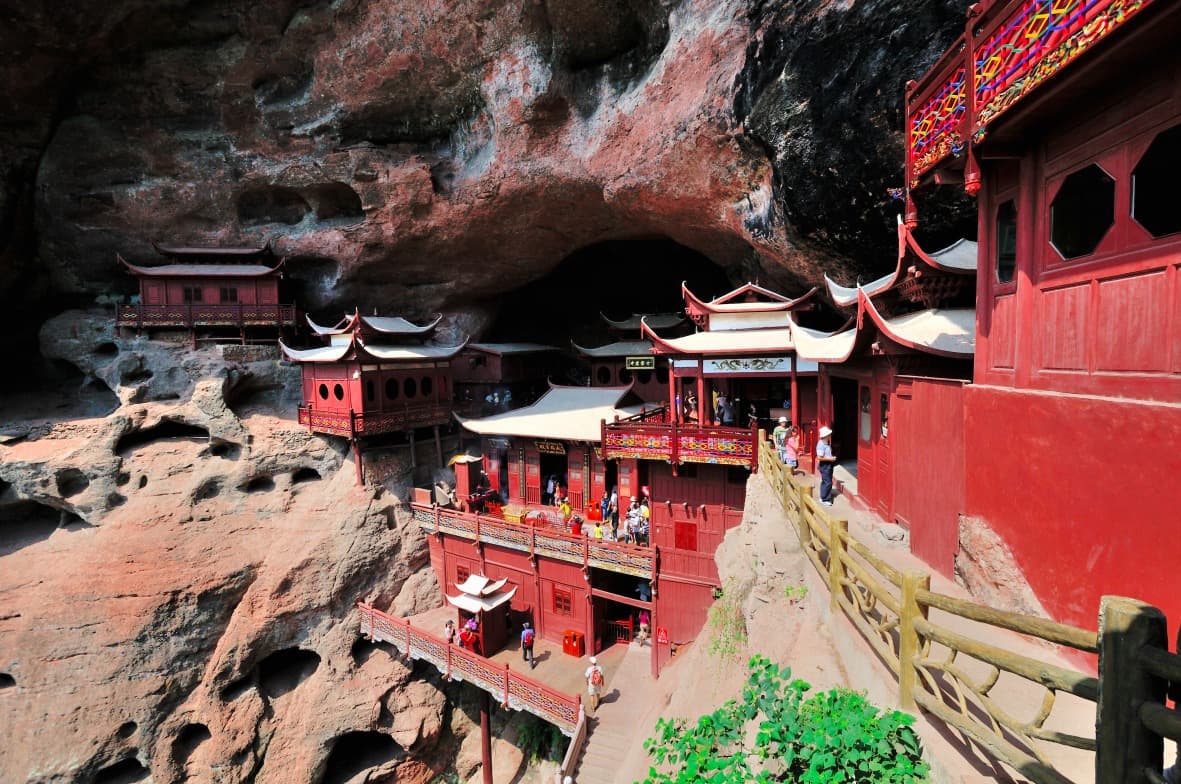
Built in 1146 within an inverted-pyramid cave on Mount Changtanrenxing, Ganluyan Temple is nicknamed the Hanging Monastery of the South in Fujian.
The Ganluyan Temple nestles within a natural cavity of Mount Changtanrenxing, on the western shore of Golden Lake, in Taining County (Fujian Province). Nicknamed the "Hanging Monastery of the South," this Buddhist sanctuary stands out for its wooden architecture hugging the rocky cliff face, constructed without nails or vertical load-bearing pillars.
Why Visit Ganluyan Temple
The temple combines three compelling reasons for the journey to Taining:
- An architectural marvel: each of the four buildings rests on a single master timber beam, and the roofs are assembled by interlocking joints, without conventional nails or ridge beams.
- A remarkable geological setting: the Min Danxia cave, which houses the temple, forms an inverted pyramid 80 metres high, characteristic of the Danxia landform inscribed as a Unesco World Heritage site.
- Dense historical significance: built in the 12th century, the site sheltered major 20th-century political figures, including Zhou Enlai and Zhu De.
History
Ganluyan Temple was constructed in 1146, during the Shaoxing era of the Southern Song Dynasty. Its founding reflects the tradition of Chan Buddhist sanctuaries built into cliffsides, which favoured spectacular natural settings for meditation.
Under the Qing Dynasty and during the early decades of the People's Republic of Chine, several complex structures served as residences for prominent political figures: Zhu De, military leader and statesman, Zhou Enlai, Premier, Peng Dehuai, military commander and politician, and Yang Shangkun, former President of the People's Republic. The site has been designated a provincial cultural heritage site since 1950.
What to See On-Site
The Min Danxia Cave
The temple is entirely contained within this cavity of Mount Changtanrenxing. The cave forms an inverted pyramid 80 metres high and 30 metres deep. Its upper opening exceeds 30 metres in width, while its base measures only about ten metres. This configuration has sheltered the buildings from the elements for nearly nine centuries.
The Four Buildings
The complex comprises four structures in red-painted wood:
- The main hall, accessible via steep steps from the cave floor;
- The Chun Pavilion;
- The Guanying Pavilion, dedicated to the Bodhisattva of Compassion;
- The Nan'an Pavilion.
Each building rests on a single timber beam and features layered roofs with slightly upturned eaves, assembled by interlocking joints. This technique, unique to Southern Song carpenters, dispensed with nails and spikes.
The Sheng Sheng Long Stalactite
Within the temple, a seeping stalactite hanging from the vault gives the place its name: Ganluyan evokes "sweet dew." Nicknamed Sheng Sheng Long ("drip by drip"), it symbolically feeds the sanctuary with water.
Practical Information
- Admission: modest entry fee, usually included in the Golden Lake geological park ticket.
- Hours: open during daytime, from morning until late afternoon. Check seasonal hours at the park entrance.
- Duration: allow 1 to 1.5 hours to explore the temple, longer if combined with a lake cruise.
- What to bring: shoes with good grip (steep steps and wet stone), water, windproof layer for shoulder seasons.
When to Visit
The site is open year-round, though Taining's weather largely determines comfort:
- Spring (April–May): lush vegetation, morning mists over Danxia reliefs, mild temperatures. Ideal season.
- Autumn (September–November): clear skies, sharp light on red cliffs, moderate crowds.
- Summer: humid heat and showers, but surrounding waterfalls at their peak.
- Winter: visitable but slippery stones and short days.
Avoid major Chinese holidays (National Day week in early October, Lunar New Year), when the site becomes crowded.
How to Get There
The temple lies within Golden Lake Park (Jinhu), about ten kilometres from Taining town.
- By train: Taining station is served by the Xiangtang–Putian high-speed line, with connections from Fuzhou, Xiamen and Nanchang.
- From the station: local buses link Taining town centre to the Golden Lake pier in roughly thirty minutes.
- On-site: access to the temple is by boat from the pier, followed by a short climb up stairs.
Road links also exist from Shanghai, Nanjing and Suzhou, though with lengthy travel times.
Nearby
The temple pairs well with other sites in Taining's World Geological Park, a Unesco Geopark:
- A cruise on Golden Lake showcases the red sandstone cliffs typical of Danxia terrain.
- The Zhaixia canyon and Shangqing valley offer hiking and boat descent.
- To further explore reliefs and caves in Chine, see also Longgong Cave and Hexigten Geopark.
- For Buddhist heritage, the Great Wild Goose Pagoda in Xi'an and the Bezeklik Thousand Buddha Caves complete a thematic itinerary.
Frequently Asked Questions
Frequently asked questions
Like the famous Xuankong Hanging Monastery in Shanxi, its buildings appear suspended from the rock face. Here, they are lodged within an inverted-pyramid cave and each rests on a single load-bearing beam, enhancing the suspension effect.
It was built in 1146, during the Shaoxing era of the Southern Song Dynasty, giving it nearly nine centuries of existence.
One to one and a half hours suffice for the temple alone. Plan half a day to a full day if combining with a Golden Lake cruise and visits to other geopark sites.
Yes, it is an active Buddhist sanctuary, designated a provincial cultural heritage site since 1950. Respectful dress is recommended and certain prayer areas remain quiet.
Yes, though signage is primarily in Chinese. An English-speaking guide helps clarify architectural and historical details, particularly connections to 20th-century political figures.
Include the Temple in Your Itinerary
Ganluyan Temple fits naturally into a circuit through Fujian or a thematic loop around Danxia reliefs. To plan a bespoke itinerary blending Buddhist heritage, geoparks and historic towns, consult our Chine journeys.
Interested in this visit?
We can include it in your personalised itinerary.