Maijishan Grottoes (Maijishan Shiku)
Maijishan Grottoes (Maijishan Shiku)
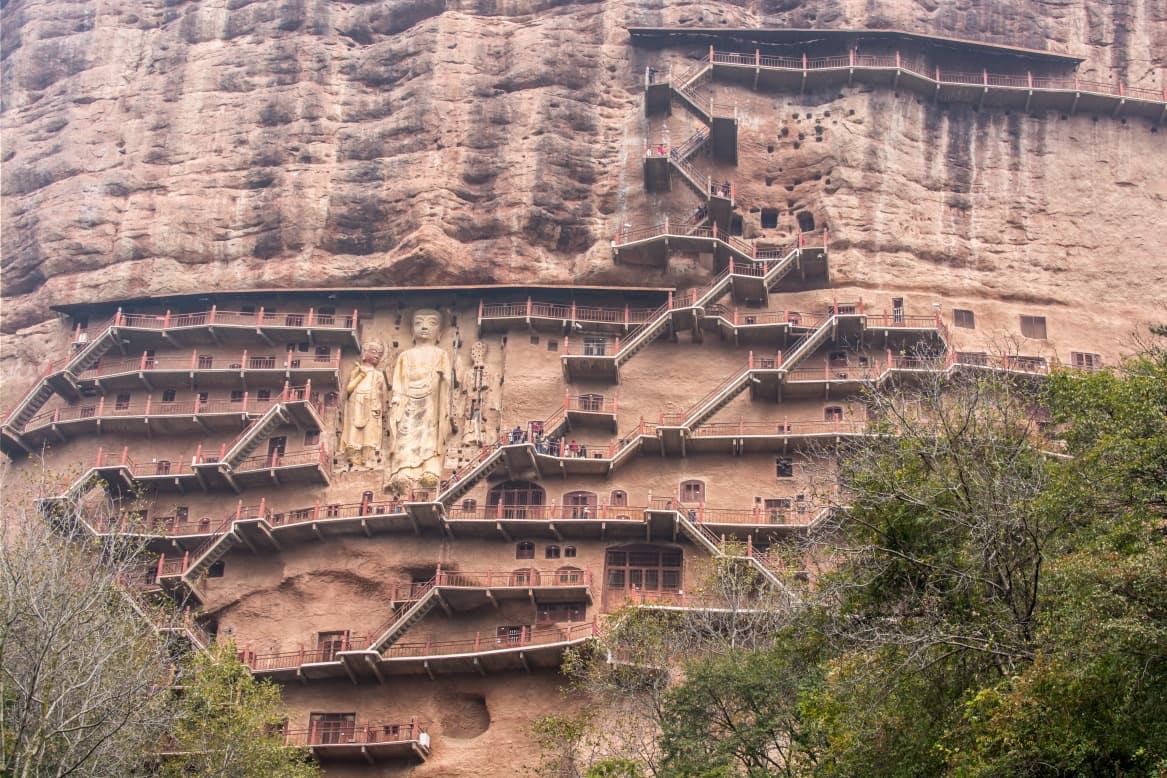
Carved into a rocky peak 45 km from Tianshui, the Maijishan Grottoes house more than 7,000 Buddhist sculptures across 194 cavities, linked by suspended walkways above a pine forest.
Carved into a rocky outcrop shaped like a haystack, the Maijishan Grottoes rise some forty kilometers southeast of Tianshui, in Gansu Province. This Buddhist site shelters more than 7,000 sculptures and murals spread across 194 grottoes, carved between the 4th and 19th centuries. Less crowded than Dunhuang or Longmen, it offers a more intimate experience on forested cliffs.
Quick Facts
- Admission: Paid entry (site ticket + extra fee for certain special grottoes)
- Access: Bus from Tianshui main bus station or taxi; the road winds through pine forest
- Recommended duration: 3 to 4 hours for a complete catwalk tour
- Attire: Closed-toe shoes required — metal walkways are narrow and suspended high above ground
- Closing time: The site closes late afternoon; check seasonal hours on-site
What to See
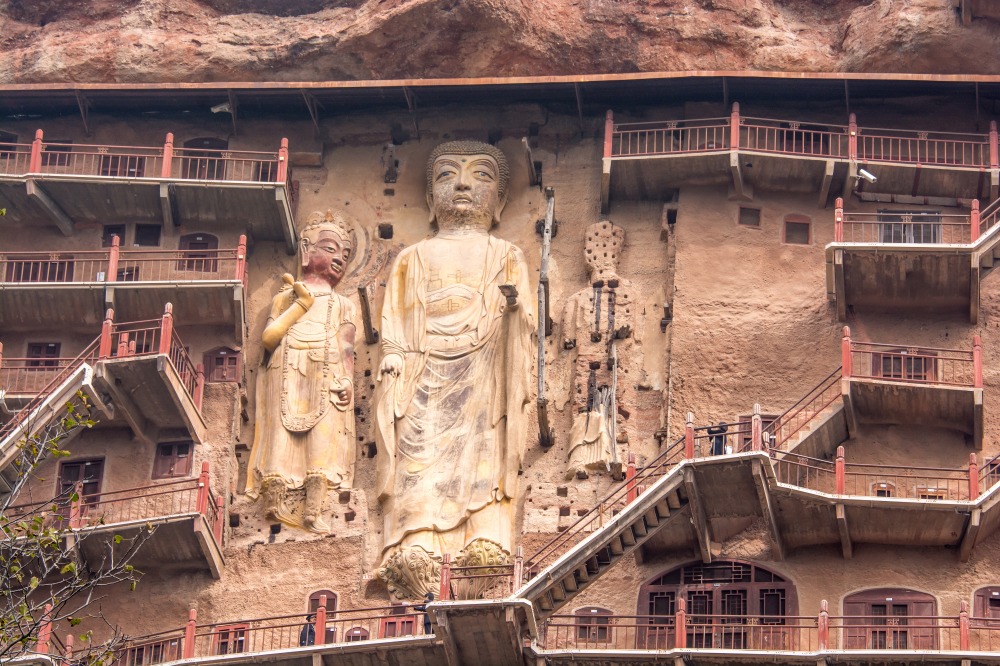
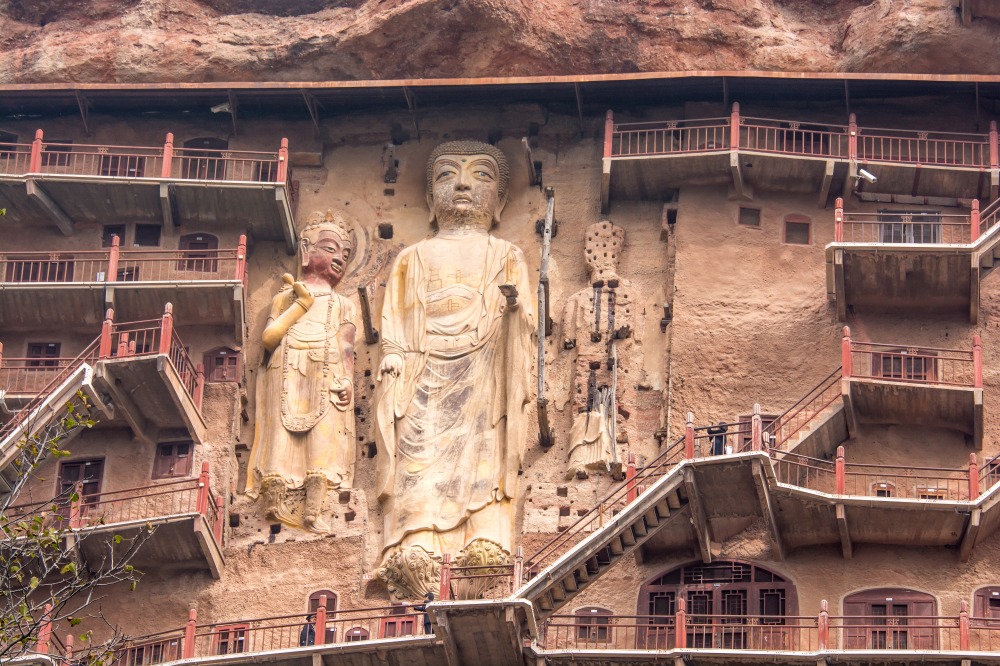
The cliff face is traversed by suspended metal catwalks clinging to the rock, linking the grottoes across multiple levels. Sculpture dominates the experience: hand-modeled clay, painted stucco, colossal Buddhas, and bodhisattvas with remarkably delicate features. Styles shift noticeably from grotto to grotto, reflecting the Northern Wei, Sui, Tang, and Song dynasties.
Two giant Buddhas carved in high relief on the main façade are visible from the base of the site without entering the grottoes. The interiors of certain cavities preserve murals with pigments still vivid.
History and Context
The first carving campaigns date to the period of the Sixteen Kingdoms (4th century), when Buddhist monks chose this isolated cliff face. The site flourished under the Northern Wei, considered its sculptural golden age. An earthquake in the 8th century fractured the cliff into two distinct massifs, creating the current configuration. Work continued nonetheless through the Qing dynasty.
Maijishan ranks among China's four great Buddhist grotto complexes, alongside Dunhuang, Longmen, and Yungang. Its UNESCO World Heritage inscription forms part of the Silk Road cultural corridor recognized in 2014.
Highlights of Your Visit
The Suspended Catwalks
The network of metal galleries clinging to the cliff face is an experience in itself. You climb from grotto to grotto with plunging views over the pine forest below. The sheer verticality of the route is breathtaking.
The Buddhas on the Western Façade
Two colossal high-relief sculptures dominate the cliff wall: a seated Buddha and a standing figure, dating from the Northern Wei and Zhou dynasties. Their scale contrasts strikingly with the delicate figurines inside the grottoes.
The Northern Wei Period Grottoes
Cavities from this era showcase faces with elongated features and the archaic smiles characteristic of the period. The preservation quality of the painted clay is remarkable for an open-air site.
The Surrounding Forest
The rocky peak rises from a dense forest of pines and cypresses. The vegetation creates an atmosphere quite different from grotto sites in desert zones. In autumn, foliage colors frame the ochre cliff.
Etiquette and Visiting Rules
- Photography is prohibited inside most grottoes; check signage at each entrance.
- Do not touch sculptures or painted walls.
- Some grottoes are accessible only with an official site guide.
- Silence is expected in spaces still used for worship.
Photography Tips
Morning light illuminates the main façade head-on — arrive early to avoid backlighting. From the upper catwalks, a wide-angle lens captures both the cliff and forest below in one frame. The exterior Buddhas are freely photographable; inside, respect posted restrictions.
Location and Access
The site sits in Maiji District, roughly 45 km southeast of central Tianshui. Regular buses depart from Tianshui's main bus station. Tianshui itself is reached by train from Xi'an (about 3 hours on high-speed rail) and Lanzhou. The site parking lot is at the cliff base; ascent is on foot via a constructed trail.
Accessibility for visitors with reduced mobility is limited: the catwalks feature numerous steps and steep sections.
In the Vicinity
- Fuxi Temple — a Daoist temple dedicated to the mythical god Fuxi, in central Tianshui, with a courtyard planted with thousand-year-old cypresses.
- Mogao Grottoes (Dunhuang) — China's largest Buddhist grotto complex, several hours west along the Silk Road.
- Bingling Grottoes — a Buddhist grotto site accessible from Lanzhou, on the banks of the Yellow River.
Frequently asked questions
Spring (April–May) and autumn (September–October) offer the best conditions: mild temperatures and colorful vegetation around the cliff. Summer is humid and can make the catwalks slippery.
Photography is prohibited in most grottoes to protect the pigments. Exterior sculptures and the façade Buddhas are freely photographable.
Certain special grottoes are accessible only with an official site guide, for an additional fee. For the standard catwalk route, self-guided visits are possible.
No. The suspended catwalks feature numerous steps and steep sections. The view of the exterior Buddhas from the base of the site remains accessible without climbing.
Tianshui sits between Xi'an and Lanzhou on the main rail line. A one-night stop in Tianshui allows you to visit Maijishan and Fuxi Temple before continuing to Lanzhou and the Bingling Grottoes.
Interested in this visit?
We can include it in your personalised itinerary.