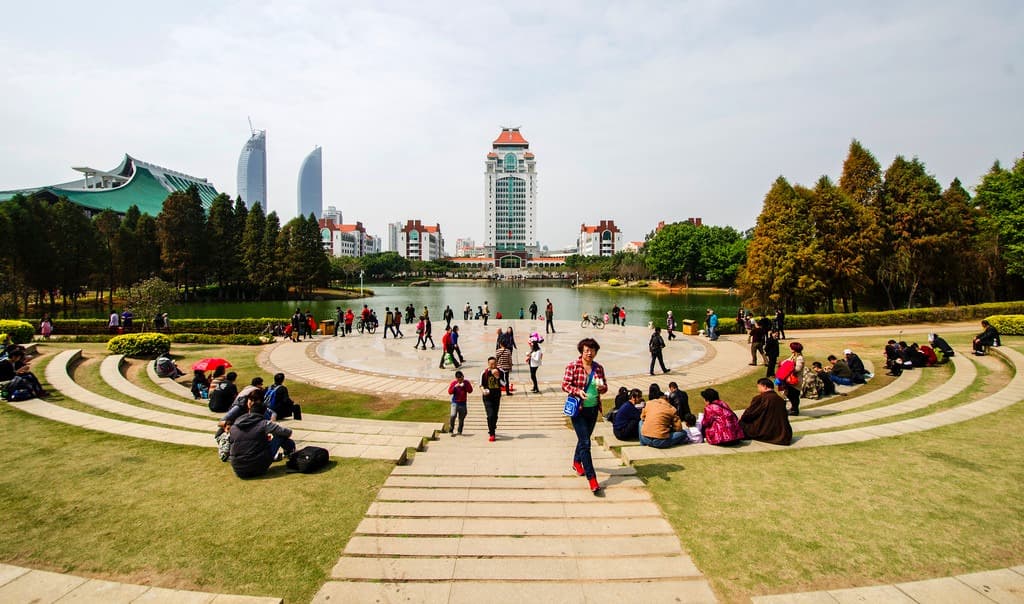
Xiamen University
Xiamen University
Founded in 1921 thanks to the Chinese diaspora from Fujian, Xiamen University is one of the most visited campuses in Chine, just steps away from Nanputuo Temple.
Founded in 1921 on the southern coast of Xiamen island, Xiamen University (Xiada) regularly features in rankings of Chine's most pleasant campuses to visit. Its architecture blends pavilions with curved roofs, colonial buildings and tree-lined promenades overlooking the sea, just steps away from Nanputuo Temple and Hulishan Fortress.
Why visit Xiamen University
The campus stands out for three elements: rare architectural heritage on mainland Chine, blending traditional Chinese style with Western influences; the atmosphere of a student town with its canteens, corner shops and terraces; and a privileged location, in the immediate vicinity of several major Xiamen sites and a beach accessible on foot.
The visit will appeal to travellers interested in the history of the Chinese diaspora and early twentieth-century architecture, as well as those seeking a peaceful interlude between two cultural stops.
A foundation carried by the diaspora
The university was founded in 1921 by Tan Kah-Kee (Chen Jiageng), a Chinese industrialist based in Singapore and a major figure in the Fujian diaspora. Its construction was financed by subsidies from overseas Chinese, mainly from southern Fujian, who wanted to provide their region of origin with a leading higher education institution.
Several buildings were damaged or destroyed during the Second World War, during the Japanese occupation of the region. Tan Kah-Kee personally financed their reconstruction after the conflict, perpetuating the original architectural style recognizable by its Chinese roofs placed on structures inspired by Western architecture.
Today, Xiada welcomes around 40,000 students, including several thousand international students, on a campus of approximately 160 hectares that remains one of the best preserved in Chine.
What to see on campus
- The historic Qunxian buildings: a group of original pavilions, identifiable by their green-tiled roofs and light-coloured stone facades.
- Furong Lake and its maintained gardens, with shaded pathways and waterside benches.
- The Furong tunnel, an underground passage entirely covered with frescoes painted by students, which has become a renowned photo spot.
- The student canteen and its terraces, which give a glimpse of daily life on campus.
- The university's anthropology museum, interesting for its collections on the peoples of south-eastern Chine.
Practical information
Campus access for visitors has been regulated for several years. The university enforces daily quotas and, in practice, requires prior booking through an online platform (often in Chinese, sometimes accessible to foreigners with a scanned passport). Conditions change regularly: it is advisable to check the arrangements with your accommodation or local agency just before your visit.
- Entrance: free, but subject to registration.
- Identification: passport required to pass through the gates.
- Duration of visit: allow 1h30 to 2h30 to explore the main points of interest.
- Busy periods: weekends and Chine school holidays, when quotas fill up quickly.
The campus remains an active place of study: visitors are asked to stay in outdoor areas and not enter teaching buildings.
How to get there
The university is located in the south-west of Xiamen island, in the Siming district. Bus No. 1 serves the main entrance directly from the city centre. Several other lines (2, 22, 29, 47) serve the campus perimeter. By taxi or VTC, ask for the west gate (Xi Men) or the south gate (Nan Men) depending on your visit schedule.
From the main entrance, Daxue Lu Street runs along the south of the campus with its student cafés and shops, and a beach is accessible on foot in about ten minutes.
Nearby
- The Nanputuo Temple, a Buddhist sanctuary nestled against the hillside just north of the campus.
- Hulishan Fortress, a late nineteenth-century coastal fortification.
- The pedestrian island of Gulangyu, accessible by ferry from Xiamen city centre.
- To extend your discovery of south-eastern Chine, you can complement it with the Lingyin Temple in Hangzhou or the West Lake.
Planning your trip
Xiamen University fits naturally into a day combining Nanputuo Temple, the campus and Daxue Lu Street, before a crossing to Gulangyu. To build an itinerary that incorporates Fujian and other regions of Chine, consult our suggestions on travel in Chine.

Interested in this visit?
We can include it in your personalised itinerary.