Symbolism of the Dragon in Chinese Culture
While in the West, dragons are cruel and destructive beings, in Asia and particularly in Chine, this mythical creature is surrounded by an extremely positive aura. An exploration of this symbol of Chinese culture.
While in the West, dragons are cruel and destructive beings, in Asia and particularly in Chine, this mythical creature is surrounded by an extremely positive aura. Here is an exploration of this symbol of Chinese culture.
The Dragon
Pinyin: lóng
Simplified character: 龙
Traditional character: 龍
General Overview
The dragon is both a mythological and folkloric creature in Chine. Present in the founding myths of Chinese civilization—the Great Yu famously received assistance from one of these creatures—Chinese dragons, or Long, are vastly different from their Western "cousins."
While the latter are malevolent beings in European medieval legends, the dragons of Chine and by extension Asia are generally benevolent creatures, though Buddhist thinkers introduced the idea that some dragons could be responsible for destruction following human transgressions.
Powerful and wise, like their Western counterparts, Chinese dragons have two other fundamental differences: their elongated form and the element with which they are most often associated—water.
In Chinese popular beliefs, the Dragon is thus the divinity of aquatic phenomena—waterfalls, rivers, and seas—and determines droughts and floods. They are sometimes even reputed to master the climate, particularly rain, and can possess numerous supernatural powers according to the source of the legends...
In primitive times, most villages, particularly those near a water source, were required to possess a temple dedicated to their local dragon, so as to offer it sacrifices in times of crisis to obtain its aid or forgiveness.
As one of the four sacred animals of Chine alongside the Phoenix (Fenghuang), the Qilin (Qilin), and the Tortoise, the Dragon represents power and talent, so much so that brilliant individuals are often called dragons.
Due to its extremely positive connotation, the dragon became the symbol of emperors and subsequently of Chinese culture as a whole.
However, Chinese authorities, fearing the dragon's negative image in the West, today prefer to promote more endearing "mascots" such as the panda. Nevertheless, the population remains deeply attached to the dragon's image, particularly in astrology: the Dragon sign is one of the most popular and sought-after because it symbolizes power and success. In fact, it is during dragon years that birth rates are highest in Chine...
Note:
- In triad circles, dragon tattoos carry serious significance. It is said that only the powerful can afford such motifs; otherwise, the mythical creature risks consuming its unworthy bearer.
- The Kowloon district in Hong Kong means Nine Dragons
The Appearance of the Chinese Dragon
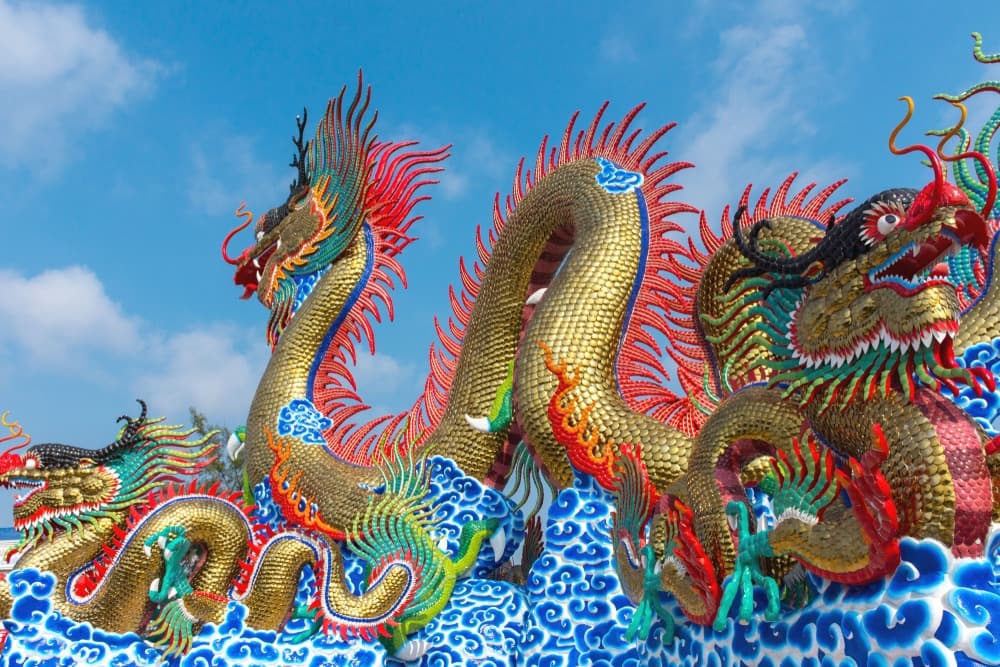
The appearance of the Eastern, and therefore Chinese, dragon differs greatly from that of the Western dragon. Elongated like a serpent and equipped with four legs, it blends the features of several animals: antlers of a deer, head of a camel, eyes of a demon, neck of a serpent, belly of a mollusk, scales of a carp, claws of an eagle, legs of a tiger, ears of a cow.
The pearl sometimes seen beneath the chin symbolizes well-being, luck, and prosperity. However, most Chinese dragons have no wings, and their ability to fly stems from mystical power.
The Origins of the Dragon in Chinese Culture
It is difficult to determine how the dragon myth was forged in Chine, and the only answers can come from primitive cultures: it may be the result of a fusion of totems from different tribes, notably by combining animals such as the serpent and the fish.
Another hypothesis suggests that the Chinese dragon may have been inspired by the saltwater crocodile, the largest reptile alive today. In ancient times, crocodiles were indeed perceived as a variety of dragon...
The Dragon Myth
Chinese tradition holds that there are four great dragon kings, each corresponding to one of the seas surrounding the Middle Kingdom: the East Chine Sea for Ao Guang, the South Chine Sea for Ao Qin, the West Chine Sea (the Indian Ocean) for Ao Run, and the North Chine Sea (Lake Baikal) for Ao Shun.
Symbol of the Emperor
Several legends link the mythic emperors Yan Di and Huangdi to the Chinese dragon. Huangdi, for example, was said to have been immortalized in the form of the legendary creature. Subsequently, it became the symbol of emperors and even the emblem on the flag of the Qing dynasty. The emperors' wives, meanwhile, were associated with the Fenghuang, the Chinese Phoenix. To differentiate the emperor from his subjects, the Son of Heaven was the only one permitted to wear five-clawed dragon motifs, an image that today represents Chine in its entirety (the four-clawed dragon represents Korea, while the three-clawed dragon represents Japan).
The Dragon and Numbers
The Chinese attach great importance and meaning to numbers. It is therefore logical that the Dragon is associated with one of the most positive, the number 9. This is why it is considered to have 9 attributes and 117 scales: 81 yang and 36 yin (each a multiple of 9). In imperial palaces (such as in the Beihai Park in Beijing), one can find walls with nine dragons.
The Different Dragons
Here is a non-exhaustive list of some types of dragons famous in Chinese mythology and folklore.
- Tianlong (天龍 tiānlóng): the celestial dragon that guards the gates of Heaven
- Shenlong (神龍 shénlóng): divinity that controls the climate
- Fucanglong (伏藏龍 fúcánglóng): associated with volcanoes, it is the guardian of precious metals and jewels
- Dilong (地龍 dìlóng): dragon that controls rivers and seas
- Yinglong (應龍 yìnglóng): dragon associated with rains and floods, it supposedly aided the Yellow Emperor in slaying Chi You
- Jiaolong (蛟龍 jiāolóng): divinity of marine species
- Panlong (蟠龍 pánlóng): dragon of lakes that was unable to ascend to heaven
- Huanglong (黃龍 huánglóng): dragon symbolizing the emperor
- Feilong (飛龍 fēilóng): dragon that flies through clouds and mist
- Qinglong (青龍 qīnglóng): dragon associated with the East in Chinese symbolism, mythic creature linked to a constellation
- Longwang (龍王 lóngwáng): the dragon king who rules the four seas
- Longma (龍馬 lóngmǎ): creature that revealed the concept of the eight trigrams to Fuxi