Temple of Heaven
Beijing's express tour continues with some of the city's unmissable sites. With multiple temples and sumptuous palaces to choose from, you'll need to prioritize—and we've selected the most celebrated ones
Beijing's express tour continues with some of the city's unmissable sites. With multiple temples and sumptuous palaces to choose from, you'll need to prioritize—and we've selected the most celebrated ones. A journey through time awaits...
Temple of Heaven
Our first stop today is the Temple of Heaven (Temple of Heaven or Tiāntán), which is in fact a complex of Taoist temples, considered the largest of its kind in Chine. So it comes as no surprise that it was inscribed as a UNESCO World Heritage site in 1998. The entire complex is surrounded by a wall with a rectangular base symbolizing the Earth, crowned with a semicircle representing the Sky. Completed in 1420 under the Ming Dynasty—roughly at the same time as the Forbidden City—it is accessible via 4 entrances surrounding a vast park (Tiāntán Gōngyuán) covering more than 250 hectares. We arrived from the Tiantandongmen metro station and used the North Gate located on Tiantan Lu. Entry costs 35 yuan—15 yuan for park access alone—and grants admission to the 3 main attractions.
The Hall of Prayer for Good Harvests (Qíniándiàn)
The Imperial Vault of Heaven (Huángqióngyǔ) or Abode of the Lord of Heaven
The Altar of Heaven (Yuánqiūtán)
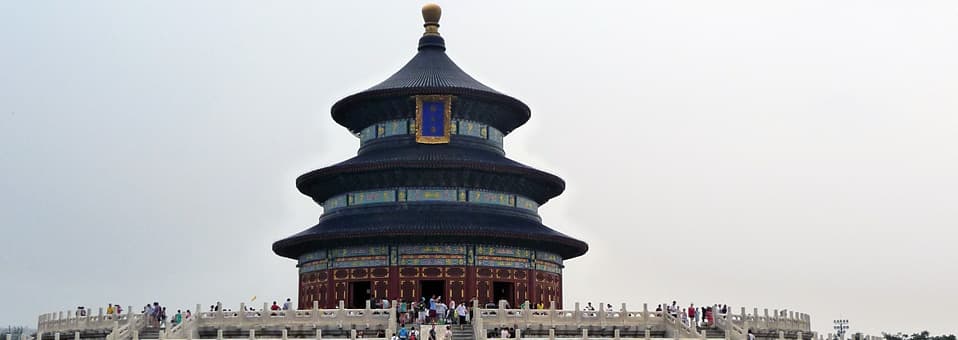
Entering via the North Gate, we were immediately confronted with the Hall of Prayer for Good Harvests, undoubtedly the most emblematic building in the complex and the jewel of the visit.
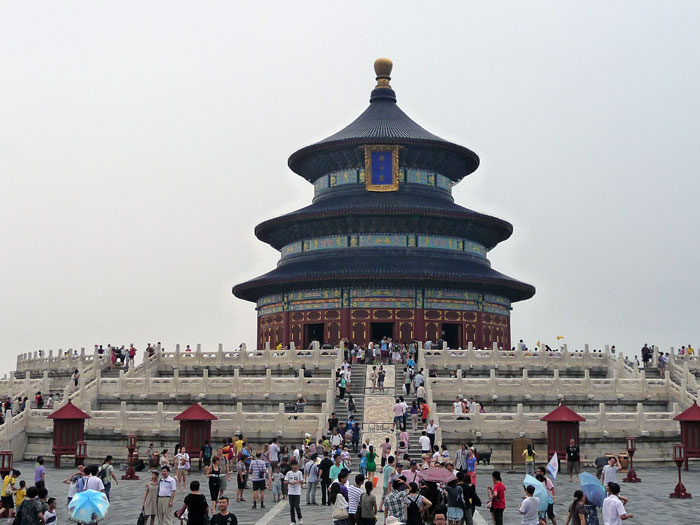
Built on three circular white marble terraces, this temple measures 30 meters in diameter and stands 38 meters tall. What's remarkable is that it was constructed entirely from wood and tiles, without a single nail. Yet this isn't the original building, as the original was struck by lightning in 1889 and destroyed by fire.
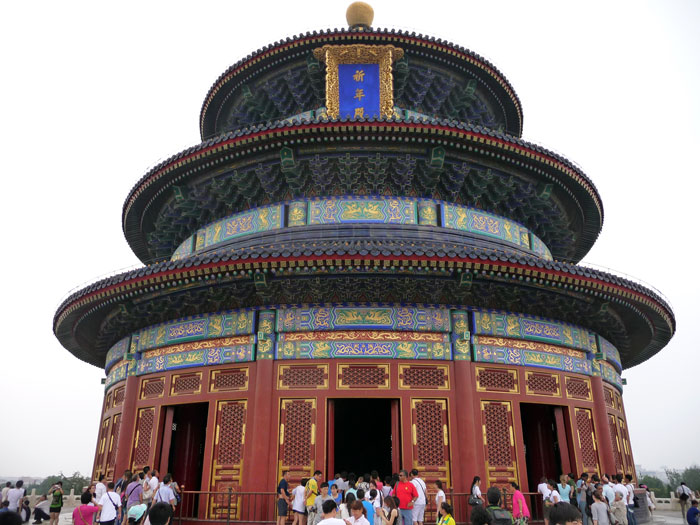
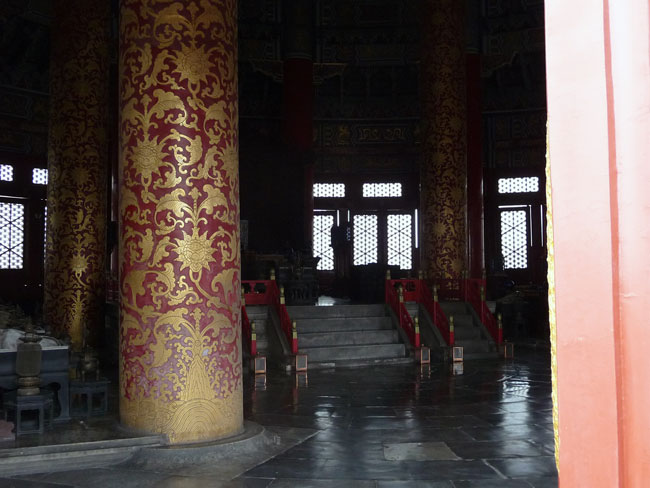
This structure lends itself to multiple celestial interpretations. It's said that the Emperor (the Son of Heaven) would come here to pray for good harvests for his people. The choice of colors is far from arbitrary—blue represents the sky, and green represents the Earth. Also noteworthy is the omnipresence of the number 9 (symbolizing the Sky, the Yang, and reserved for the Emperor) and its multiples, which appear throughout the temples' design, on the tiles, steps, and everywhere else. In short, a mecca of symbolism and symmetry for aspiring mathematicians!
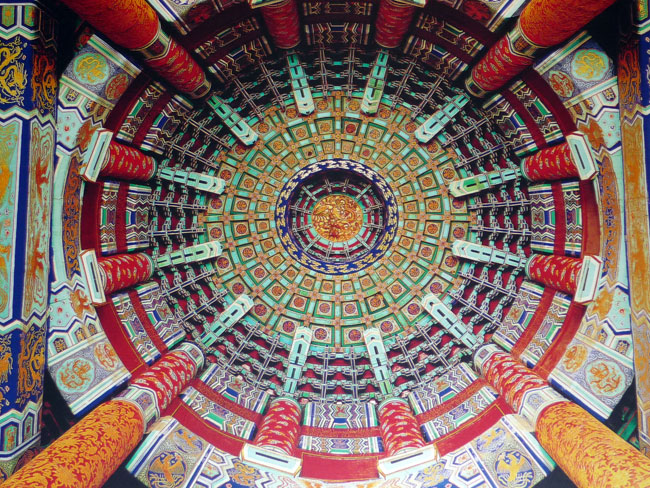

Below stands the Temple of the August Heaven (Huangqiandian), which has been converted into a museum.
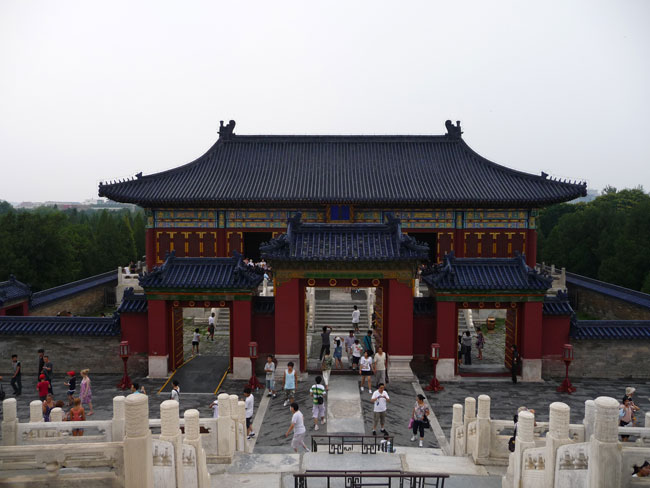
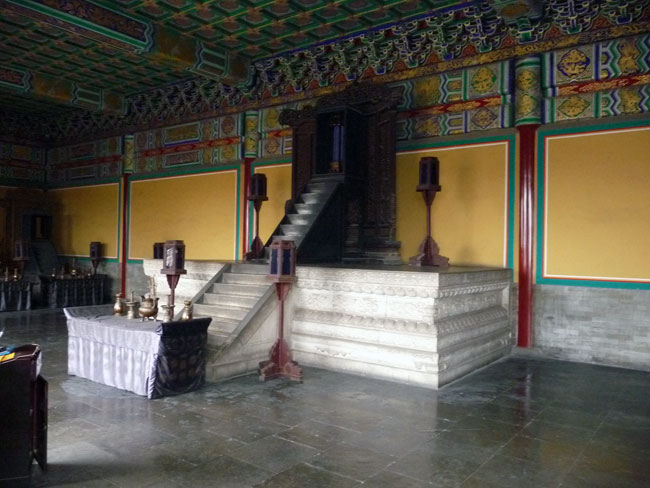
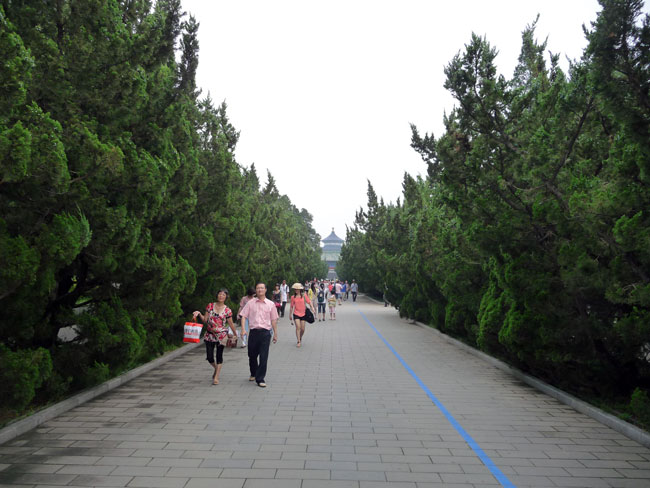
From here, we make our way to the Red Stairway Bridge, a 360-meter avenue leading to the Imperial Vault of Heaven, a miniature replica of the Hall of Prayer for Good Harvests we'd just visited.


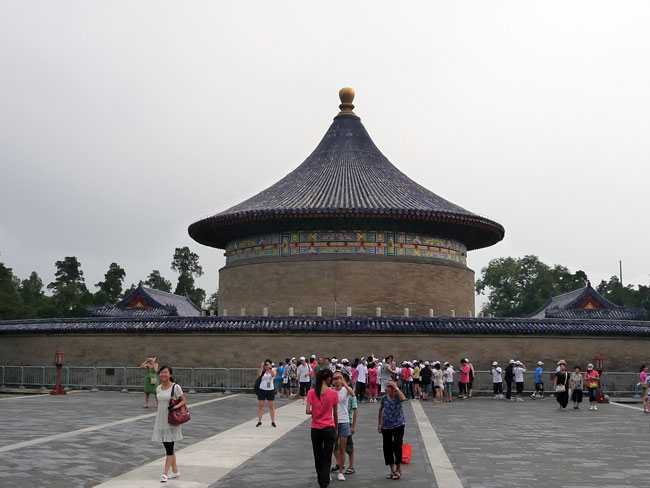
It is surrounded by the Echo Wall (Echo Wall), a unique circular structure built such that a person speaking along the wall will be heard clearly from the opposite side of the building. Given the number of Chinese tourists present, needless to say the experience wasn't particularly conclusive... Beyond that stands the Altar of Heaven (or Circular Altar), an open structure meant to echo the original earthen mound. Built in 1530, the altar comprises three concentric terraces surrounded by white marble balustrades, and represents the place where the emperor performed sacrifices.
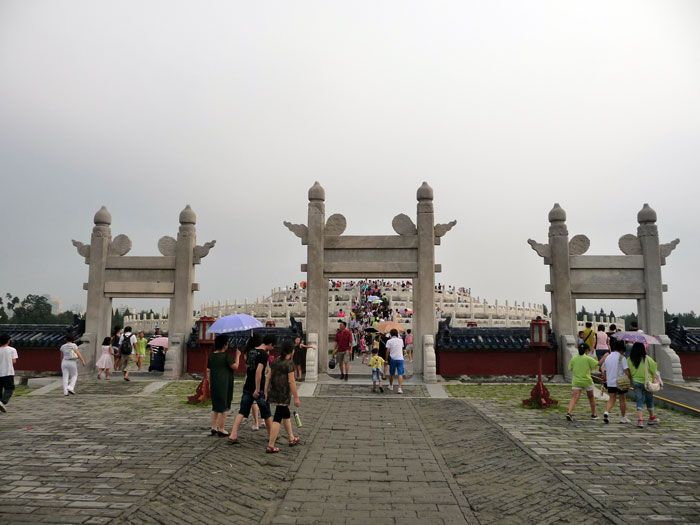

Other buildings were seemingly worth the detour (Hall of Abstinence, Pavilion of Longevity, to name but a few), yet to be honest the sheer number of similar structures can make visits feel repetitive. Still, there's a particular atmosphere here that's absolutely worth experiencing. We exit the park via the West Gate, determined to reach the nearest metro station for our next visit—one that promises to be entirely different...
Beijing Olympic Park
We return to the present day by heading to the Beijing Olympic Park (or Olympic Green), which houses the main facilities from the 2008 Olympic Games as well as the Olympic village. A fun detail: the Olympics began on 08/08/2008 at 08:08, as the 8 is considered a lucky number in Chine (quite the coincidence...). The Olympics Sports Center metro station (Aolinpike Zhongxin) on line 8 is notably more modern than other stations, easily comparable to those in Guangzhou.
Upon arrival, we're confronted with a gigantic esplanade, populated by thousands of people and activities. The district sits near a ring road and is a stark contrast to the hutongs of the historic center.
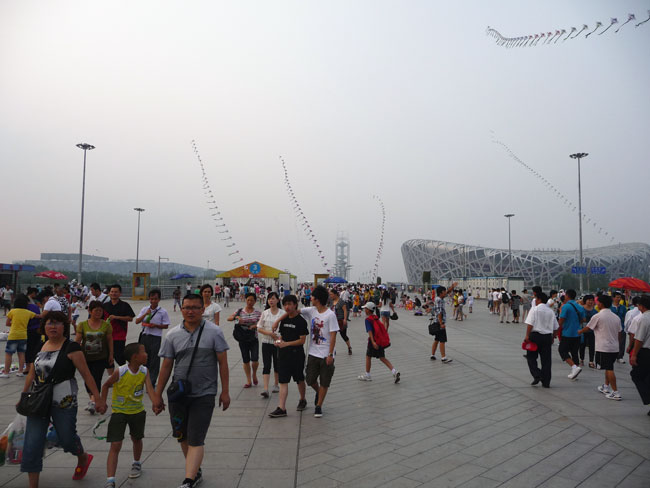
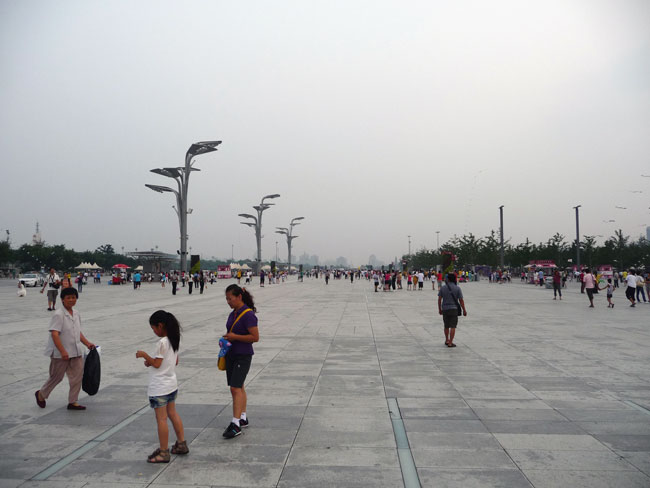
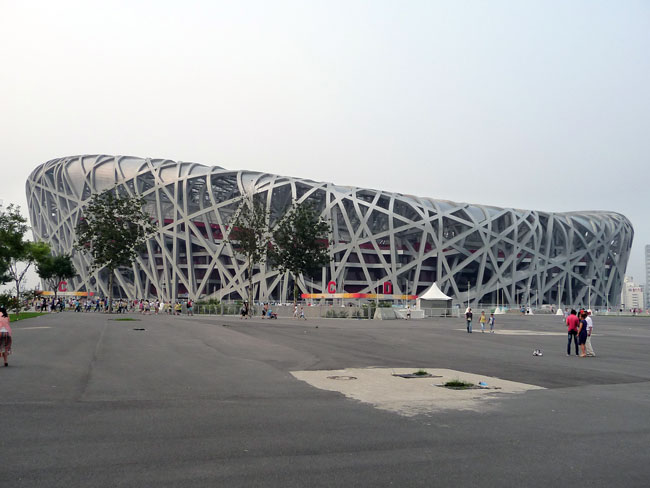
In the distance, we spot the famous National Stadium, shaped like a bird's nest, that captured so much attention—a blend of steel and concrete. With a capacity of 80,000, it hosted the opening and closing ceremonies as well as the main athletic events.
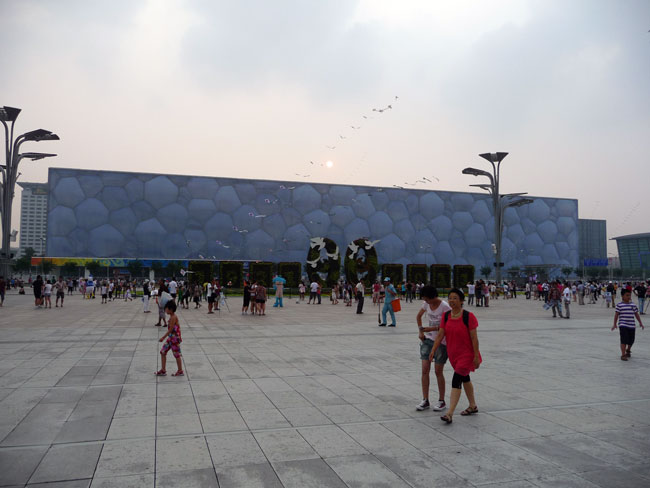
Chinese architectural audacity is equally evident in the Water Cube nearby, which housed most of the aquatic events. Despite the late hour, we decide to venture inside, fascinated by this peculiar bubble-like structure. The Aquacube has been open to the general public since 2010, and to our surprise, it houses an aquatic leisure center similar to Center Park.
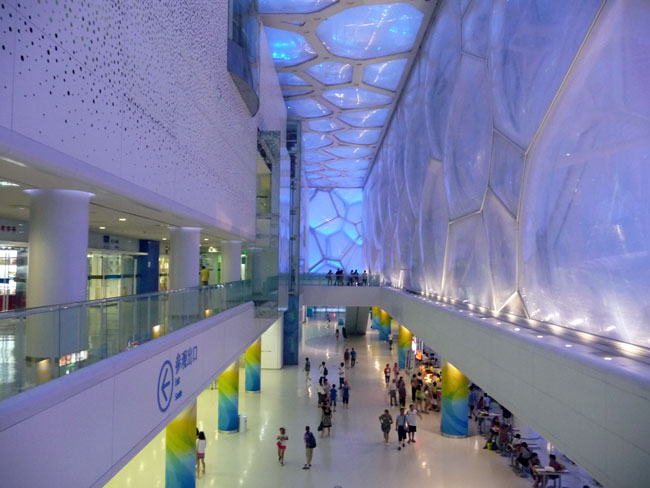
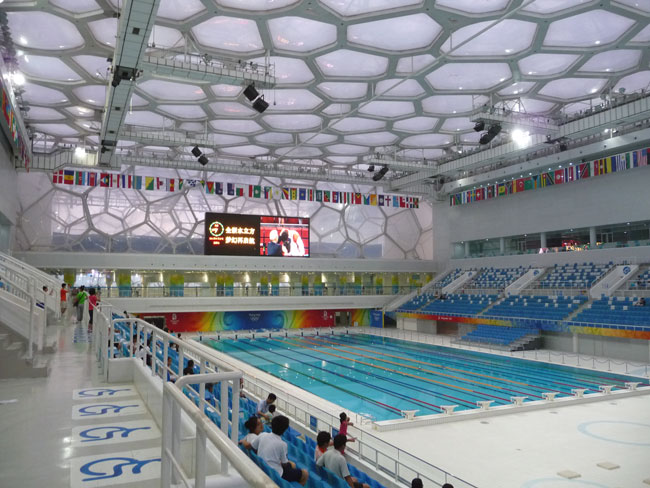
We take a few photos of the Olympic pool, and suddenly realize that the exterior of the cube has begun to illuminate. We'd been told that visiting the Olympic Park at dusk is particularly striking, and this is proving to be entirely accurate as the facilities come alive with light.
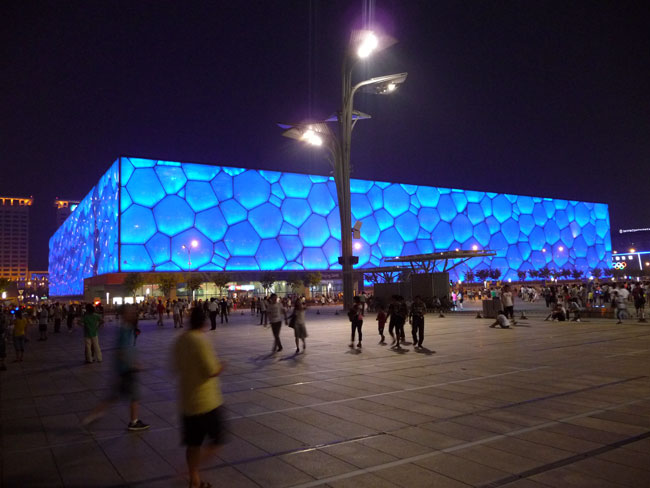
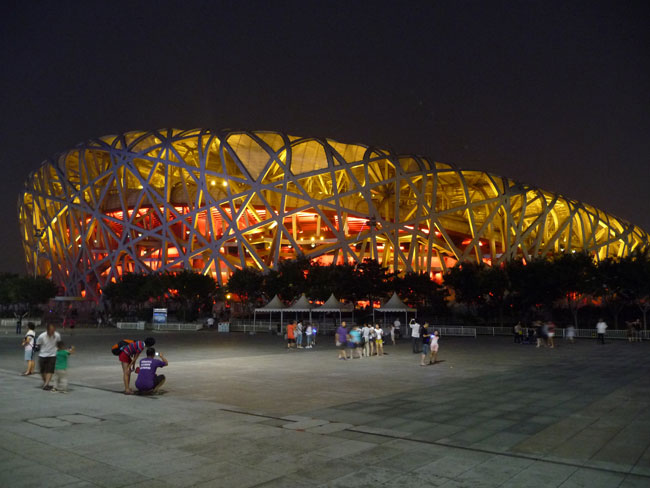
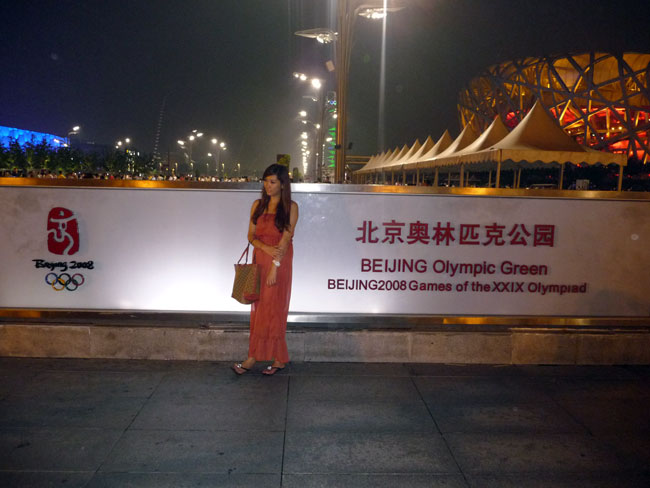
As for the Chinese tourists, they seem immensely proud to have hosted the Olympic Games in their country, and rightly so.
Summer Palace
The next day, we turn to another celebrated Beijing monument: the Summer Palace (Summer Palace) or Yíhéyuán for Garden of Cultivated Harmony. Not to be confused with the Old Summer Palace, which today is nothing more than ruins following pillage and fires set by British and French troops in 1860 during the Second Opium War. We enter via the East Gate, which soon draws us into a maze of alleyways featuring multiple temples with similar architecture. We wander from the Temple of Benevolence and Longevity to the Hall of Embracing the Universe, all amid ever-increasing crowds of Chinese visitors that make the visit more tiring than expected.
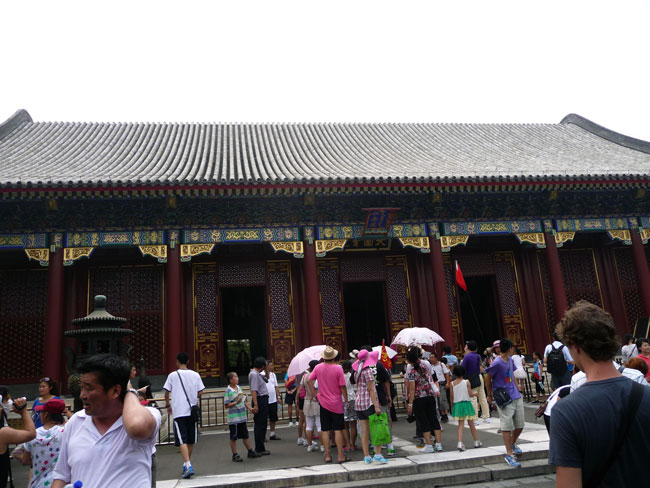
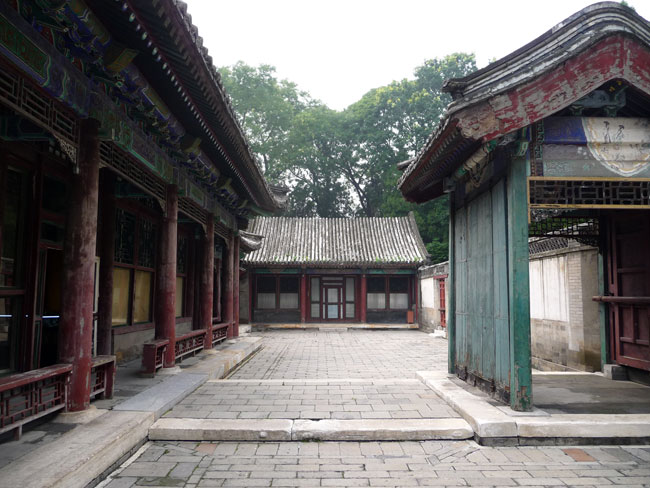
We eventually stumble upon the Garden of Virtue and Harmony, which houses a famous three-story theater, considered the birthplace of Peking Opera. Many celebrated actors came to perform here for the empress Cixi, who had invested a significant portion of the imperial treasury in restoring this sanctuary of peace.
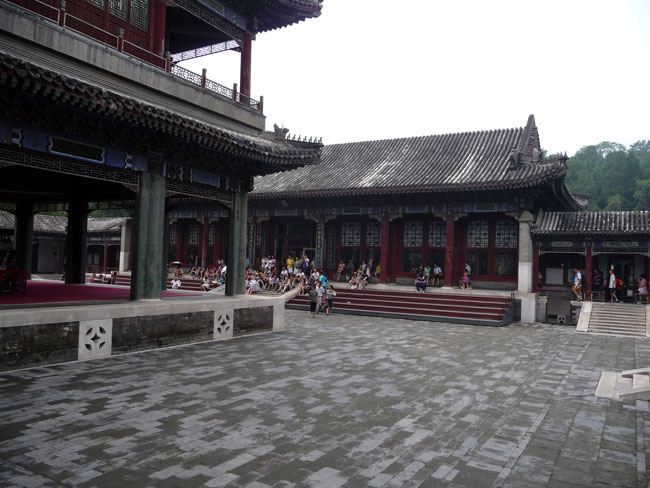
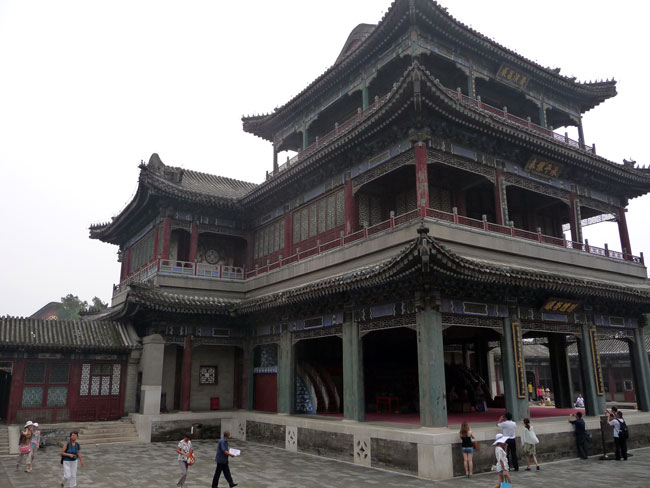
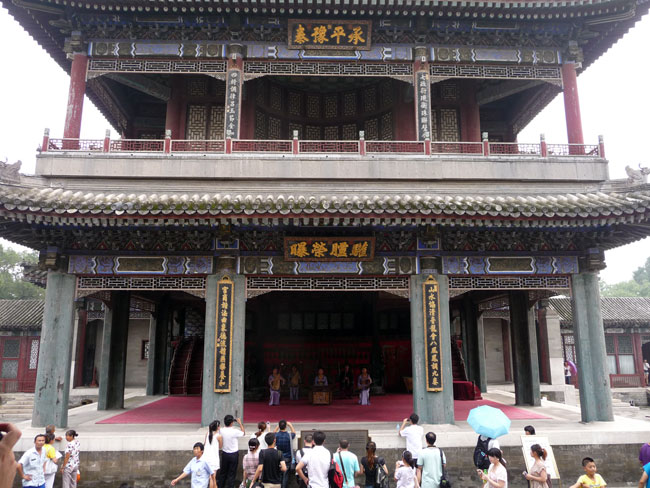
We finally reach the shores of Kunming Lake, where numerous boats and paddle boats glide across the water. The ambient mist doesn't prevent us from making out, in the distance, the Longevity Hill (Wahnshou Shan), dominated by the complex's most celebrated building: the Pavilion of Buddhist Incense (Fo Xiang Ge).
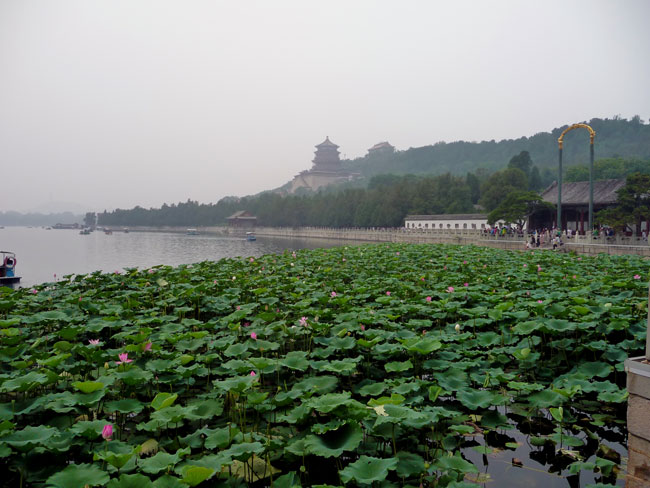
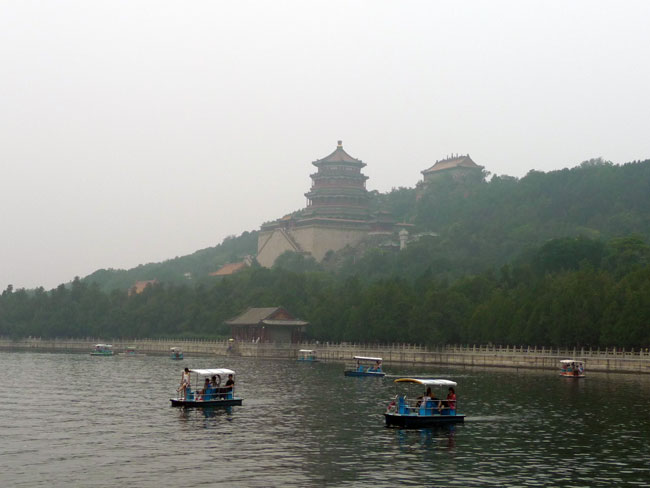
We must traverse a long corridor, a covered gallery punctuated periodically by pavilions, to reach the foot of the hill. And so begins a modest climb that will treat us to a festival of colors and beauty along the stairs.
At the summit, we enjoy panoramic views over the temple rooftops and Kunming Lake, though the gray haze somewhat dampens the spectacle.
Inside the Pavilion of Buddhist Incense stands a statue of Guanyin Buddha with a Thousand Hands, which Chinese visitors (and ourselves) eagerly photograph despite the prohibitions.
The Temple Zhihuihai (Sea of Perfect Wisdom) rises behind and gives us reason to climb a little higher.
We'll descend the hill from the other side, revealing an expansive park containing numerous Buddhist temples and pavilions. Only after crossing multiple gardens and bridges do we finally reach the North Gate and the commercial Suzhou street, feeling we've seen the essentials. Heading to Qianmen Hostel for well-deserved rest, we anticipate our upcoming journey to the Great Wall of Chine... To view photos related to this article, feel free to visit the gallery of Beijing.
Frequently asked questions
Entry to the Temple of Heaven park (Tiāntán Gōngyuán) costs 15 yuan. The combined ticket providing access to the 3 main attractions (Hall of Prayer for Good Harvests, Imperial Vault of Heaven, and Altar of Heaven) is offered at 35 yuan. Note that these prices date from 2012 and may have changed: verify current prices before your visit.
The nearest metro station is Tiantandongmen, which provides easy access to the park's North Gate on Tiantan Lu. The Temple of Heaven is well served by Beijing's metro network.
Plan for 2 to 3 hours for a complete visit of the complex, taking time to explore the 3 main attractions and stroll through the 250-hectare park. For a combined visit with the Summer Palace in the same day, set aside a full day.
It's the most emblematic building in the Temple of Heaven complex. Built on three circular white marble terraces, it measures 30 meters in diameter and 38 meters tall. Constructed entirely from wood and tiles without a single nail, it was the place where the Emperor prayed for good harvests. The current building dates from the late 19th century, the original having been destroyed by lightning and fire in 1889.
Yes, the Water Cube has been open to the general public since 2010. It now houses a water leisure center. The visit is particularly recommended at dusk, when the external structure illuminates for a unique visual spectacle.
The Summer Palace (Yíhéyuán), also called the Garden of Cultivated Harmony, is the main site still largely intact, featuring temples, Kunming Lake, and Longevity Hill. The Old Summer Palace, by contrast, is now merely a collection of ruins: it was pillaged and burned by British and French troops in 1860 during the Second Opium War. These are two distinct sites that should not be confused when planning your visit.