In China: The World's Largest Buddha Statue Has Just Resurfaced
Hidden beneath luxuriant vegetation, a mysterious Buddha statue has just resurfaced in southern China. This discovery was made possible by a deforestation operation in the region.
Hidden beneath luxuriant vegetation, a mysterious Buddha statue has just resurfaced in southern China. This discovery was made possible by a deforestation operation in the region. Here's a closer look at the story.
A Most Surprising Discovery
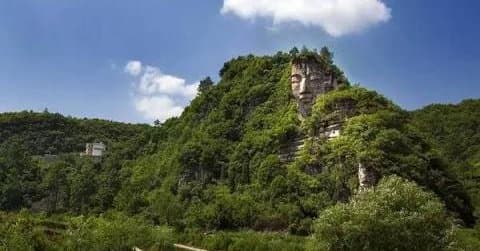
Concealed for more than a thousand years, a colossal statue has recently emerged in the mountains of the Baiyun District, more precisely in the city of Guiyang, in the province of Guizhou in southern China.
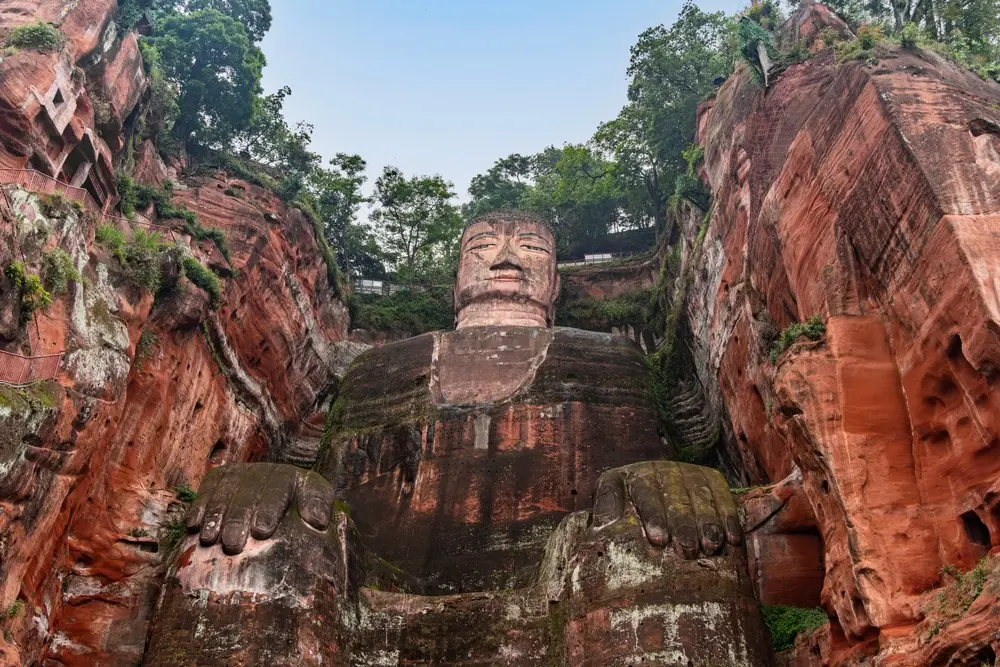
Carved directly into the rock, this architectural marvel stands over 50 meters tall, with the head alone estimated at 16 meters. As a result, it surpasses by 4 meters the Leshan Buddha statue, in Sichuan, which had been considered up until now as the largest rock-carved Buddha representation.
The Origin of the Statue
According to legend, the origins of this statue date back to the reign of the Tang Dynasty, from 618 to 907 A.D. Indeed, during this period, the master Hai Nag and his apprentice Hai Tung were passing through the city of Guiyang when the river level rose and devastated everything in its path. To protect themselves from future natural disasters, the master and his disciple decided to erect two large Buddha statues.
However, as the master was already advanced in age and his health was deteriorating day by day, he asked his disciple to construct the Leshan Buddha and committed himself to building the one in Guiyang. Time eventually caught up with the old master, who passed away before completing his work. The statue was so well hidden in the depths of the mountains that no one suspected its existence until now.
Frequently asked questions
The statue was discovered in the mountains of Baiyun District, in the city of Guiyang, in Guizhou Province, in southern China.
The statue stands over 50 meters tall, with the head alone measuring 16 meters. It thus surpasses by 4 meters the famous Leshan Buddha in Sichuan.
The statue was entirely concealed beneath luxuriant vegetation for more than a thousand years. A deforestation operation in the region made its rediscovery possible in 2017.
According to legend, the statue was erected during the Tang Dynasty (618-907 A.D.) by a Buddhist master named Hai Nag, who wished to protect the region from natural disasters. He passed away before completing his work.
The statue is located in Baiyun District, near the city of Guiyang, the capital of Guizhou Province. Additional information about access and visiting conditions should be verified with local authorities or regional tourism offices.
Both statues are carved directly into the rock. The Leshan Buddha, listed as a UNESCO World Heritage site, stands approximately 71 meters tall and was until recently considered the largest rock-carved Buddha statue. The Guiyang one is said to measure over 50 meters, surpassing Leshan by 4 meters according to initial estimates. However, these figures remain to be confirmed by further studies.