Mount Maiji Shan
Mount Maiji Shan
Located 45 km from Tianshui, Mount Maiji Shan shelters 194 Buddhist caves carved over 1,500 years, inscribed on UNESCO's World Heritage list.
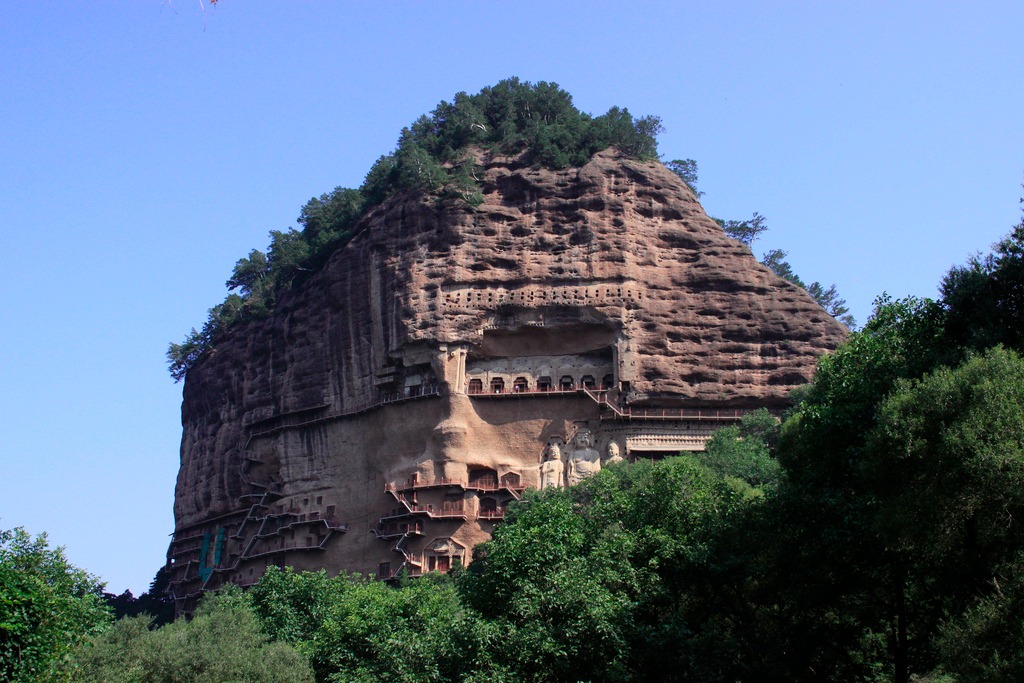
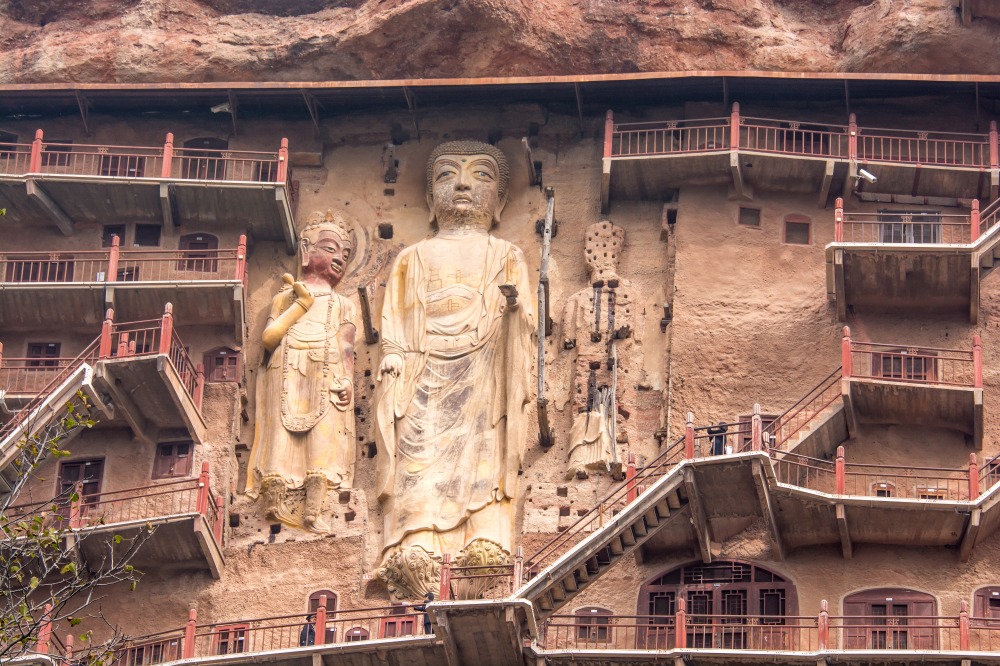
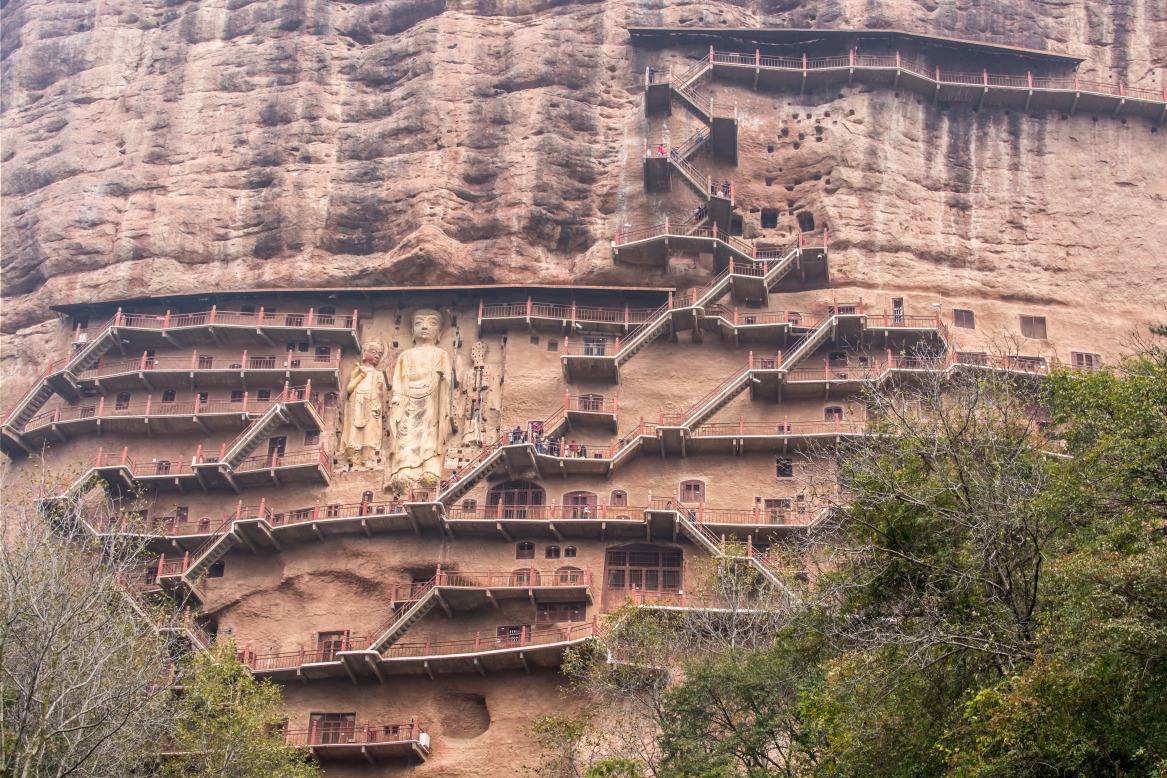
Mount Maiji Shan rises approximately 45 km south-east of Tianshui, in Gansu province. A solitary peak reaching 1,742 m, its name — "Maiji" meaning "wheat pile" — derives from its silhouette, which resembles a mound of straw. Its rock faces are carved with 194 Buddhist caves linked by a network of wooden walkways. The site is nicknamed the "Oriental Museum of Sculptures" and ranks among the four great Buddhist rock art complexes in Chine, alongside Mogao, Yungang, and Longmen.
Why visit Mount Maiji Shan
The site combines three distinctive features rarely found in a single location:
- A Buddhist rock art complex shaped over more than 1,500 years, inscribed on UNESCO's World Heritage list in 2014.
- An exceptional collection of 7,200 clay statues and 1,300 m² of wall paintings, documenting the evolution of Chinese Buddhist art across more than a dozen dynasties.
- A remarkable natural setting, with an isolated peak surrounded by forests and valleys, designated a national park since 1982.
For those interested in Chinese religious history or rock art, Maiji Shan logically complements an itinerary through the Hexi Corridor and along the Silk Road.
History of the site
The creation of the earliest caves dates back to the late Qin dynasty (221-206 BCE), when Buddhism was beginning to penetrate Chine. Successive dynasties — from the Northern Wei to the Qing — each added to or restored sculptures, turning the mountain into a continuous stratification of Buddhist styles and schools.
The site was not always purely religious. According to local tradition, until 1524 the caves served as a base for a Chinese assassin brotherhood. Conquered by the imperial army under Emperor Jiajing, nicknamed "the Tigers," they were later repurposed as a prison for political opponents before regaining their heritage status.
Mount Maiji was proclaimed a national park on November 8, 1982, then inscribed on UNESCO's World Heritage list on June 22, 2014, as part of the serial property "Silk Roads."
What to see on site
The caves and their sculptures
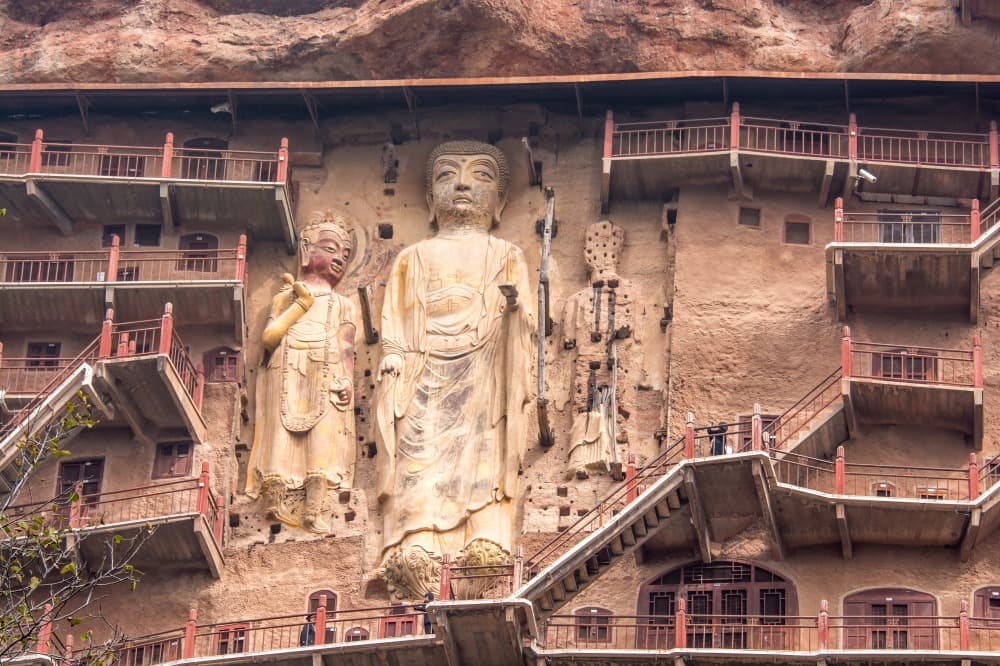
The 194 caves are tiered along the north and east faces of the peak, connected by wooden walkways suspended sometimes dozens of metres above the ground. Progress is single-file along a marked route. You'll see monumental Buddhas carved directly from the cliff face, clay bodhisattvas, frescoes with still-visible pigments, and compositions that reveal successive influences — Gandharan in origin, increasingly Chinese from the Tang period onwards.
The peak and its surroundings
The summit offers views of neighbouring ridges: Xianren Cliff, Shimen Mountain, Quxi, and Maiji Arboretum. The area is densely forested, with temperate humid vegetation quite different from the rest of Gansu, which is more arid. Several trails allow you to extend your visit with hiking, particularly towards Xianren Cliff.
Practical information
- Duration of visit: allow 2 to 4 hours for the caves and tour around the peak; a half-day if you add a nearby trail.
- Ticketing: moderate entrance fee for the scenic area, supplement for cave access. Prices vary between peak and off-season; it's best to check closer to your travel dates.
- Opening hours: daytime opening with late afternoon closure. Ticket distribution ends earlier than site closure.
- Visit conditions: walkways are narrow and expose you to vertiginous heights; closed-toe shoes recommended, and caution advised if you're sensitive to heights.
- Photography: often restricted or forbidden inside caves to preserve pigments.
When to visit
The best period runs from late April through October. Spring and autumn offer mild temperatures and clear views of the landscape. Summer is hot and prone to rain — walkways can become slippery, and fog is frequent on the peak. Winter is possible but cold, sometimes with snow and access restrictions. If possible, avoid Chinese national holidays (early May and early October), when crowding on the walkways significantly slows the visit.
How to get there
The logical starting point is Tianshui, accessible by train from Xi'an and Lanzhou. From Tianshui railway station, bus line 34 goes directly to Mount Maiji; the terminus is just tens of metres from the ticket office. Allow approximately one hour of travel. Taxi or ride-sharing remain faster options for groups.
Nearby
To extend your discovery of Gansu and its Buddhist sites:
- Labrang Monastery — one of the great centres of Tibetan Buddhism in Amdo.
- Longwu Monastery — major stop in the Tongren region.
- Haizang Temple in Wuwei — along the Hexi Corridor route.
- Wild Goose Pagoda — in Xi'an, upstream or downstream of your journey.
Frequently asked questions
Frequently asked questions
Allow between 2 and 4 hours to walk the walkways and observe the main caves. A half-day is comfortable if you'd like to add a trail in the park.
The wooden walkways are narrow and cantilevered over the rock face. The route can be challenging for those sensitive to heights; certain sections remain close to the ground.
Bus line 34, departing from Tianshui railway station, leads directly to the site entrance. The journey takes about one hour.
These four sites make up the ensemble of great Buddhist rock art complexes in Chine. Maiji stands out for its concentration of clay sculptures, while the others favour stone carving.
Yes, Mount Maiji was inscribed on the World Heritage list on June 22, 2014, as part of the serial property Silk Roads.
Include Mount Maiji in your journey
Mount Maiji fits naturally into an itinerary combining Xi'an, Gansu, and the Silk Road. To craft a tailored route, explore our Chine travel ideas.
Interested in this visit?
We can include it in your personalised itinerary.