Jiayuguan Fort (嘉峪关城楼)
Jiayuguan Fort (嘉峪关城楼)
The last fortified pass of the Great Wall, Jiayuguan Fort rises with its Ming towers between the Gobi Desert and the Qilian Mountains. A major Silk Road site, beautifully preserved.
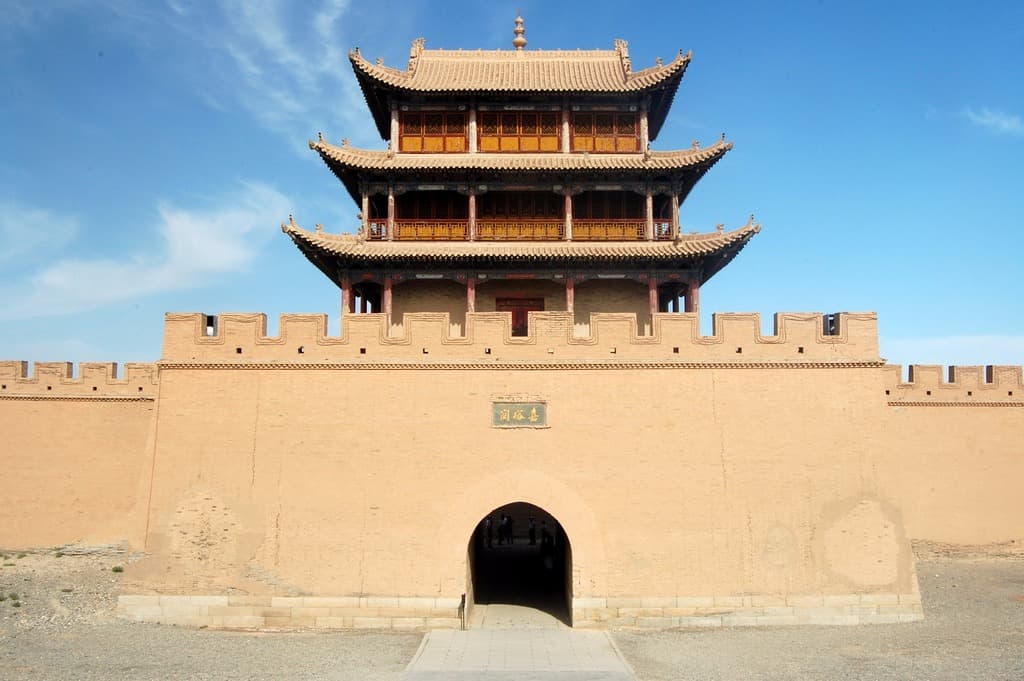
Built at the western extremity of China's Great Wall, Jiayuguan Fort marks the final fortified pass before the Gobi Desert. Constructed under the Ming Dynasty in the 14th century, this military complex defended the Silk Road and symbolised the frontier between imperial Chine and "barbarian" territories. Its rammed-earth ramparts, corner towers and monumental gates form one of the country's best-preserved fortified complexes.
Practical Information at a Glance
- Admission: Paid entry (tickets typically include the fort, the Great Wall's First Pass and associated museum — verify current rates with your local agency).
- Recommended duration: 2 to 3 hours for the fort alone; a half-day for the complete site.
- Access: Jiayuguan city is served by high-speed train from Lanzhou and Dunhuang. Taxis and shuttles connect the station to the fort.
- Dress code: No clothing restrictions, but comfortable shoes are essential for climbing the ramparts.
- Accessibility: Rampart access is limited due to steep stairs; the inner courtyard is accessible on level ground.
What You'll See
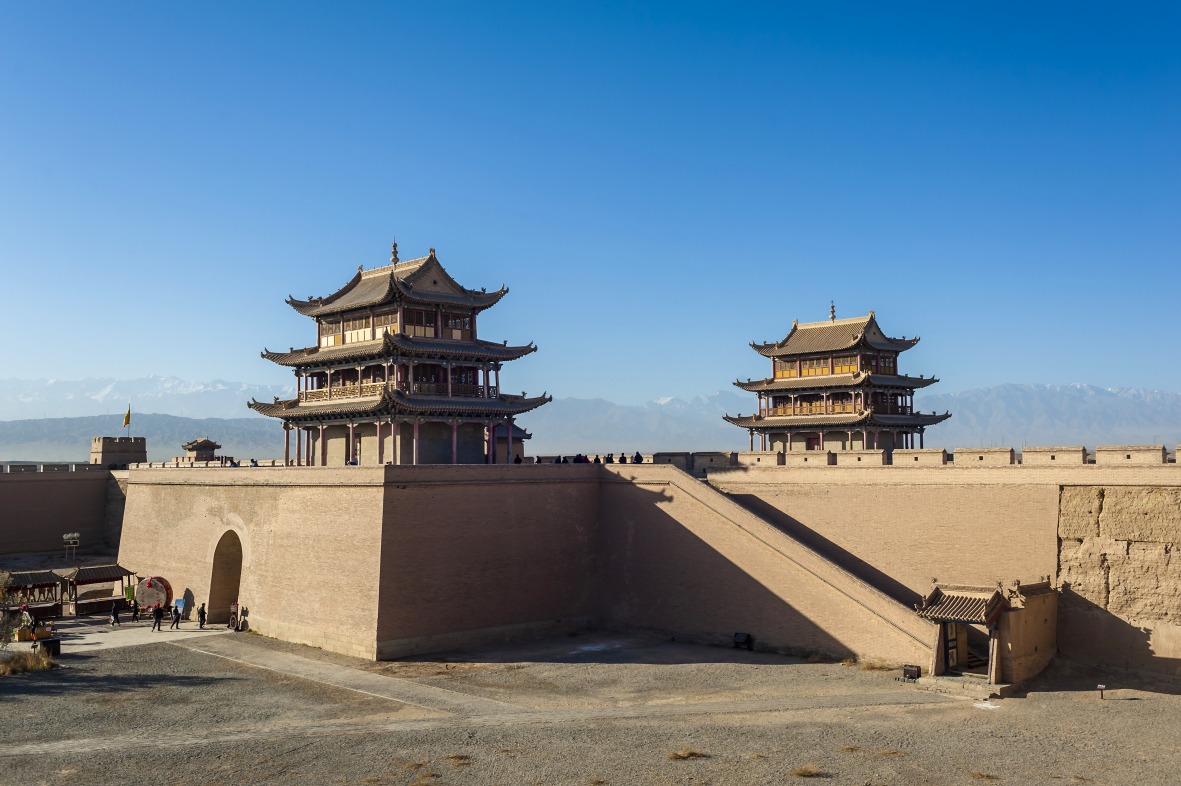
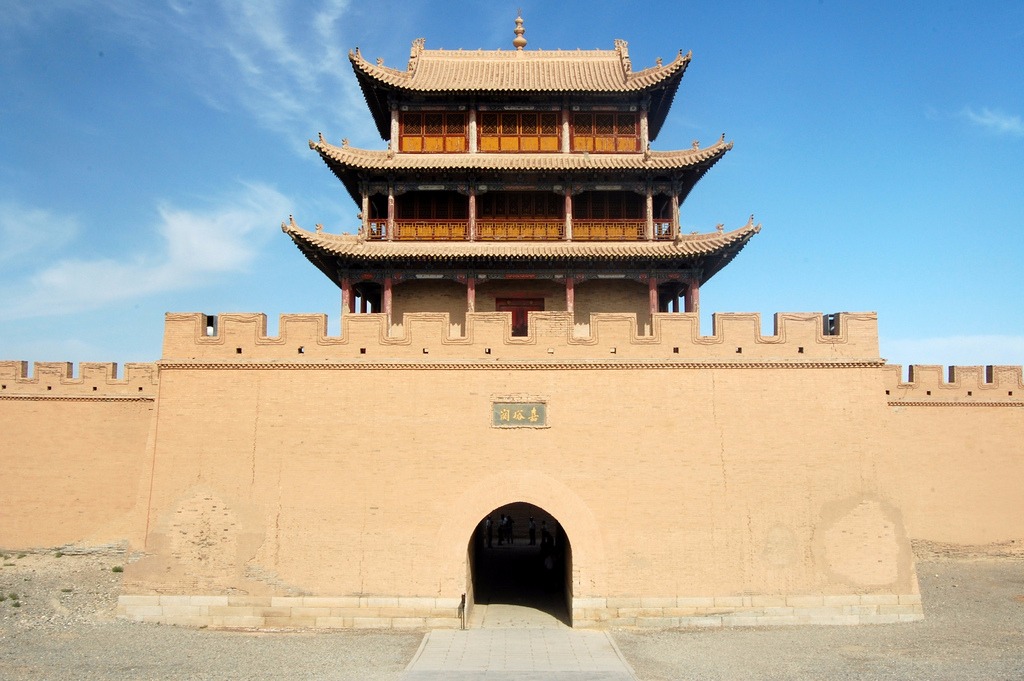
The fort comprises three concentric enclosures. The outer courtyard houses reconstructed administrative and military buildings. The inner courtyard contains two multi-storey pavilions — the West Gate Tower (Rouyuan) and the East Gate Tower (Guanghua) — featuring the characteristic double-eave roofs of Ming architecture. The ramparts offer sweeping views of the snow-capped Qilian Mountains to the south and the Gobi Desert to the north.
History and Context
Construction began in 1372 under Emperor Hongwu's reign. The fort takes its name from the Jiayuguan pass (guan), meaning "valley of good fortune pass". For centuries, it controlled the passage of caravans, diplomats and soldiers. Exiles and the condemned crossed here into the unknown: the pass became known as "the pass of sorrow". The site is UNESCO World Heritage listed as part of the Great Wall.
Highlights of Your Visit
The West Gate Tower (Rouyuan Lou)
This is the fort's iconic façade, photographed from the access road. Its three storeys of red lacquered wood stand out against the ochre-coloured earth ramparts. Climb inside to observe traditional carpentry and the desert vista.
The Rampart Walk
A complete circuit of the outer ramparts takes roughly 45 minutes. The crenellations, loopholes and corner towers offer tangible insights into the defensive system. On clear days, the snow-capped peaks of the Qilian range provide a striking backdrop.
The Great Wall's First Pass
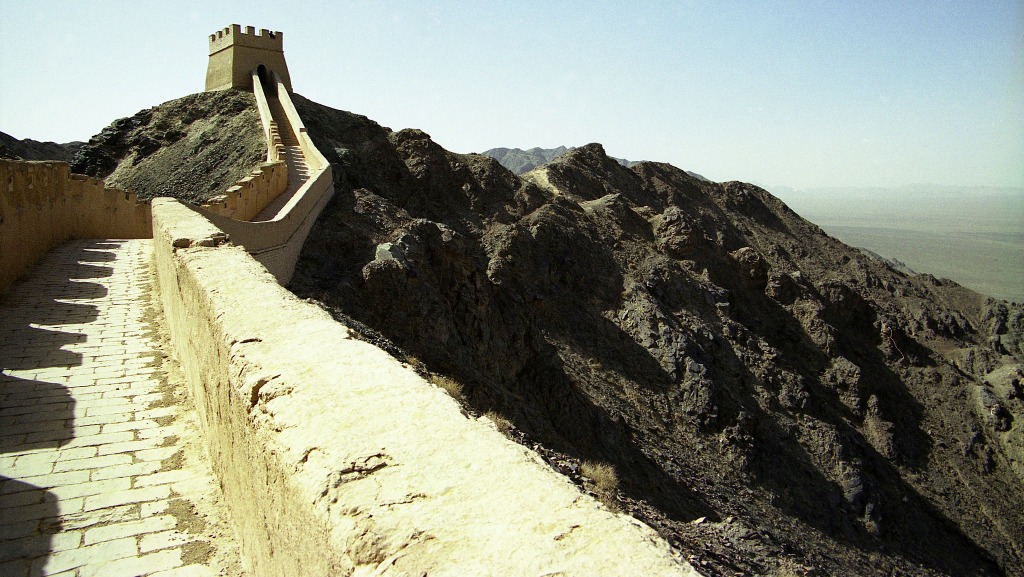
A few kilometres from the fort, a stretch of rammed-earth (pisé) wall extends into the desert. Less restored than sections in Hebei, it presents an authentic, unpolished image of the Ming wall in an arid setting.
The Great Wall Museum
Located within the site grounds, it traces the wall's construction history through scale models, period tools and historical documents. Allow an additional 30 to 45 minutes.
Photography Tips
Morning light (before 9 a.m.) is ideal: the rising sun illuminates the fort's eastern façade and casts long shadows across the ramparts. Late afternoon brings golden light that flatters the ochre-hued walls. From the northern rampart walk, the framing combines ramparts, desert and the Qilian Mountains in a single composition. No known photography restrictions within the site.
Location and Access
The fort sits approximately 6 km south-west of Jiayuguan's city centre. The city is a railway hub on the Lanzhou–Xinjiang line: high-speed trains connect Lanzhou in under 3 hours and Dunhuang (via connection) in a few hours. Taxis and local buses serve the site from the station. Mandarin-language guided tours are available on-site; multi-language audioguides are available at the entrance.
Nearby
- Mogao Caves (Dunhuang) — Chine's largest Buddhist cave complex, hours to the west along the Silk Road.
- Crescent Moon Lake (Dunhuang) — A crescent-shaped oasis nestled amid the Mingsha sand dunes.
- Great Wall — First Pass — The rammed-earth stretch extending into the Gobi, a few kilometres from the fort.
- Zhangye Danxia — Multicoloured rock formations in Gansu, accessible from Zhangye to the east.
Photos
Interested in this visit?
We can include it in your personalised itinerary.