Sik Sik Yuen Wong Tai Sin Temple
Sik Sik Yuen Wong Tai Sin Temple
A major syncretic sanctuary in Hong Kong, Wong Tai Sin Temple blends Taoism, Buddhism, and Confucianism within an architecture designed according to the five elements.
The Sik Sik Yuen Wong Tai Sin Temple is one of the most visited sanctuaries in Hong Kong. Situated on the southern slope of Lion Rock, north of Kowloon, it brings together Taoist, Buddhist, and Confucian devotees within a vibrant complex, renowned for its fortune tellers and architecture designed according to the five elements of Feng Shui.
Why Visit Wong Tai Sin Temple
Three elements distinguish this temple from other places of worship in Hong Kong:
- Embraced religious syncretism: Taoism, Buddhism, and Confucianism coexist on the same site, which remains rare in Asia.
- Architecture readable through Feng Shui: each major building embodies one of the five elements (metal, wood, water, fire, earth), transforming the visit into a symbolic journey.
- A vibrant atmosphere: incense wisps, divination sticks shaken in bamboo pots, fortune teller stalls — the temple is a place of active practice, not a museum.
History of the Temple and Wong Tai Sin
The main altar was built in 1921, then renovated between 2008 and 2010. The portrait of Master Wong Tai Sin presides at the center, his biography engraved beneath the image.
According to tradition, Wong Cho-ping is said to have been born around 328, during the Jin dynasty. From a poor family, he became a shepherd at age 8. At 15, the legend recounts, an immortal initiated him into the art of Tao on Jinhua Mountain. Forty years later, he is said to have achieved enlightenment and performed several miracles. Worship spread from Guangdong to Hong Kong in the early 20th century.
The temple opened partially to the public in 1934, during Chinese New Year, but full opening permission was only granted in 1956. The present complex, in its monumental configuration, was built in 1973. Wong Tai Sin is venerated here as a god of mercy, fortune, and healing.
What to See on Site
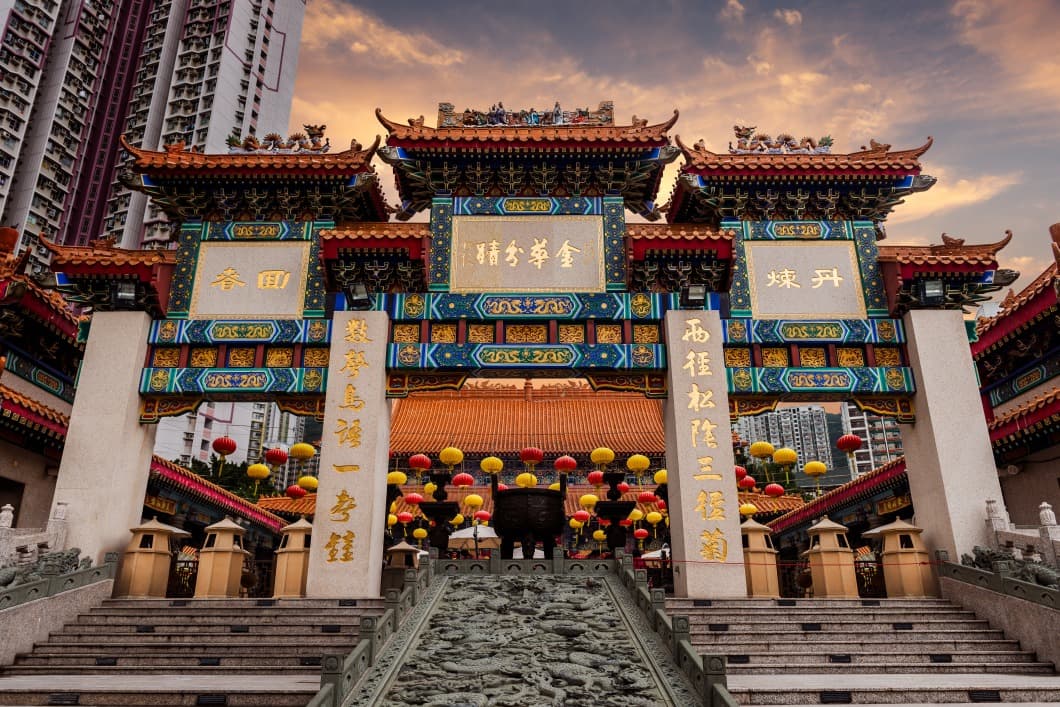
The complex covers approximately 18,000 m², organized around traditional architecture: red pillars, golden roofs, blue and yellow friezes, polychrome sculptures. Three commemorative archways mark the main entrances.
The Major Buildings
- The Grand Hall: the heart of worship, where offerings and divination by kau cim sticks are concentrated.
- The Sansheng Hall and Daxiong-baodian: secondary halls dedicated to other deities of the pantheon.
- The Wish Garden: laid out with zigzag bridges inspired by the Summer Palace in Beijing, as well as a replica of the Wall of Nine Dragons.
The Five Feng Shui Elements
Each building embodies one of the five fundamental elements:
- Metal — the bronze pavilion
- Wood — the archives hall
- Water — the Yuk Yik fountain
- Fire — the Yue Heung sanctuary
- Earth — the Earth Wall
The Fortune Tellers
On the arcade to the left of the main entrance, a row of stalls offers palm readings, divination by sticks, and interpretation of signs. Some operators speak English, more rarely French. A quick consultation offers insight into an important dimension of Hong Kong's popular culture, believer or not.
When to Visit
The temple is open year-round, but visitor numbers vary considerably:
- Chinese New Year (late January – mid-February): major peak period, dense atmosphere, very active rituals — but long queues.
- Wong Tai Sin's Birthday, celebrated on the 23rd day of the 8th lunar month (usually September-October): ceremonies, processions, incense.
- Rest of the year: for a quieter visit, favor weekday mornings.
Practical Information
- Admission: temple access is free; a small contribution is requested for the Wish Garden.
- Hours: open daily, with broad hours from morning until late afternoon. Check official hours before your visit, especially during festivals.
- Suggested duration: allow approximately 1 to 1.5 hours for the temple, 2 hours if you take time to observe ritual practices and visit the garden.
- Dress code: shoulders and knees covered appreciated, especially during busy times.
How to Get There
The simplest means remains the MTR:
- Wong Tai Sin Station, served by the Tsuen Wan and Kwun Tong lines. Exit B2, the temple is signposted 2-3 minutes on foot.
- Multiple bus lines connect Kowloon and the New Territories to the site. Fares in HKD, Octopus card payment recommended.
Nearby
The neighborhood offers several easy extensions:
- Chi Lin Nunnery and Nan Lian Garden: Buddhist monastery in Tang style reconstructed without nails, about two MTR stations away. A calming contrast after Wong Tai Sin's energy.
- Lion Rock: the hike to the summit (panoramic views of Kowloon) departs from the heights north of the temple, for equipped hikers.
- Kowloon City: a popular neighborhood known for its Thai and Chiu Chow cuisine, a short taxi ride away.
To plan the rest of your stay, also consult our Hong Kong guide.
Frequently Asked Questions
Frequently asked questions
Access to the temple itself is free. A small contribution is requested to enter the Wish Garden, which is a separate part of the complex.
Allow 1 to 1.5 hours to explore the main buildings. If you wish to observe divination practices or consult a fortune teller, plan for 2 hours.
Morning on a weekday to avoid crowds. To experience the ritual atmosphere at its peak, aim for Chinese New Year or Wong Tai Sin's Birthday (23rd day of the 8th lunar month), knowing that crowds will be very large.
Devotees shake a pot of numbered sticks (kau cim) until a single one falls out. The number corresponds to an oracle that is then interpreted by a fortune teller on the arcade to the left of the entrance.
Exterior spaces and gardens can be freely photographed. Inside the halls, be discreet during rituals and respect any posted prohibitions.
Extend Into China
Wong Tai Sin Temple is merely a gateway into the spiritual and architectural richness of China. To build an itinerary combining Hong Kong, Taoist sites, and major Buddhist sanctuaries, explore our customized China journeys.
Interested in this visit?
We can include it in your personalised itinerary.