Wudangzhao Lamasery
Wudangzhao Lamasery
Located 70 km from Baotou, Wudangzhao is Inner Mongolia's largest Tibetan Buddhist lamasery: Qing-era history, architecture inspired by Tashilhunpo, and an annual summer ritual.
The Wudangzhao Lamasery ranks as Inner Mongolia's largest Tibetan Buddhist lamasery. Set against mountains approximately 70 km from Baotou, its whitewashed buildings align across a valley once planted with willows—hence its Mongolian name Wudangzhao, meaning "Lamasery of the Willows." The entire complex is designated a historical monument of China.
Why visit Wudangzhao Lamasery
Three compelling reasons merit a detour to Wudangzhao from Baotou:
- A living Tibetan lamasery: despite fewer resident monks, daily prayers, prayer wheels lining the alleys, and annual rituals sustain genuine religious activity.
- Rare architecture in Inner Mongolia: the complex draws inspiration from the Tashilhunpo Tibetan monastery, the traditional seat of the Panchen Lamas, making it a singular witness to Gelugpa Buddhism outside Tibet.
- A mountain setting: more than an hour from the city, the lamasery offers a serene natural environment ideal for a walking tour among its various temples.
History of the lamasery
Wudangzhao was founded in 1749, under the Qing dynasty—during the reign of Emperor Qianlong (not Kangxi, who died in 1722, as sometimes claimed). The site was established in an area then covered with willows, accounting for its Mongolian name.
Between 1763 and 1955, the lamasery served as residence for successive generations of Living Buddhas. Their ashes remain preserved in a funerary hall within the complex. At its peak, the monastery housed over 1,200 apprentice monks of the Gelugpa school, known as the "Yellow Hat" sect.
Several teaching halls were erected over time:
- Ahui Hall (1800): medical training;
- Suguqin Hall (1835): doctrine, religion, philosophy;
- Rimulun Hall (1892): history of Lamaism;
- Central House: astronomy, geography, calendar, mathematics, and theology.
What to see on site
The complex spans more than 20 hectares, with approximately 2,500 rooms distributed across independent buildings and nearly 1,500 Buddha statues. Exploration is primarily on foot, following alleys connecting the various temples.
Tibetan architecture
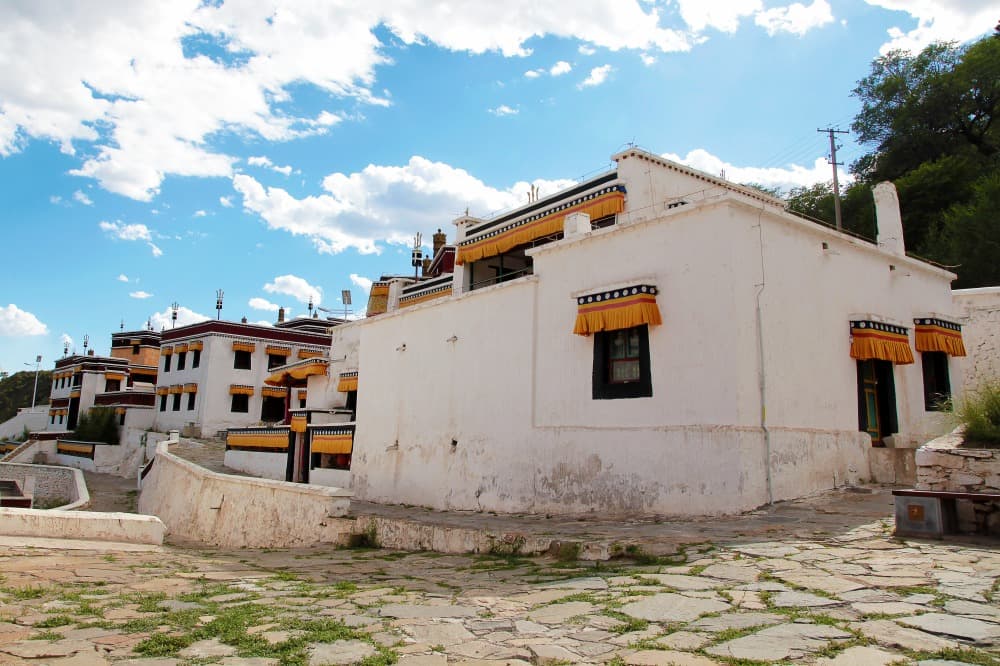
Whitewashed walls, ochre and black trim, flat roofs: the lamasery echoes the architectural codes of the Tashilhunpo monastery near Shigatse. This architectural lineage is rare at this latitude and partly explains the site's heritage significance.
Teaching halls
Each major hall (Ahui, Suguqin, Rimulun, Central House) corresponds to a discipline taught to monks. Interiors preserve murals, sculptures, and ritual objects in gold, silver, copper, and wood, illustrating Tibetan Buddhist iconography.
Alleys and prayer wheels
Between buildings, prayer wheels line the passages, spun by pilgrims and visitors. Among the site's most photographed features, they offer glimpses of ritual practices in their daily setting.
The annual summer ritual
From late July through August by lunar calendar, monks hold a ceremony spanning several days. Sutra chanting takes place in Suguqin Hall, and at dusk, monks circumambulate the complex turning prayer wheels, accompanied by sheep-skin drums. If your visit coincides with this period, it marks the highlight of the experience.
When to visit
The lamasery welcomes visitors year-round, though Inner Mongolia's climate warrants seasonal consideration:
- May through September: most comfortable period, mild temperatures, mountains fully accessible.
- Late July–August (lunar calendar): annual religious ritual, maximum cultural interest but higher visitor numbers.
- Winter: dry, sharp cold, reduced crowds; suited to well-equipped travelers.
Practical information
- Duration: allow 2 to 3 hours to explore the entire complex without rushing.
- Admission: modest entrance fee (verify on-site, fees vary).
- Hours: daytime access, typically morning through late afternoon. Arrive early to maximize light and avoid return schedule constraints.
- Dress code: shoulders and knees covered to enter prayer halls; comfortable shoes for stairs and sloped paths.
- Photography: typically prohibited inside temples, permitted in courtyards and alleys.
How to get there
The lamasery sits approximately 70 km northeast of Baotou in mountainous terrain. Two primary options:
- From Shiguai District (Baotou): shuttles and coaches provide direct service to the monastery. Confirm the last return time, usually early afternoon—a detail not to overlook to avoid being stranded.
- From Baotou Railway Station: direct shuttles depart early morning.
- By taxi or private vehicle: more flexible for a half-day visit with late-afternoon departure.
Nearby combinations
Wudangzhao is typically visited from Baotou, the logical base for exploring this section of Inner Mongolia. Extending south into neighboring Shanxi, several major Buddhist sites complement the visit well: the Yungang Caves near Datong and Mount Hengshan with its hanging monastery. Farther west, the Haizang Temple in Wuwei offers another perspective on northwestern China's Buddhism.
Frequently asked questions
Frequently asked questions
Plan 2 to 3 hours to tour the main halls and alleys lined with prayer wheels. A half-day is comfortable if you include travel from Baotou.
Shuttles and coaches depart from Shiguai District and Baotou Railway Station for direct service. Verify the last return time before departing—it is typically in the early afternoon.
Late July through August by lunar calendar (therefore variable year to year). Monks chant sutras in Suguqin Hall and circumambulate the complex at dusk to the sound of sheep-skin drums.
This is the official designation, supported by Chinese sources and confirmed by the complex's scale (over 20 hectares, approximately 2,500 rooms). The site holds historical monument status in China.
Photography is generally prohibited inside prayer halls but permitted in courtyards, alleys, and surrounding areas. Follow posted instructions and exercise discretion near monks engaged in rituals.
Include Wudangzhao in your itinerary
Wudangzhao integrates seamlessly into a journey combining Inner Mongolia and northern China. To design a custom itinerary including Baotou and the region's major Buddhist sites, explore our China trips.
Interested in this visit?
We can include it in your personalised itinerary.