Huashan Rock Paintings (Hua Shan Bi Hua)
Huashan Rock Paintings (Hua Shan Bi Hua)
On the cliffs of the Zuojiang River in Guangxi, over 1,900 figures painted in red ochre by the Luoyue people two millennia ago. A UNESCO-listed rock art site, accessible only by boat.
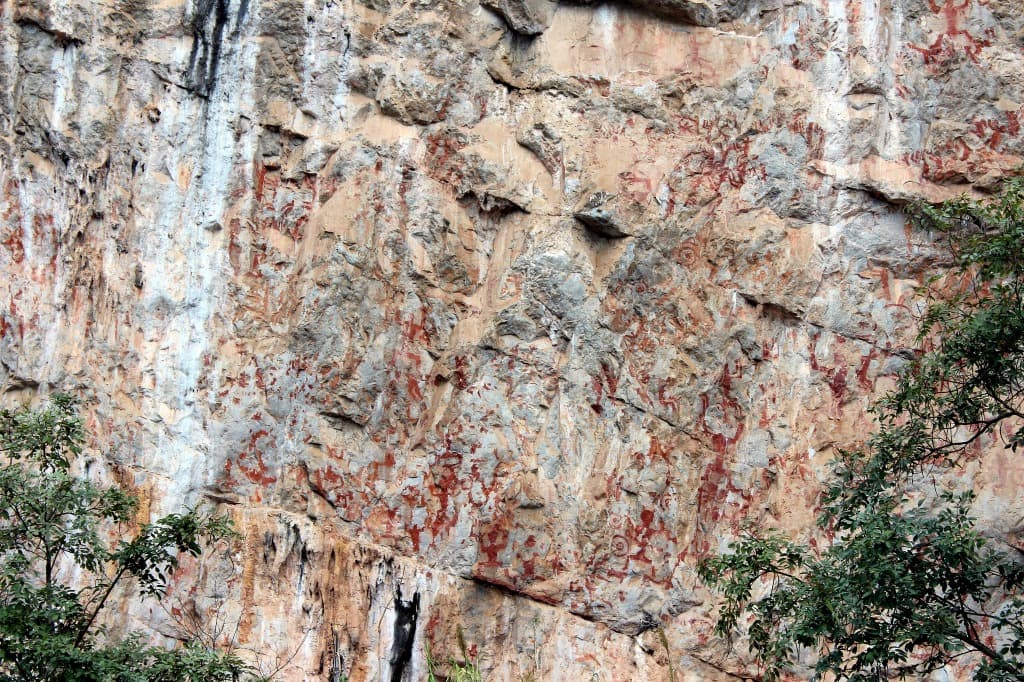
Across the limestone cliffs lining the Zuojiang River in Guangxi, thousands of figures painted in red ochre cover vertical rock faces for several kilometers. Created by the Luoyue people more than two thousand years ago, these paintings form one of Southeast Asia's most extensive rock art ensembles. Inscribed as a UNESCO World Heritage site in 2016, they bear witness to an ancient civilization still poorly understood.
Key practical information
- Access: from Chongzuo or Ningming, by boat on the Zuojiang — the only way to reach the cliffs.
- Suggested duration: half-day to full day depending on your chosen boat route.
- Entrance fee: paid admission (site managed by Huashan National Park).
- Dress code: no particular restrictions; wear comfortable shoes for landing areas.
What you'll see
The south-facing rock faces display over 1,900 identified figures at the main site alone. Dominant motifs include human silhouettes with raised arms, bronze drums (Dong Son style), animals, and geometric patterns. The paint, made from hematite mixed with animal fat, retains a striking red hue despite the centuries.
Figures vary in size: some exceed two meters in height. Their placement on cliffs inaccessible from ground level remains an unresolved mystery—scaffolding, ropes, or boats are the leading theories.
History and context
The paintings are attributed to the Luoyue people, ancestors of today's Zhuang, dating roughly from the 5th century BCE to the 2nd century CE. They fit within a ritual context linked to fertility ceremonies or warfare, according to archaeological interpretations. The Zuojiang River was then a major circulation and power axis in this border region with present-day Vietnam.
The 2016 UNESCO inscription grouped several rock art sites in the valley under the designation "Zuojiang Huashan Cultural Landscape."
Highlights of your visit
The boat journey
Approaching by river is inseparable from the experience. The limestone cliffs plunge directly into the water; the paintings emerge gradually as the boat traces the rock face. Morning light reveals the contrasts of red ochre against gray limestone most effectively.
The main Huashan site
Concentrated on a cliff over 200 meters long, this panel holds the highest density of figures. A boardwalk allows you to disembark and observe the paintings at a reasonable distance with binoculars or photographic zoom.
The site museum
A museum space at the park entrance presents reconstructions, pigment analyses, and theories about Luoyue rituals. It provides useful context before or after your boat tour.
Photography tips
Early morning light, angled across the south-facing cliff, brings out relief and intensifies pigment color. A telephoto lens (200 mm or longer) is essential: the paintings remain at distance from the boat or boardwalk. Avoid midday sun, which creates glare on the wet rock face. Photography is permitted from public areas.
Location and access
The site lies in Ningming County, roughly 50 km south of Chongzuo, in Guangxi. Access is from Ningming by minibus or taxi to the boat landing, then by tourist boat on the Zuojiang. From Nanning, the regional capital, allow approximately two hours by road to Ningming. No direct road access to the cliffs exists.
Nearby attractions
- Detian Falls — Asia's largest transnational waterfalls, at the Sino-Vietnamese border, roughly 100 km west.
- Nanning — capital of Guangxi, a logistics hub featuring Zhuang markets and a regional museum.
- Beihai — a Guangxi coastal city known for its beaches and colonial quarter, accessible from Nanning.
Frequently asked questions
Autumn (October–November) and spring (March–April) offer dry weather and pleasant temperatures. Summer is hot and humid; rains can make the river murky and limit visibility of the cliff faces.
No. The cliffs are inaccessible from the shore. Visits are exclusively by boat, with a possible stop on a boardwalk facing the main site.
Yes, strongly recommended. The most detailed figures are positioned high on the rock face. Binoculars or a photographic telephoto lens greatly improve your ability to read the patterns.
Yes, both sites lie in the same border region of Guangxi. A two- to three-day itinerary from Nanning allows you to visit Huashan and Detian without unnecessary backtracking.
Boat access is practicable, but boardwalks and site paths may have irregularities. It is advisable to contact the park directly before your visit.
Photos
Interested in this visit?
We can include it in your personalised itinerary.