Temple of Heaven
Temple of Heaven
UNESCO-listed imperial site south of Beijing, the Temple of Heaven brings together the Circular Altar, the Imperial Vault of Heaven, and the Hall of Prayer for Good Harvests.
The Temple of Heaven (Tiantan) occupies a park of approximately 270 hectares in the Chongwen district, southeast of central Beijing. Inscribed as a UNESCO World Heritage site in 1998, this vast complex served emperors of the Ming (1368–1644) and Qing (1644–1911) dynasties to celebrate rites of Heaven, particularly prayers for good harvests and the winter solstice ceremony. The site's architecture, layout, and proportions are rooted in ancient Chinese cosmology and imperial symbolism.
Why visit the Temple of Heaven
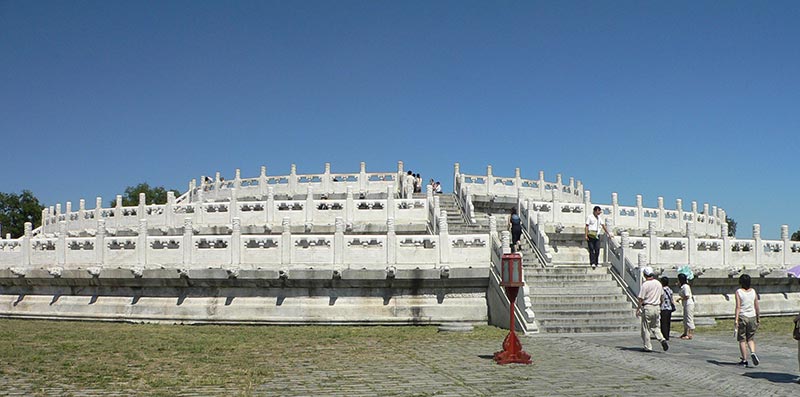
- An imperial ceremonial complex larger than the Forbidden City, conceived as a representation of the universe according to ancient Chinese thought.
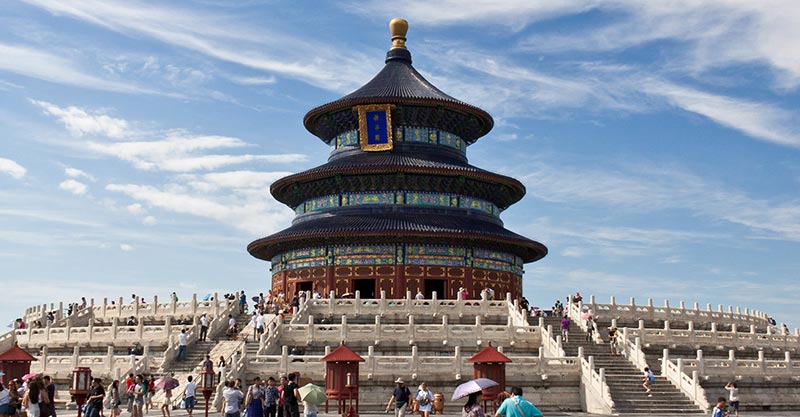
- Exceptional wooden architecture, including the Hall of Prayer for Good Harvests assembled without nails or cement.
- A living park: in the early morning hours, residents practice tai chi, dance, water calligraphy, and traditional games.
- A visit that complements the Forbidden City and Tiananmen Square to understand Beijing's imperial urban planning.
History
Construction began in 1406 and was completed in 1420 under Emperor Yongle, who also commissioned the Forbidden City. The complex was initially dedicated to Heaven and Earth, before being refocused on the worship of Heaven alone and renamed the Temple of Heaven under Emperor Jiajing of the Ming dynasty. It was later rebuilt and modified under Emperor Qianlong of the Qing dynasty.
The emperor, considered the "Son of Heaven," conducted solemn rituals here to obtain good harvests, seek divine clemency, and atone for the sins of the people. In 1889, during the reign of Emperor Guangxu, lightning destroyed the Hall of Prayer for Good Harvests. It was rebuilt the following year using original Ming architectural techniques. The site opened to the general public in 1988 and was listed by UNESCO in 1998.
What to see on the site
A symbolic layout: round sky, square earth
The enclosure combines a rectangular base, symbolizing the Earth, and a semi-circular top, representing Heaven. The northern section, higher and rounded, dominates the southern section, square and lower: a direct expression of the ancient belief that "the sky is round and the Earth is square." The complex is divided into two enclosures separated by an inner wall.
The Circular Altar
Entering through the south gate leads to the Circular Altar (or Altar of Heaven). Its geometry is entirely constructed around the number 9, considered celestial because it is the largest odd number. The upper terrace is composed of nine concentric rings of stone slabs, with the number at each level being a multiple of 9—the ninth ring contains 81 slabs. The steps and balustrades follow the same rule. At the center of the terrace, sound emitted reflects off the marble balustrades and amplifies; the effect is lost when visitor numbers are high.
The Imperial Vault of Heaven and the Echo Wall
North of the altar stands the Imperial Vault of Heaven (Huang Qiongyu), an octagonal building that housed the tablets of imperial ancestors used during the winter solstice ceremony. It is enclosed by the Echo Wall, famous for its acoustic properties: a whisper spoken from one side is audible at the opposite end, provided visitor numbers are low.
The Red Staircase Bridge and the Hall of Prayer for Good Harvests
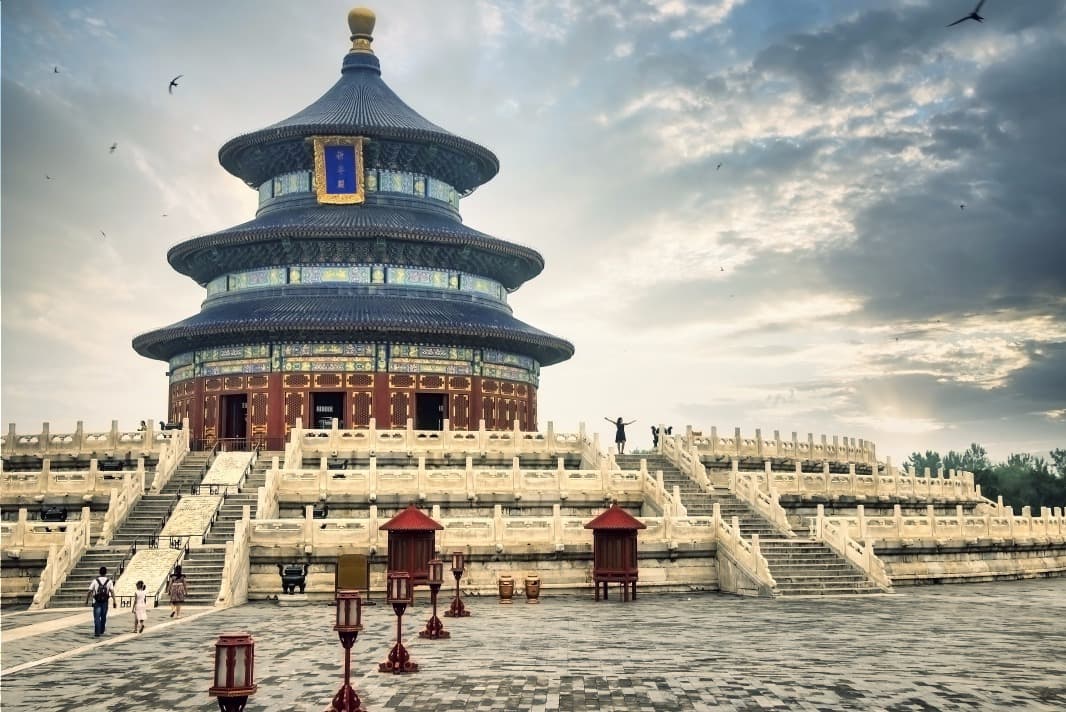
An elevated 360-meter-long walkway, the Red Staircase Bridge, connects the altar to the site's masterpiece. The Hall of Prayer for Good Harvests stands 38 meters high with a diameter of 30 meters, rests on three circular marble terraces, and is crowned by a triple conical roof of blue tiles. Its timber frame, supported by a system of wooden pillars assembled without nails or cement, illustrates the craftsmanship of Ming carpenters.
When to visit
The site is open year-round. Spring (April–May) and autumn (September–October) offer the most pleasant conditions, with moderate temperatures and often clear skies. Summer is hot and humid; winter, dry and cold, can be interesting for its atmosphere and for evoking the historical winter solstice ceremony.
The most vibrant time remains early morning, when Beijingers fill the park's pathways to practice tai chi, qigong, dance, singing, or chess. Arriving at opening hours also lets you enjoy the Echo Wall's acoustics before tour groups arrive.
Practical information
- Duration of visit: allow 2 to 3 hours to tour the main buildings and park pathways.
- Opening hours: the park opens early in the morning and closes in the evening; the historic buildings (Hall of Prayer, Circular Altar, Imperial Vault of Heaven) open later and close in late afternoon, with seasonal variations.
- Tickets: moderate pricing, with a simple park entrance ticket and a combined ticket including access to the main structures; prices vary by season (peak or low).
- Tips: arrive at opening time for morning exercises and acoustics; bring water in summer; internal distances are substantial, so comfortable walking shoes are essential.
How to get there
The simplest way is by metro: Line 5, Tiantan Dongmen (East Gate) station, exit A, which opens directly facing the park's east entrance. Many bus lines also serve the four gates (East, South, West, North); any taxi or ride-hailing service knows the site by the name Tiantan Gongyuan. From the Forbidden City or Tiananmen Square, allow about twenty minutes by metro or taxi.
What to combine nearby
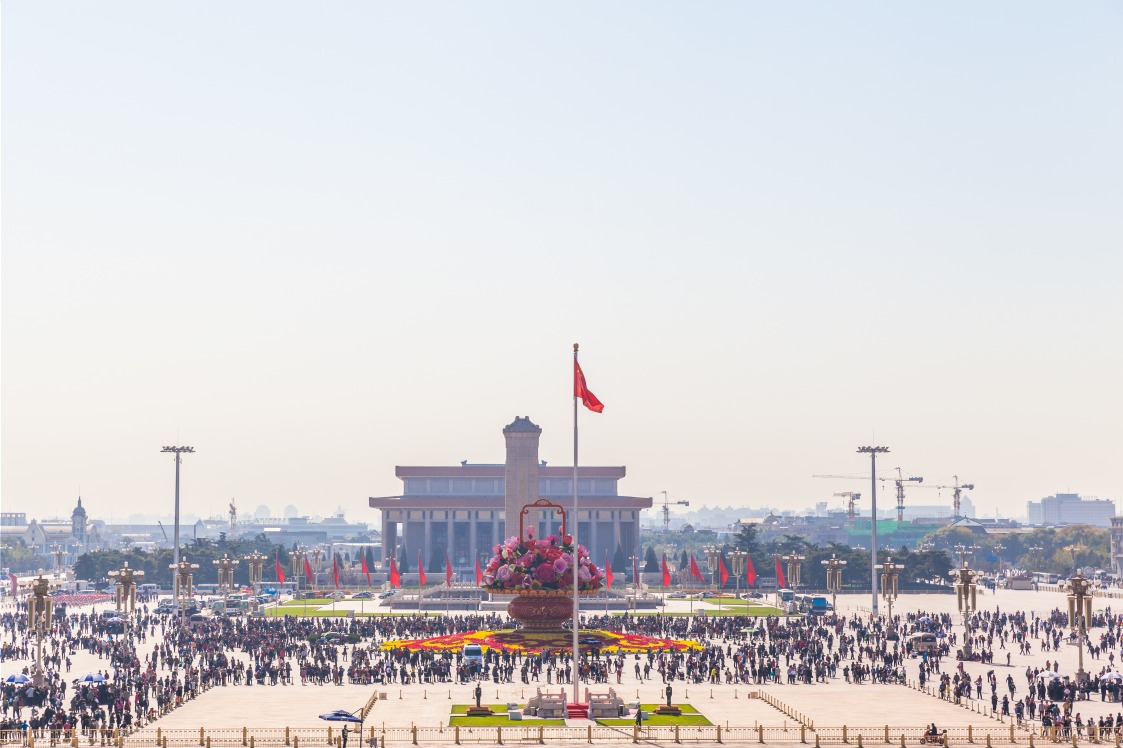
- Tiananmen Square: Beijing's symbolic center, one metro station away.
- Beihai Park: former imperial garden surrounding a lake, a natural complement to visiting the Temple of Heaven.
- Zhongshan Park: located adjacent to the Forbidden City, it pleasantly extends your exploration of imperial urban planning.
Frequently asked questions
Frequently asked questions
Allow 2 to 3 hours to visit the Circular Altar, the Imperial Vault of Heaven, and the Hall of Prayer for Good Harvests while strolling through the park. A faster visit (1.5 hours) is possible if you focus on the central axis.
Early in the morning, right at park opening. You will enjoy the Echo Wall's acoustic effect before crowds arrive, and you will encounter Beijingers practicing tai chi, qigong, dance, or water calligraphy along the pathways.
A simple entrance ticket gives access to the park and morning exercises, but not to the historic buildings. To visit the Hall of Prayer for Good Harvests, the Circular Altar, and the Imperial Vault of Heaven, choose the combined ticket, which remains moderately priced.
No. Imperial rituals ceased with the fall of the Qing dynasty in the early twentieth century. The site now functions as a public park and heritage museum, open to the public since 1988.
It is possible but demanding. It is better to plan the Temple of Heaven for early morning, then head to the Forbidden City and Tiananmen Square in the afternoon by metro (Line 5 then Line 1).
Preparing your trip to Chine
The Temple of Heaven is part of a broader discovery of Beijing, among the Forbidden City, hutongs, and the Great Wall. To build a custom itinerary including the capital and other regions, consult our trips to Chine.
Photos
Nearby
Interested in this visit?
We can include it in your personalised itinerary.